

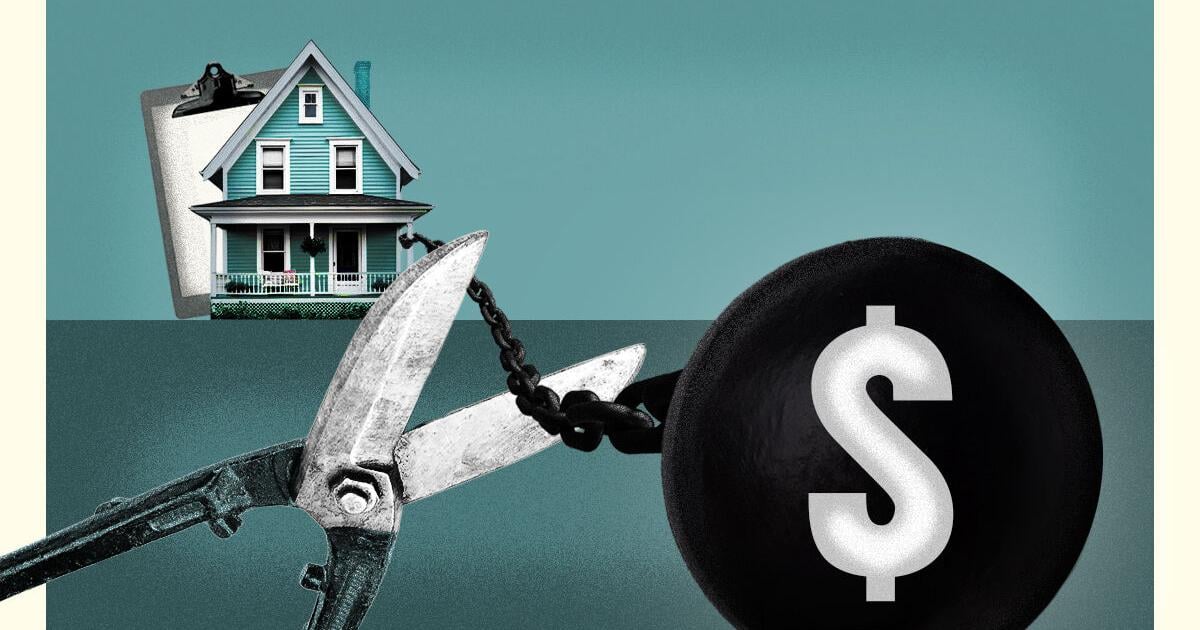
If you renewed your fixed-rate mortgage in 2022 or 2023 you may be regretting it now. Fixed rates have been falling since October 2023, with five-year rates dropping as low as 3.79 per cent as of the end of November, according to Ratehub.
There is a way out: Even if you’re locked in, you can break your mortgage — effectively ending the contract before the end of your term — and refinance at a lower rate.
Unfortunately it will cost you, sometimes quite a lot. Is it worth it?
The answer depends on some serious math, says Leah Zlatkin, licensed mortgage broker and LowestRates.ca expert.
“Numbers don’t lie,” Zlatkin says. “A lot of people want to go with their gut, but your gut can be wrong. You need to look at the actual numbers and see where it makes sense and where you’re going to save the most.”
The first questions to ask yourself are whether you have a fixed- or a variable-rate mortgage, and whether it is open or closed, says Victor Tran, a Rates.ca mortgage and real estate expert.
If you have an open mortgage, you can generally break it without penalty. But if you have a closed mortgage, beware of steep penalties, which depend on factors like what type of mortgage it is, how long you have left in the term, and the difference between the new and old rate.
In a fixed mortgage the interest rate stays the same throughout the length of the term, typically three or five years. For a fixed-rate mortgage, the penalty is often the higher of three months of interest or a complex calculation called the interest rate differential (IRD).
That number is not easy to determine for the average homeowner. Different lenders calculate it slightly differently “and sometimes vastly differently,” says Dan Eisner, founder and CEO of True North Mortgage, who adds that “these IRD penalties can be pretty brutal.”
You need to figure out the difference between the rate you have and the new rate you’d be getting to determine how much interest the lender would lose by breaking your mortgage.
Say you signed a five-year fixed-term mortgage in November 2023 at six per cent interest, which Tran says at the time was a possibility, with a remaining balance of $500,000.
According to TD Bank’s online calculator, Tran says the penalty would amount to almost $30,000, a substantial sum.
Most people don’t have that money lying around so they refinance and roll the amount into their mortgage, Tran says. This requires requalifying, maybe a new property appraisal and the legal process to register the new mortgage. Throw a mortgage discharge fee (usually a few hundred dollars), plus legal fees and any appraisal fees on top of the already big penalty.
“If the outstanding balance of the new mortgage, at the current maturity date, is lower than the current mortgage maturity balance, by an amount greater than the penalty and fees, then yes, it is worthwhile to pay the penalty to renew early or refinance,” Tran says. “This exercise basically examines the break-even point of when the penalty and fees can be recouped.”
Tran has had a few rare cases where clients will still pay the penalty even if they don’t break even, because they believe rates will be higher by their renewal date.
“I did a few of these deals in 2020-21 when rates were sub-two per cent, and it worked out very well for them,” he says. “Short-term pain for long-term gain.”
Eisner’s firm recently helped a client break their five-year fixed mortgage, dumping their 5.99 per cent rate to get a five-year variable-rate mortgage at 4.45 per cent.
It might seem like a small difference, but this saved them $359 a month on their mortgage payments. The original mortgage was signed in September 2023, and they paid $7,000 to break it (out of pocket, not rolled into a new mortgage). There’s a net savings of $20,597.57, after the penalty, so it was worth it. As they’re now on a variable-rate mortgage, their rate has dropped even further, to 3.45 per cent.
Sometimes Eisner sees clients who want to wait a bit to see if rates drop more. But “as rates go down, IRD penalties go up, so it’s a double-edged sword,” Eisner says.
Other options that can help you get a lower rate with your current lender without penalty, says Tran, are a “blend and extend” and “blend and increase.” They each give you a blend of your original rate and the current market one, although it wouldn’t be as low as signing a totally new mortgage. In a blend and extend you extend the mortgage term; in a blend and increase you are refinancing to increase the mortgage.
It’s important to note that breaking your mortgage doesn’t directly impact your credit score, though your score could be indirectly affected if you’re unable to pay the associated penalties and fees.
Zlatkin likens a mortgage to a snowflake; every one is different, so you need to read the fine print carefully. But in general, the “sweet spot” for breaking your mortgage is at the beginning or the end. Some lenders may have clauses to break without penalty in the first six months, or close to the renewal date.
“Every lender is a little bit different, but some of them will start rolling those penalties or waiving those penalties as close to six months before renewal,” Zlatkin says.
This is a lot to digest, which is why Zlatkin recommends sitting down with a mortgage professional who can crunch the numbers and run these different scenarios.
She likens this to a scene in the movie “Miracle on 34th Street,” where people flock to a retail Santa Claus who tells them where they can go for what they want at the best price — even if it’s not his store.
“Just like that Santa Claus, a good mortgage person is going to give you the best advice for your scenario because they know it’s going to lead to future referrals,” she says.

