

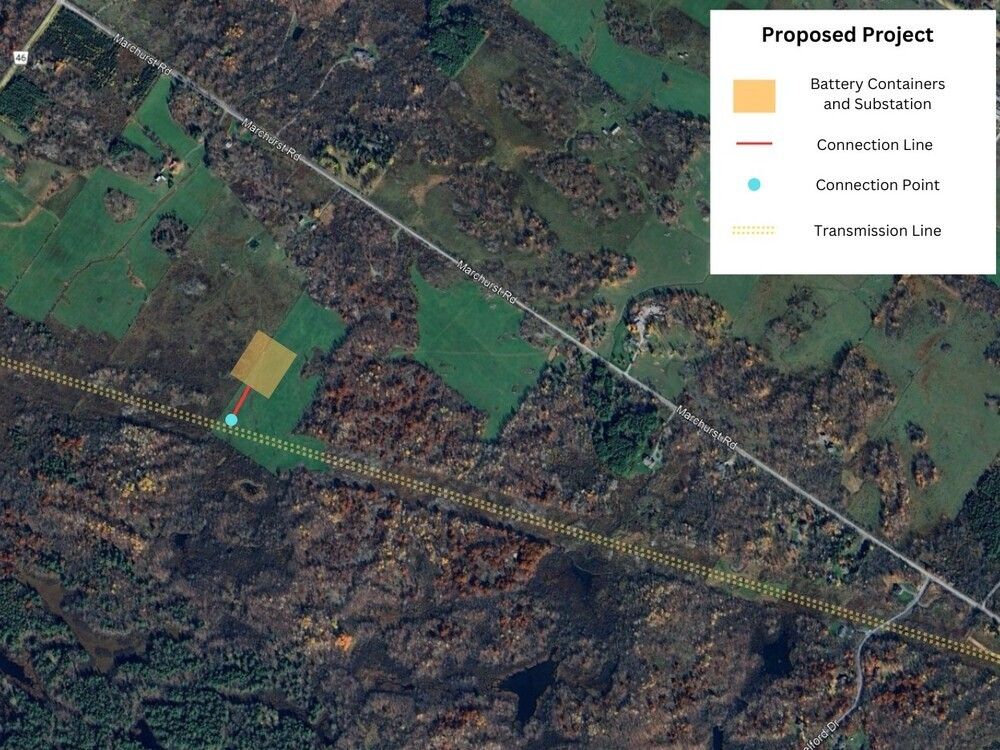
Ottawa’s Agricultural and Rural Affairs Committee has rejected rezoning a property near Dunrobin as a site for a massive battery to store electricity.
Three of the five rural councillors on the committee voted against rezoning land on Marchurst Road from rural countryside to rural general industrial to allow for construction of
the controversial battery energy storage system, or BESS.
A BESS is a giant collective battery — in this case, a lithium-ion battery — used to store electricity and distribute it as needed. Under the proposal from Brookfield Renewables, the 15-acre site on Marchurst Road would be home to a substation, 256 battery containers with noise walls and a stormwater management system to capture runoff.
Residents have concerns, including noise, potential fires and contaminated well water. They also say details are sparse about decommissioning the $650-million facility once it has outlived its 25-year life expectancy.
The Independent Electricity System Operator (IESO), the authority responsible for managing the flow of electricity across Ontario, has contracted 26 batteries across Ontario because they are the “safest and most cost-effective tool to meet growing electricity needs and manage daily fluctuation and supply and demand in our grid,” Geoff Wright, senior vice-president of strategic partnerships at Brookfield, told the committee.
Brookfield is one of the largest battery developers in the world with a track record of safely managing large infrastructure projects, said Wright. Battery technology has also matured, and standards continue to evolve, said Wright.
“There are now safer configurations where the projects are containerized and installed in large, open, outdoor spaces.”
About 40 people signed up to make presentations to the committee.
Nicky Trudell, who lives in Rideau ward, said she’s an advocate for clean, affordable energy. Storage is needed for
renewable energy such as solar
and wind power, she said.
“This is how we begin to reduce usage of expensive and dirty sources of electricity generation and lower the marginal cost of electricity generation to benefit everyone.”
But Marchurst-area residents said no one has listened to rural communities and Brookfield waited until six days before Monday’s meeting to hold a town hall.
“This is not about the technology, it’s about the location,” said Cori Ann Terai, who lives about a kilometre-and-a-half away from the proposed site.
“We are not against innovation or renewable energy, but we are against placing this project in a location that destroys agricultural farmland, wildlife, habitat and the rural character of our community,” she said.
“This zoning amendment sets a dangerous precedent. If approved, it opens the door for more industrial projects in rural zones, eroding the very identity of our community.”
West Carleton Coun. Clarke Kelly said rejecting the rezoning is not a vote on whether battery energy storage is a useful technology. Earlier in the meeting, the committee recommended that city council approve a Municipal Support Confirmation (MSC) for a smaller BESS at the Carp Airport with 16 battery storage containers, he pointed out.
The questions around the Marchurst proposal include whether the zoning bylaw amendment meets the city’s planning rules, protects rural Ottawa and offers a fair process for the people who live beside the proposed facility, Kelly said.
Some of the documents to support the project are still incomplete, including a noise control and environmental impact study. Meanwhile, the emergency response and hazardous materials studies are being treated as “living drafts,” he said.
“This is not an apartment building. We are not talking about where the garbage or the bike rack goes,” said Kelly, who argued that once zoning is passed, the site control plan decisions are delegated to city staff and do not return to the rural affairs committee or city council.
“Once we pass zoning, council loses all leverage on the file.”
The city did not play a part in selecting the site, and the procurement process created a narrow delivery requirement along transmission corridors, with the search narrowed to those corridors, said Kelly.
“This is the wrong place for an industrial-scale facility,” he said. “The rural countryside is not a default industrial catch basin.”
Osgoode Coun. Isabelle Skalski and Rideau-Jock Coun. David Brown, who chairs the committee, supported a motion by Kelly to refuse the rezoning. Orléans East-Cumberland Coun. Matthew Luloff was not present for the vote. Orléans South-Navan Coun. Catherine Kitts voted against refusing the rezoning.
“I do have great empathy for the residents because this is so new. And I think when something new comes forward, there’s a sort of real fear, and that’s what we’re hearing from the delegations,” said Kitts. “I think eventually it will not be new. It will be more commonplace.”
Monday’s committee decision is not the end of the matter, which will go to city council on Dec. 10. If approved by city council, the MSC will confirm that the city agrees in principle to the Marchurst proposal.
It’s likely councillors will support the rezoning. In July, council as a whole
voted 20-3 in favour of moving forward
with a Municipal Support Resolution (MSR), an instrument introduced by the Ontario government to gauge a municipality’s interest in building new energy projects. Monday’s meeting over the rezoning bylaw amendment was the next step in the process.
In a letter to Mayor Mark Sutcliffe last April, Minister of Energy and Mines Stephen Lecce indicated his support for the project.
The IESO contractual deadline for the South March project is Jan. 8, 2026, said Lecce.
“Municipalities that make the approval and permitting process for BESS projects overly onerous or prohibitive endanger the region’s growth and the province’s ability to meet forecasted electricity demand, which is projected to increase by 75 per cent by 2050,” he warned.
“If the province cannot address the grid’s capacity needs with battery storage systems, it will reduce the overall cleanliness of Ontario’s electrical grid while also increasing costs to ratepayers.”
Related
- Public service unions seek clarity on return-to-office ‘rumours’
- Concerns raised that another Canadian Army project is being tailored just for U.S. equipment

