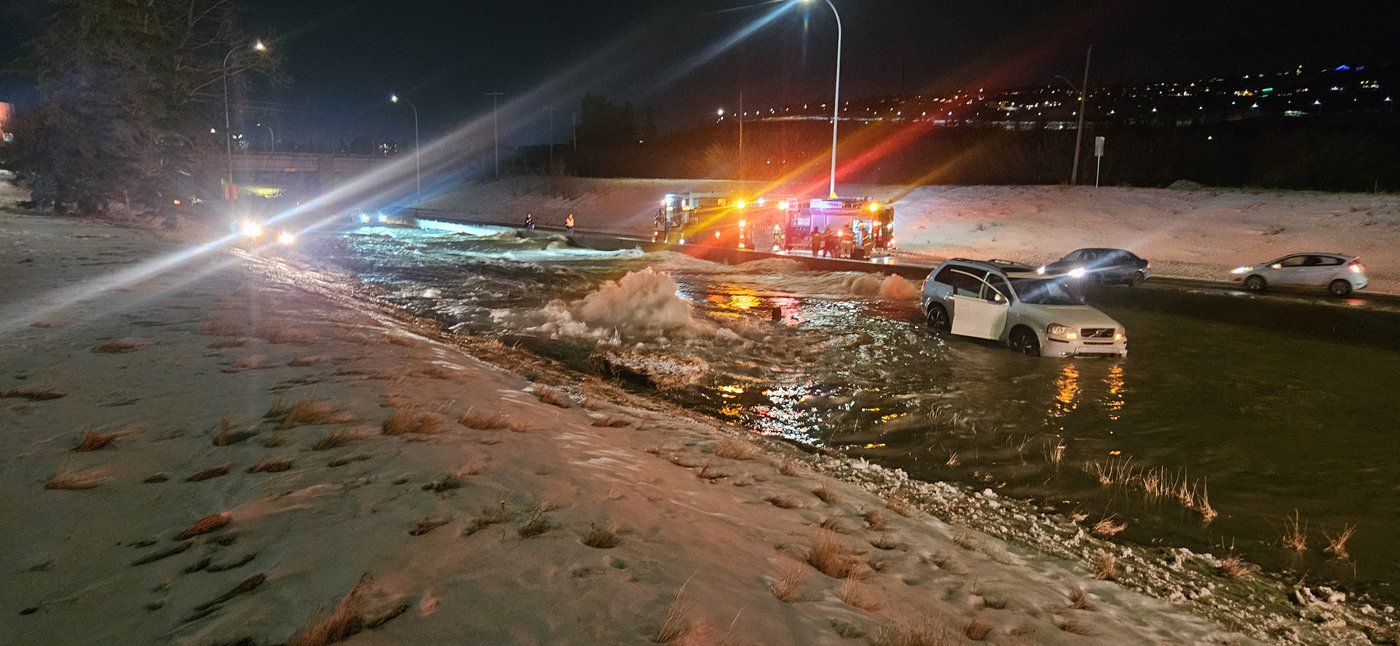
CALGARY — Officials in Calgary are urging residents to save water by taking shorter showers after a major water main broke for the second time in less than two years.
Calgary Mayor Jeromy Farkas said the Bearspaw South Feeder Main remains “very much in the red zone” after it ruptured Dec. 30, and the city is using more water than it can produce and store.
“There’s incredible amount of work that still needs to be done,” he said Thursday. “But we have stabilized the immediate urgency.”
Chris Huston, Calgary’s manager for drinking water distribution, said the city of 1.6 million people needs to use less than 485 million litres of water every day for several weeks.
Huston said the loss of the pipeline means that the city has lost 40 per cent of its capacity to move water around. “It’s not that we don’t have water available from the rivers or from the sources,” he said. “It just makes it difficult to provide water to the whole city.”
Huston said operators are moving the water around differently to ensure everybody has access. “But we do have some asks for you,” he said.
Huston said each Calgarian can do their part and save 10 to 30 litres per day by showering for three minutes instead of 10 and only running their washing machines or dishwashers when they are full.
“We don’t want people to stop those things,” Huston said. “We just want you to be conservative as we do those things.”
The conservation efforts aren’t much, he said.
“It becomes a ton of water that we can save,” he said. “That gets us to our target really easily.”
But that message might still be sinking in.
“We haven’t seen a measurable reduction in demand,” Nicole Newton, director of climate and environment, said Thursday. “People seem to be continuing their day-to-day pattern.”
Michael Thompson, general manager of infrastructure services, said it’s not clear why the water main broke a second time, following a rupture in the summer of 2024 that prompted months of water restrictions, advisories and the invocation of a state of emergency.
“We need to figure that out,” Thompson said. “We need to look at the other sections of the pipe and figure out what action we need to take.”
Thompson said the city completed 23 urgent repairs in 2024 to stabilize the pipeline. “We understood the pipe would need to continue to operate in its current condition, while we developed a plan for a long-term replacement.”
Thompson said the city’s acoustical monitoring system of the pipe was operating normally at the time of the recent break.
“In the 10 months up until Dec. 30, we have not heard a wire snap along the pipe or anything in this area,” Thompson said. “However, as we learned this week, monitoring reduces our risk, but it doesn’t eliminate it. The pipe can break without us hearing a wire snap.”
Huston said the city’s goal is to fix the pipe within two weeks of the moment that the break happened. “So we are trying to stick to that target,” Huston said.
Huston added it is not clear how much the repair will cost, adding that it won’t be as high as in 2024 because that situation involved multiple repairs.
Farkas said the water main has reached the end of its reliable life.
“We can keep patching it, we can keep reacting, but it will continue to fail until there is an alternative built,” he said. “No amount of short-term fixes will change that.”
He said the only choice is to build a line on which Calgarians can rely for generations.
“We will do this faster than anything we have ever done before, and we will be accountable every step of the way,” he said.
This report by The Canadian Press was first published Jan. 1, 2026.
— By Wolfgang Depner in Victoria
The Canadian Press