It was the biggest and most controversial album cover recall in Canadian music history — and it involved an unlikely band.
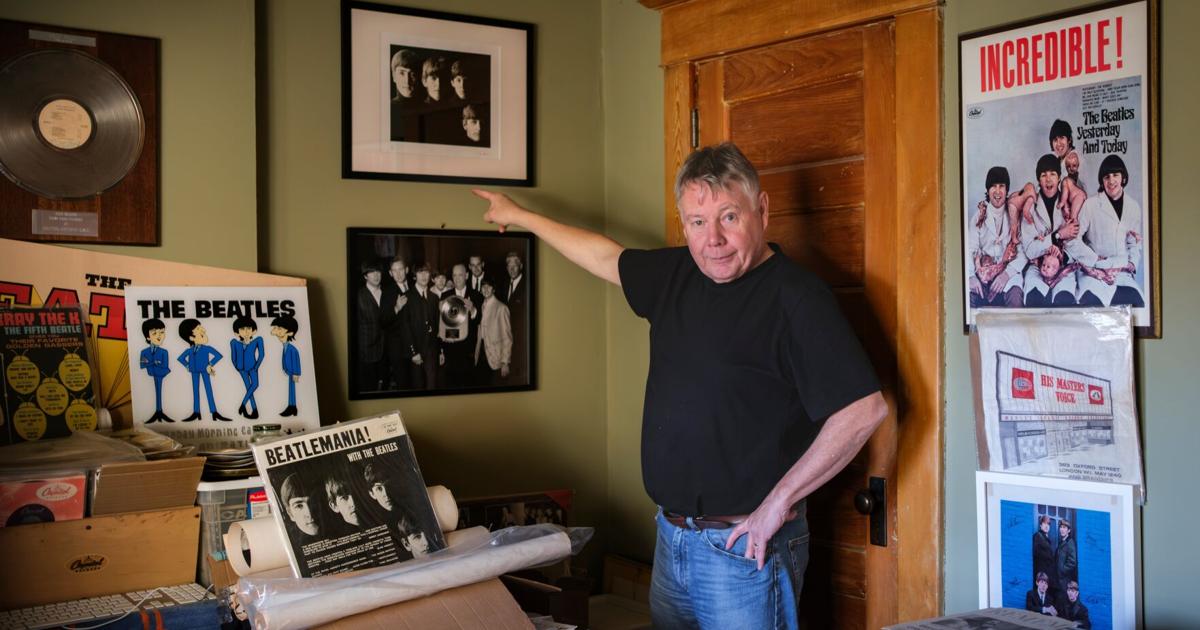
With the unprecedented popularity of the Beatles still cresting in the mid-‘60s with no end in sight, John Lennon, Paul McCartney, George Harrison and Ringo Starr decided to push the parameters of their fame by posing for the cover of their 1966 album “Yesterday and Today” wearing butcher’s aprons covered in decapitated baby doll parts and pieces of raw meat.
Needless to say, any pretence to mop-top innocence and wholesomeness that the band had cultivated up to that point would have been seriously compromised had that album been released to retail, so at the eleventh hour, Capitol Records, the Beatles’ U.S. record label, issued an edict to destroy the covers and replace them with a sanitized version of the Fab Four from Liverpool standing next to each other in aprons.
There was only one problem: a large amount of the album jackets in Canada had not only been manufactured, but already shipped to retailers across the country, creating a big problem for Paul White, the label’s artist-and-repertoire manager who introduced the Beatles to domestic audiences a year before the British Invasion took off in the U.S.
“All of a sudden, Paul White is told he’s got to scrap 80,000 copies of a record that’s just come out of the factory, shipped onto his loading dock — and he’s got to figure out how to get rid of those things and get a new cover on them, all at once,” said Piers Hemmingsen, the Toronto Beatles historian who recently published “The Beatles in Canada: The Evolution 1964-1970,” an exhaustive 638-page book 10 years in the making.
White got the job done.
“He made sure that every damn album was returned,” said Hemmingsen in a recent interview with the Star. “I interviewed somebody who worked for Compo Records (hired by Capitol Canada to print the album).
“On the Monday, they were pressing those records at Cornwall (Ont.) at the Compo plant. He then told me that when they came in the next night, he was working a four-to-midnight shift and that their job, instead of pressing and packing records, was to take all of the 80,000 albums, open them up, put all the albums in one pile and all the sleeves in another, and then they were given 80,000 brand new sleeves in which to put all these records.
“Then the 80,000 covers of the ‘Butcher’ album were incinerated behind the plant at Cornwall.”
Well, almost all of them. Hemmingsen said one escaped destruction by accident.
“One copy of the album was handed to a truck driver as a thank you for all of his good work,” Hemmingsen said. “That truck driver was probably in his early 30s, had a young family and a two-year-old boy.
He wasn’t a Beatles fan, Hemmingsen said, but he took the verboten cover home, shoved it into his record cabinet and forgot about it. His son, when he was older, contacted Hemmingsen and said, “I think I have one of these ‘Butcher’ albums.”
“It’s the only production ‘Butcher’ album that ever survived the recall,” Hemmingsen said. “There’s no other ‘Butcher’ covers out there, other than the sample ones that were sent to Paul White.”
This is one of the many fascinating tales chronicled in the new book, a companion to the author’s “The Beatles in Canada: The Origins of Beatlemania” from 2016.
Testaments to their influence, inspiration and status — they’ve reportedly sold more than 500 million albums and still retain 32 million listeners on Spotify alone — are the number of Beatles-related projects that have recently been released or are projected to be completed in the near future.
Aside from Hemmingsen’s book, which is a limited edition of 1,500 copies, other recent or upcoming Beatles highlights include:
Paul McCartney’s Nov. 21 sellout concert at Hamilton’s TD Coliseum in Hamilton: 83 years young and still rolling along with three-hour performances.
The “Anthology 4” compilation of rare tracks and demos and the remastered “Beatles Anthology” documentary on Disney Plus, also the home of Peter Jackson’s three-part “The Beatles: Get Back” documentary and other Fab Four programming.
The forthcoming Art Gallery of Ontario exhibit, “Paul McCartney Photographs 1963-64: Eyes of the Storm,” which opens Feb. 18.
Academy Award-winning director Sam Mendes’s four-part, interconnected Beatle biopics starring Paul Mescal as Paul McCartney, Harris Dickinson as John Lennon, Joseph Quinn as George Harrison and Barry Keoghan as Ringo Starr, all of which are expected to simultaneously hit movie theatres in April 2028.
And hopefully, the official release one day of the 1965 Maple Leaf Gardens concert tapes that Hemmingsen has in his possession.
What accounts for their staying power, 62 years after they were first introduced to Canadian audiences?
“Well, there’s the music of course,” said Hemmingsen, referencing a hit parade of chart-topping evergreens like “Yesterday,” “Hey Jude,” “She Loves You,” “All My Loving,” “Let It Be.”
“If you want to classify it, it’s pop music, but again, much of the Beatles’ catalogue has crossed over into classical music, jazz, R&B, country — a lot of different places. They’re the most covered band of the time.
“When you go back to the classical composers like Bach or Beethoven, they made amazing music, but they never had popular culture behind them. The Beatles, of course, have a footprint in popular culture, whether it was fashion or their thoughts on religion or sex. They had a voice beyond their music.”
The Beatles also had an indirect hand in developing Canadian talent. It was the money they generated in singles and album sales that allowed Paul White to sign homegrown acts to Capitol.
It was White who signed Anne Murray to her first record deal, as well as such acts as the future Steppenwolf and the Five Man Electrical Band under their earlier names of Jack London and the Sparrows and the Staccatos, respectively.
And they were hardly the only ones who felt the Beatles’ sway.
“In the book, you’ll see in there that the people I talk to — like Anne Murray, David Clayton-Thomas, Andy Kim, Terry (Jacks) from the Poppy Family — all these people were influenced by the Beatles,” said Hemmingsen, who plans to publish an expanded version of his “Red” book — “The Beatles in … Canada — the Origins of Beatlemania,” once the new “Blue” book has sold out.
There are also tales of a joint Beatles and Elvis Presley concert potentially planned for Expo 67 that never panned out — as Beatles manager Brian Epstein passed before the idea could be fleshed out.
Hemmingsen said we will never see another phenomenon like them and quotes former Ottawa Journal columnist Sandy Gardiner — one of the very first to cover the Beatles in Canada — on their everlasting legacy.
“The Beatles seem to be bulletproof, and as Sandy summed it up best in the foreword to the ‘Blue’ book, he calls the Beatles, ‘the band for infinity.’”
Error! Sorry, there was an error processing your request.
There was a problem with the recaptcha. Please try again.
You may unsubscribe at any time. By signing up, you agree to our terms of use and privacy policy. This site is protected by reCAPTCHA and the Google privacy policy and terms of service apply.
Want more of the latest from us? Sign up for more at our newsletter page.