

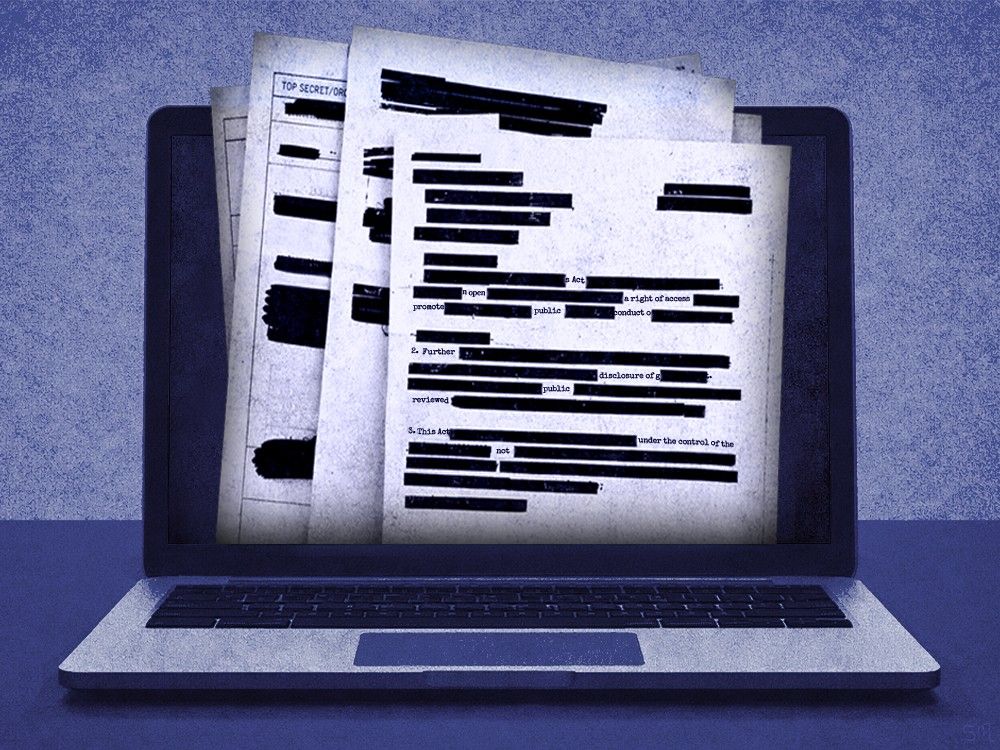
At least three federal government departments are developing artificial intelligence tools to help redact sensitive information from documents before they’re released to the public, and observers warn it could damage transparency in an already secretive access-to-information system.
“It’s not a tool of release — it’s going to be used as a tool of repression,” said Ken Rubin, an Ottawa-based expert on Canada’s access to information and privacy (ATIP) law.
Rubin, who has uncovered reams of government documents as an independent researcher and activist, expects the use of AI to further “sanitize, exempt and control the flow of information.”
The proposed use of AI for redactions comes amid a sweeping expansion of the technology across the public service.
Prime Minister Mark Carney
has repeatedly signalled an intention to embrace AI
, and his government’s first budget pointed to the “integration of technology and artificial intelligence” as a key strategy for boosting productivity and improving services.
But, as controversy over
redacted information in the Jeffrey Epstein files grabs headlines in the United States, transparency activists say Canada should reconsider whether AI is the right tool for judging which information to release and which to black out.
Tools in development
The three redaction tools are listed in the
Treasury Board’s AI register
,
part of a
federal strategy
designed to shape how the government expands its use of the technology through 2027.
The tools are “in development” at Transport Canada, the Department of National Defence (DND) and Public Services and Procurement Canada (PSPC).
The register includes only basic descriptions of each one.
The entry for DND describes “an AI-based tool to identify and redact sensitive information from documents before release.”
PSPC’s “AI assistant” uses “history-based intelligent redaction suggestions to improve accuracy and efficiency in the redaction process.”
And Transport Canada’s “ATIP Document Inspector” is designed to complement existing case management and redaction tools, among other functions.
None of the departments responded to questions from the Ottawa Citizen by deadline.
Activists raise a few key concerns with using the technology in the ATIP system from the potential for inaccurate redactions to fears about job losses in an overburdened sector.
‘Nonsensical’ redactions
Frequent ATIP users say it’s common practice for governments in Canada to withhold information without adequate justification.
At the federal level, the
Access to Information Act
lays out the ground rules for what gets released and it
includes numerous exemptions.
The government, for example, can withhold information if it’s deemed “injurious” to federal-provincial affairs, international affairs, national defence or the economy — and the list goes on.
“We protect a lot of information way too excessively,”
Rubin said. “The exemptions are so nonsensical in so many cases.”
And the law is applied differently across departments, experts say.
“It’s very discretionary right now,” said Kevin Walby, a criminology professor at the University of Winnipeg. “Tonnes of variation from shop to shop.”
Walby,
who is also director of the university’s Centre for Access to Information and Justice, says he expects AI will further entrench the existing practice of applying “overbroad interpretations” of the law by baking an approach into algorithms that favours protection of information over disclosure.
“AI is a technocrat’s dream,” he said. “But I believe it’s going to turn out to be a nightmare.”
Often the goal of the technology is to increase efficiency, he said, but many people who use the access-to-information system care more about the depth of disclosure than the time it takes to receive documents.
“They don’t want to get whited-out and blacked-out documents,” he said.

‘Gutting’ of sector
Decades ago, Rubin
was involved in a citizen-led effort
calling on the government to introduce access-to-information legislation, a fight they won in 1982.
Since then, Walby said, a professionalized workforce within the public service has gradually built up to manage requests filed under the act.
But most frequent ATIP users today will describe a sluggish system badly in
need of modernization
.
Walby doesn’t believe AI is the solution. He fears the technology will instead be used to gut a relatively young sector suffering from staffing shortages and resource constraints.
“What we’re getting is a more technocratic approach focused on time to completion,” he said.
“That is not consistent with the overall objective of access to information, which is transparency.”
Related
Our website is your destination for up-to-the-minute news, so make sure to bookmark our homepage and sign up for our newsletters so we can keep you informed.

