The Citizen’s restaurant critic, Peter Hum is the first non-chef to hold this role, which shines spotlight on rising culinary talents from across Canada.
I’ve never done restaurant criticism in real time, in front of the chefs responsible, no less. But there’s a first time for everything.
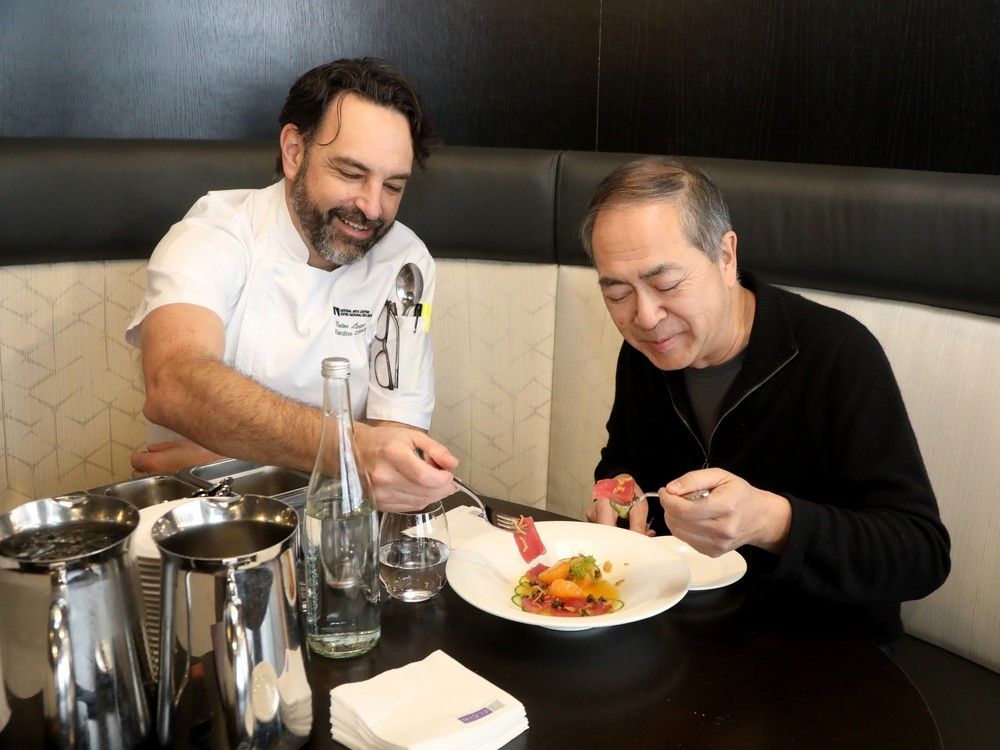
It’s the first Monday afternoon of the New Year. I’m sitting in a booth at 1 Elgin, the National Arts Centre’s restaurant. Across from me sits NAC executive chef Kenton Leier and between us on the table are a stack of small plates and stainless steel hotel pans filled with cutlery. Connor McQuay, the NAC’s executive sous chef, brings dish after dish from the kitchen for Leier and me to try.

There’s tuna crudo. There’s beef tartare. There’s roast pork belly, followed by crispy pan-fried haddock and then a duck breast, massive enough to feed two people. There are two kinds of soups and three kinds of desserts.

The Evening Citizen
These dishes aren’t even on the 1 Elgin menu. Or rather, they are a few days away from debuting, when they’ll sustain NAC patrons grabbing a quick dinner before they take in a play or orchestra performance. But I’m getting an advance tasting session, and my task is to suggest tweaks before the dishes go public for their two-month run at the restaurant.
“This wonton soup is made with chicken, not pork. But it’s good,” I say.
“This needs salt,” I say of the tuna crudo. “Also, could you use tangerines in this dish?”
“These aren’t the right condiments,” I say of the accompaniments with the pork belly.
This isn’t how a restaurant critic usually operates. At 1 Elgin, I have another role. I’m fulfilling my duties as the NAC’s first resident chef this year.
But instead of donning chef’s whites or even a cook’s black uniform and getting my hands dirty in the kitchen, I’m essentially a consultant.
Last summer, months before the January get-together, I met with Leier and McQuay to discuss dishes that could be served at 1 Elgin, basically under my name, in early 2026. We brainstormed dishes and looked at cookbooks and menus. We also talked about my recent travels in China — a life-changing journey that I chronicled last year in the Citizen — and my family history. After all, these were the aspects of my life that prompted Nelson Borges, the NAC’s general manager of food and beverage, to make a lateral move and invite me, a restaurant critic, to be a resident chef.
I’m the first non-chef to hold this esteemed role since the program, which shines the NAC’s spotlight on rising culinary talents from across Canada, debuted in the fall of 2019.
I’m also the first Chinese-Canadian to be a NAC resident chef. I’m proud of that.
I’m even more proud that 1 Elgin menu items, from appetizers to mains to desserts, call back to dishes I ate last fall in Hong Kong and China, and to dishes I ate at home, decades earlier, growing up in Nepean. Some dishes harken to my father’s old restaurant, the Marco Polo Tavern Restaurant, on Bank Street near Heron Road, where I worked during high school in the 1980s.
I like to think that my NAC residency even nods to my grandfather, who left his village of Soon On Lee in Southern China in 1900 and by 1910 was operating the Ontario Cafe, one of Ottawa’s first Chinese-run businesses, on Rideau Street where the Rideau Centre is now.
When Borges offered me the residency, I was surprised. Now, I think: “Why didn’t this happen sooner?”
***
My grandfather’s village in Southern China is as a faraway location, seemingly in the distant past, on the other side of the world. And yet, I along with almost 20 of my Canadian relatives went there last fall — in part to throw a huge luncheon party for almost 150 people.
The gathering was my idea, as tour leader, so to speak, for us Canadian Hums. A year before, in the fall of 2024, I found and visited the humble, rustic village of Soon On Lee in China’s Guangdong province. I even met some distant Chinese relatives that I didn’t know existed. A year later, I led a return trip for my cousins, their children, and even some grandchildren, to share with what I’d discovered.
Village parties, it turns out, are not uncommon. They can mark weddings or births or, as in our case, the return of overseas Chinese to the place they left or the place their ancestors left.
My cousins and I felt we should throw the party to show our indebtedness to the village, where our grandfather came from and where our parents had spent some of their childhoods.
When I first came here in 2024, it was my first visit to China. Suddenly, thanks to Chinese record-keeping, my lineage was extended by 30 generations. Now, my cousins and their children, and my 22-year-old son as well, were immersing themselves in this powerful feeling of profound rootedness. We surely had reason to celebrate.
On a Sunday afternoon, we staged an outdoor lunch on the large asphalt strip next to the village, where only a few dozen elderly people now live. We filled 14 tables of ten with guests, including my cousins from Ottawa, Calgary and Toronto and their children, our distant Chinese relatives who also spanned three generations, and village residents and their descendants who had moved to nearby towns.
A crew from a restaurant in the region set up an on-site kitchen. A red-aproned cook roasted pork in what looked like a massive metal kiln. Prep tables were filled with bowls of soup, and plates of chopped chicken and goose.
Under a giant, temporary canopy fronted by an huge red inflatable archway, we sat on red plastic stools in front of circular tables with red table cloths. Speedy servers brought us stir-fried noodles, metal bowls filled with steamed rice, platters of large, shell-on shrimp. At my table, a young girl, the daughter of someone who I could refer to as my Chinese nephew, put on plastic gloves and peeled all the shrimp.
I like to think of an upcoming NAC gala dinner marking my chef’s residency as the Canadian equivalent of this village party.
Sure, the sold-out NAC dinner on Jan. 29 will be nearly twice as well-attended. Its setting, the Canada Room inside a great national institution, could not be more different from a parking-lot banquet outside a rural Chinese village, surrounded by verdant hills and fields where water buffalo graze.
But if both meals are successful, they will unite people through delicious food and even similar flavours.
***
Wonton noodle soup would be my choice for my last meal on earth. I have loved it since I was a kid and eaten countless deeply comforting bowls.
My trip to China last November also allowed me to sample one of the best bowls of wonton noodle soup in my life.
Still, I’m a little insecure about it being on the menu of the National Arts Centre’s fine-dining restaurant.
Part of me thinks it’s only wonton soup, that typical, appetizer-sized serving of dumplings in broth, minus tasty noodles, which Chinese-Canadian restaurants have served across the country since the 1950s, if not longer.
Just for fun, I searched newspaper databases to find the earliest media mentions of wonton soup in Ottawa. I learned of Ahuntsic brand canned wonton soup, sold for 29 cents a can at local grocery stores in the 1960s. The first restaurant-review mention of wonton soup in Ottawa apparently wasn’t until the fall of 1973.
Then-Ottawa Citizen reviewer Paula Collins looked down at the 75-cent wonton soup served at the Sampan on Carling Avenue. “Its stock was watery, stuffed wonton lacking, and the fresh green onions floating could not save it from mediocrity,” Collins wrote.
That assessment triggers my insecurity about wonton soup. Yes, it’s 50 years later, but who else might think that it’s nothing more than a cheap treat representing a second-rate cuisine, scarcely a step from the $1.25 wonton soup sold at the Marco Polo when I worked there?
But back when Collins was criticizing one underwhelming bowl of wonton soup, I was a nine-year-old happily devouring a great and heaping bowl of it at a restaurant in Vancouver’s Chinatown. Five decades later, I still smile about that summer-vacation meal. The wontons likely tasted of shrimp, not just pork. Probably the wrappers were soft, slippery and admirably thin. The broth was surely tasty, and a snarl of egg noodles, which also might have tasted of shrimp, completed the dish.
Moreover, my mother, a fine cook, made wonton noodle soup for me and my sister when we were kids at home in Nepean. It was time-consuming work to make the filling for wontons and then stuff the wrappers, which thankfully could be frozen and enjoyed later. But this is how my mother, not one to say many affectionate things, showed us that she loved us.
It took me years to realize that.
Last fall, when I was in Guangzhou, a metropolis of 18 million people in Southern China, I wanted wonton noodle soup in the part of the world from which that dish came.
My 22-year-old son, Pascal, with our young Chinese friends Chloe Chen and Jessie Lin, lucked out. Around the corner from our hotel on Guangzhou’s bustling Beijing Road strip, we went for lunch at Xiguan Zhuyan, a wonton noodle shop that proudly displayed its Michelin Bib Gourmand kudos, meaning that it makes great and affordable food in the eyes of Michelin’s inspectors.
We opted for crab wontons that were mild but flavourful, and blessed with ridiculously thin skins that seemed to disappear as you ate them. The noodles in our soup were extra savoury because duck eggs were used to make them. The broth was made from pork backbones and dried shrimp.
Here, the restaurant raised homemade wonton noodle soup to an exalted level as a matter of quotidian, fiercely proud craftsmanship.
I threw down the gauntlet to see if the NAC’s chefs could create a wonton soup worthy of this memory.
But there have to be compromises. At 1 Elgin, sous chef McQuay proposed the wontons be made with chicken, rather than pork, so that people who don’t eat pork might enjoy them. After tasting them that Monday, I said “Sure!”
For me, the non-negotiable thing was that inclusion of shrimp in the wontons, and that the chop of the shrimp be coarse. That’s how my mom did it, and I’d hate for wonton soup sold under my name to taste like a machine had whipped the wonton fillings into an over-manipulated farce. Where’s the love in that?
Also, at the NAC’s gala dinner, the wonton soup will have shaved truffles on top. We’ll see if a little Western flourish will suit this iconic Eastern dish.
***
Tuna crudo is anything but a Chinese dish.
But it’s found on many Ottawa menus, a dish that people rightfully love. While meeting with the NAC’s chefs, I thought of a way to make a tuna crudo dish at 1 Elgin meaningful to me.
The two menus that I have a say in — 1 Elgin’s menu until early March and the menu at the Jan. 29 gala dinner — include dishes that sit on the continuum of East-meets-West food. Tuna crudo slides considerably further west.
The original crudos in Italy were raw fish dishes with just a few elements bolstering the fish. By the early 2000s, chefs in New York were serving crudos. I had my first crudo at Eataly, the Italian food hall in New York, a few months after it opened in the summer of 2010. The raw salmon, tuna and scallop I had were simply dressed with lemon juice and olive oil. “That’s it,” chef Dave Pasternack told me.
But over the years, crudos in North America have become more complicated, departing from Italian minimalism to become dishes with vinaigrettes, garnishes and any number of supporting flavours.
At the NAC, apart from a hit of salt, I asked for tangerines to be used in the crudo. I have a recently developed sentimental attachment to tangerines, and especially the tangerines of Southern China.
In Kaiping, the county of Guangdong province that my grandfather left in 1900 to come to Canada, tangerines are an extremely hot commodity. They have been for centuries, but for a surprising reason.
What’s valued are the fruit’s peels, which are sun-dried and used in cooking everything from soups to stir-fries to desserts, as well as in traditional Chinese medicinal preparations. As the peels age, they become darker, harder and more bittersweetly flavourful.
They also become more valuable. In 2023, a kilogram of dried tangerine peels produced in 1968 sold at a Hong Kong auction for 75,000 Hong Kong dollars, which is now the equivalent of more than $13,300.
When I visited China last year, my relatives there wanted to give me a bag of dried tangerine peels to bring back to Ottawa. Sadly, I said no thanks. I worried that Canada Customs would have seized my tangerine peels as questionable or prohibited goods. I did, however, bring home from China a painting of tangerines in a bowl as a souvenir that now hangs in my kitchen.
Casting forward, tangerines (and oranges and kumquats) go hand in hand with the Lunar New Year, which this year falls on Feb. 17. The Chinese words for tangerine and orange sound similar to words meaning “luck” and “gold.” For that reason alone they’re auspicious and lucky. Also, their round shape is synonymous with completeness, harmony and even familial bonds.
Given all that, adding tangerines to the tuna crudo was an easy sell to the NAC’s chefs.
***
Whenever I eat Cantonese roast pork belly, I think of my late father, Joe Hum, who most of all liked its prized, crispy skin.
Although he co-owned the Marco Polo from the mid-1960s to the late 1980s, his eatery never served this prized meat preparation. It wasn’t the kind of food — think fried rice, chow mein, chop suey, various flavours of chicken balls, garlic spare ribs, egg rolls and wonton soup — that the Marco Polo sold to its white clientele. My father would buy his siu yuk, as it’s known in Cantonese, from roast meat shops in Chinatown.
I wonder if it reminded him of his youth in China, in the village of Soon On Lee. While my father was born in Ottawa in 1922, he returned to China with my grandfather four years later, and only returned to Canada and its capital in the mid-1930s.
In Guangzhou last fall, when I visited a venerable, upscale dim sum eatery called Tao Tao Ju, I had to order the siu yuk. At that restaurant, which had four years’ worth of Michelin commendation plaques on its wall, the succulent meat came in perfect, bite-sized morsels that stood upright on the plate and were topped with shatteringly crisp, golden crispy skin.
Siu yuk of that lofty calibre comes only after decades of repetition and the knowledge of how sublime the preparation can be. I showed photos of Tao Tao Ju’s stellar siu yuk to the NAC’s chefs. “Can you make it like this too?” I asked.
Trying the NAC’s Cantonese roast pork belly this month, I admired the meat’s taste and texture, even if the skin could have been still crisper. But more significantly, on that East-West culinary continuum, I wanted to nudge that dish closer to its authentic Cantonese roots.
That meant removing the sweet-savoury hoisin sauce that had been applied to the pork after it was cooked. It could go on the side, if at all, I suggested.
Also, at the pre-debut tasting, the pork came with Sriracha and Kewpie mayonnaise. Neither struck me as right. My call was to swap in hot mustard, which I recalled at Tao Tao Ju was the condiment of choice.
For that matter, when I worked at the Marco Polo as a teenager, I’d always eat pork-and-cabbage-stuffed egg rolls with hot mustard rather than plum sauce. I don’t know why my teenaged palate made that choice, but it’s completely consistent with preferring hot mustard with siu yuk.
Maybe that pairing of Cantonese roast pork and mustard is in my DNA? Whatever the reason, I’m glad that the NAC is offering siu yuk as authentically as possible.
***
I’d like to say that I circulated among the tables at our village lunch in Soon On Lee, greeting relatives and strangers like the long-lost relative I was to them. But I speak Chinese at a toddler’s level, and it wouldn’t get me very far.
I was more focused on the food in front me — the toothsome roast pork, the neatly peeled shrimp. I carried on basic conversations with my Chinese nephew and niece, the latter of whom speaks solid English.
She told me that the village party’s food was a hit. My cousins and I had paid a little more to chose one restaurant over another. My niece said the pick of eateries had paid off, and that the villagers thought the spread was the best they could remember.
I hope the food at 1 Elgin will generate similar positive feedback. So far, reviews have been good.
“Really enjoyed Peter Hum’s menu at 1 Elgin,” Paul Wells, a pundit when it comes to food as well as politics, wrote on Facebook. “Cantonese food, faithfully executed and elevated in collaboration with the regular kitchen crew…. I’ll be back.”
Food and beverage general manager Borges says plates picked up by servers are coming back empty. That’s arguably the best indicator of how things are going, he says.
I couldn’t be more proud.
Many of my Canadian relatives who attended the Chinese village lunch will also come to the Jan. 29 NAC dinner. It will be our first reunion since our monumental trip last fall.
I expect they’ll enjoy the food. But more than that, I know we’ll all be grateful to our ancestors, who came to Ottawa from the village that we’d visited together so that they could write their stories here. We, in turn, continue them.
Peter Hum, the Ottawa Citizen’s restaurant critic, is once again taking your questions, next week during an online chat at ottawacitizen.com. Come to the website on Tuesday, Jan. 27 at noon for a wide-ranging discussion of topics dear to Ottawa food-lovers. Feel free to ask Peter for restaurant recommendations, for Valentine’s Day or any date night. Or, request insider tips regarding Peter’s resident chef’s menu currently served at 1 Elgin, the National Arts Centre’s restaurant. Or, chat about the upcoming Canadian Culinary Championship to be held in Ottawa Jan. 29 to 31, when Stofa chef Jason Sawision will represent Canada’s capital. Peter will be only to happy to share his opinions if you ask.