


Conservative Leader Pierre Poilievre is facing a must-win leadership vote at the party’s convention in Calgary on Friday. Follow the Star’s live coverage.
Updated 18 hrs ago
How much support is enough for Pierre Poilievre to stay as Conservative leader?


Conservative Leader Pierre Poilievre arrives on Parliament Hill on Jan. 27, 2026.
Adrian Wyld/The Canadian Press
OTTAWA — It’s the number everyone is thinking about, but won’t say out loud.
As delegates gather in Calgary for the Conservative party’s national convention that officially kicks off Thursday, there is one matter capturing their attention: Pierre Poilievre’s leadership review.
There are plenty of other agenda items that will tie up the party faithful over the three-day confab, including debating new policies, hashing out changes to the party’s constitution, electing a new national council, and presenting an update on the state of the party’s finances.
But Friday’s referendum on Poilievre’s leadership is a consequential moment for the modern Conservative movement in Canada. It’s the party’s first leadership review in 21 years, and the first time members will decide whether Poilievre — the person who brought the party closest to electoral victory since the days of Stephen Harper — should remain at the helm.
It is largely believed Poilievre will pull through the vote. The question now is by what margin he survives.
The percentage of delegates who vote against triggering a race to replace Poilievre will lay bare just how much of the Conservative base views Poilievre as its ticket back to the prime minister’s office.
“If the number starts with an eight, you’re absolutely safe,” said Mitch Heimpel, a former Conservative staffer and vice-president of government relations at Texture Communications.
“If it starts with a five, you’re absolutely dead. If it starts with a seven, you’re safe, but the party is restless. If it starts with a six, that second number matters.”
Poilievre’s team has not publicly shared the level of support it is targeting, nor the lowest threshold it believes Poilievre must secure to safely remain leader. Party officials did not respond to, or declined to answer, the Star’s questions on the matter.
It’s not uncommon for parties to keep those numbers close to the vest: disclosing them puts the leader in a risky position should they fall below their stated target, and can also signal how much faith officials have in a leader before votes are even cast.
That’s also why many outside the leader’s circle also refuse to weigh in publicly.
Several premiers in the capital Wednesday avoided questions about what percentage of delegates they think Poilievre needs to win over to remain leader.
“We’re having our convention the same time they are,” Premier Doug Ford told reporters in Ottawa.
“Good luck at the federal Conservative convention, but that’s going to be up to them to determine if they want to move forward with Pierre Poilievre.”
Ford and Poilievre had a strained relationship during last spring’s federal election campaign, and their duelling party conventions means that some Ford loyalists will bow out of the Calgary vote in favour of attending the Ontario gathering.
Nova Scotia’s Tim Houston is another Progressive Conservative premier with whom the federal Conservatives have sparred. He also declined to speculate on the outcome of the leadership review vote.
“I won’t be attending the convention and I’m not a member of the federal party, so I’ve kind of been focused on my Nova Scotia priorities,” said Houston.
He said he’d had a “short exchange” with Poilievre’s office since the election but characterized the interaction as “nothing meaningful.”
Saskatchewan Premier Scott Moe, however, said that given today’s “politically charged” environment, he suspects Poilievre may not secure a number “as high as what traditionally leaders have expected or received.”
While the Conservative party’s constitution requires a leadership review by delegates at the first party convention following a defeat in a general election, Friday’s vote will be the party’s first since 2005 when Harper received 84 per cent support. Harper stepped down after his 2015 election loss.
His successor, Andrew Scheer, resigned weeks after the Conservatives’ 2019 election defeat. Scheer’s successor, Erin O’Toole, was removed as leader by a vote of Conservative MPs just months after their 2021 election loss.
Progressive Conservative leader Joe Clark resigned when he received 66.9 per cent support in a 1983 review vote, triggering a leadership race. He then ran in the ensuing contest to see if he could secure more support, only to be defeated by Brian Mulroney.
As NDP leader, Jack Layton’s already high level of delegate support soared to 97.9 per cent after he led the party to Official Opposition status in 2011. His successor, Thomas Mulcair, faced his second leadership review in 2016, when 52 per cent of delegates voted to trigger a race to replace him. Jagmeet Singh received his lowest result in 2023, when 81 per cent of delegates voted in favour of his continued leadership.
Heimpel pointed to former Ontario Liberal leader Bonnie Crombie, who technically won her leadership review vote last year with 57 per cent support, but stepped down anyway because that level was widely perceived as too low.
Several Conservatives, who spoke to the Star on the condition they not be named, found it difficult to predict the level of support they believe Poilievre will ultimately secure.
One source said support of 70 per cent or lower would likely be grounds for his exit, while a second said a result between 70 and 80 per cent would not be viewed as a clear victory, even if it meant the leader stayed on.
The second source said less than 80 per cent support would be damaging for Poilievre, given that the party moved the timing of the convention to earlier this year and selected the Conservative stronghold of Calgary as its location.
Poilievre won the party’s leadership election in 2022 with 70.7 per cent of votes cast.

Updated 18 hrs ago

The one thing standing in the way of Pierre Poilievre becoming prime minister is Pierre Poilievre

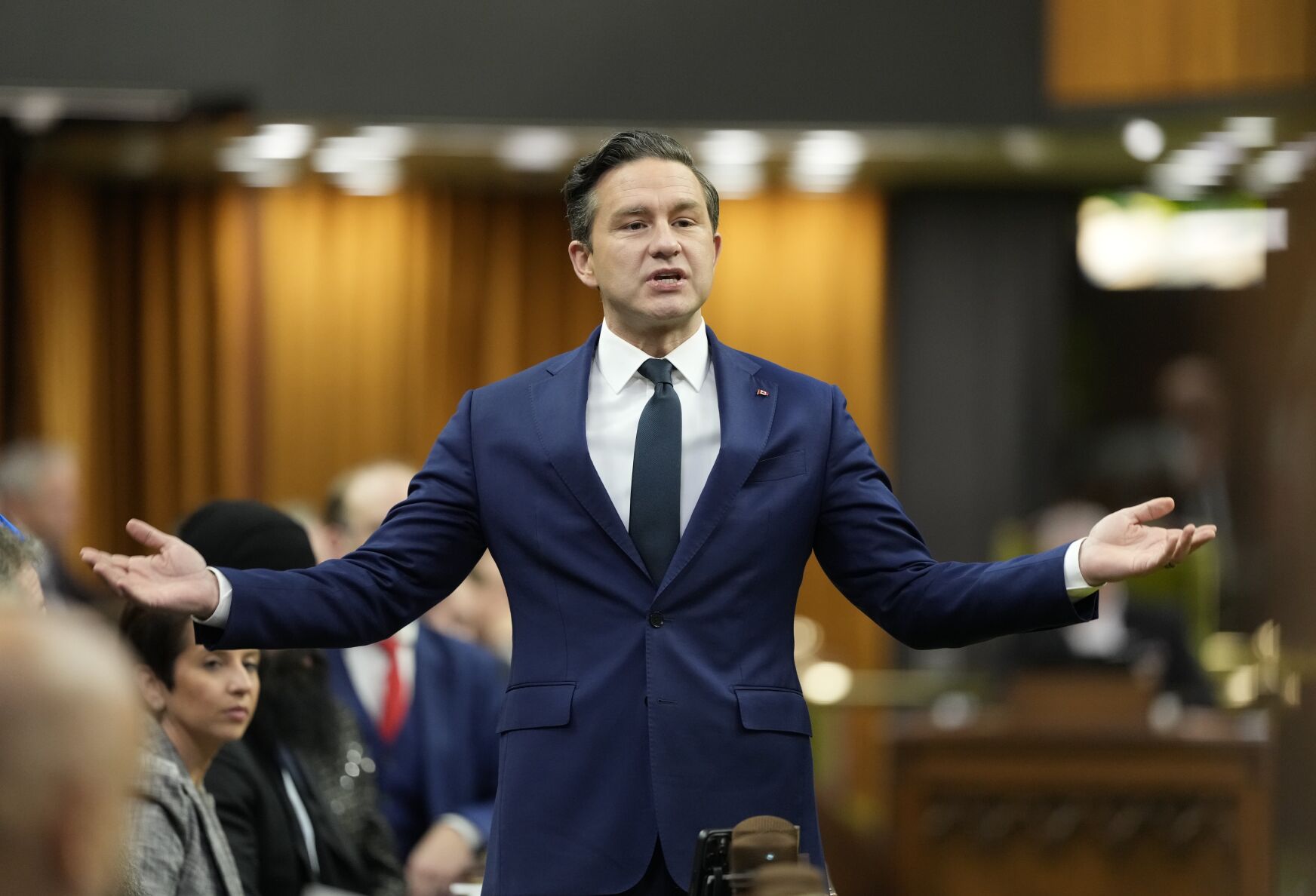
Conservative Leader Pierre Poilievre faces a difficult challenge, writes David Coletto: continue to appeal to his base or expand his reach and risk alienating that same base.
Adrian Wyld/The Canadian Press
Later this week, Conservatives will gather in Calgary for their national convention, where Pierre Poilievre faces a mandatory leadership review on January 30. He is widely expected to win easily.
The more interesting challenge the Conservatives face, however, is how to grow beyond the coalition they have today.
Over the past week, this paper has reported on a national survey of just over 2,000 Canadian adults conducted by Abacus Data that explored public opinion about the Conservative party. The results help explain why Poilievre looks so secure inside his party, and why that security doesn’t automatically translate into broader appeal.
Let’s start with the obvious strength. Poilievre is not in trouble with his base. If anything, he has it locked down. Among Conservative base voters, 79 per cent rate his performance as party leader as excellent or good. Seventy-eight per cent think the party is headed in the right direction under his leadership and 76 per cent would vote to keep him as leader. His net favourability among Conservative supporters is a striking +64.
This doesn’t look like a coalition merely tolerating its leader. It looks like a coalition that actually likes him. Conservative base voters and the broader Conservative voter group are aligned across most measures, from Poilievre’s tone and style to the party’s direction and its priorities. The roughly 40 per cent support Conservatives earned in last year’s federal election looks less like a high-water mark and more like a stable foundation.
But there’s a catch.
The same traits that work so well with the base appear to be limiting his reach beyond it. Among “accessible Conservatives,” the 14 per cent of Canadians who do not currently support the party but remain open to considering it, only 30 per cent have a positive impression of Poilievre. His net favourability with this group is -4. Just 29 per cent rate his performance positively. And if they were voting in a leadership review, 43 per cent would replace him.
These are not voters who are fundamentally hostile to the Conservative brand. What they’re unsure about is Poilievre himself. When asked what would increase their confidence, they point to the same themes: more attention to everyday “kitchen table” issues, a less combative tone, more willingness to work with others, and more detail about what he would actually do in government.
In other words, they are looking for something quite different from what many Conservative base voters seem to want more of.
Outside the Conservative orbit, things harden further. Among non-Conservative supporters, only 9 per cent have a positive impression of Poilievre, while 71 per cent see him negatively. Sixty-two per cent think the party is headed in the wrong direction under his leadership. And 52 per cent say he is a lot like Donald Trump.
All of this creates a ceiling problem.
A party can sometimes win without being broadly popular if the election becomes a referendum on the incumbent. But Mark Carney’s personal favourability currently outpaces Poilievre’s. Voters are not simply choosing between change and continuity. They’re also weighing competing leadership styles and competing visions of what the country needs next. Poilievre looks well-positioned to hold his base, but not to make meaningful gains beyond it.
You can see the tension in what different groups want the Conservative party to do.
Conservative voters generally want the party to stay the course, or even push harder. Seventy-one per cent support using language like “Canada is broken.” Fifty-four per cent want the party to be tougher and more confrontational with the media and institutions. Fifty-nine per cent think Conservatives should stand firm on conservative principles even if it makes winning harder.
Accessible Conservatives lean in the other direction on almost all of these.
This is the dilemma heading into Calgary. The party can’t fully satisfy both audiences at once. A strategy built to maximize base enthusiasm risks narrowing the pool of persuadable voters, which has already tightened from 53 per cent in mid-2025 to 48 per cent today. But a strategy designed to broaden appeal risks frustrating a base that currently looks rock solid.
Some of what happens next will depend on the shape of the wider race. If the NDP gains traction under new leadership and pulls meaningful support away from the Liberals, the Conservative floor of 40 per cent could be enough to win. But if the next election becomes a straight Liberal vs. Conservative decision, the limits of the current strategy become harder to avoid.
This convention will offer some signals about where Poilievre wants to take the party. Does he widen the tent, or does he lean even more into the version of Conservatism that has kept his base unified and motivated?
For Conservatives, the problem isn’t holding what they have. It’s deciding whether they have to add more to win.
Updated 18 hrs ago
Pierre Poilievre has more than Conservatives to convince this weekend


Conservative Leader Pierre Poilievre arrives on Parliament Hill on Jan. 27, 2026 in Ottawa.
Adrian Wyld/The Canadian Press
Thousands of Conservatives will gather in Calgary this week with one key decision to make — to bolster or weaken their leader, Pierre Poilievre.
Poilievre is the second leader of the modern Conservative party to face a leadership vote following an election defeat. Former prime minister Stephen Harper faced a review in 2005, after he lost the 2004 election to Liberal Paul Martin. Harper received 84 per cent of support and went on to win a minority government in 2006. In 2015, Harper resigned after his defeat to Liberal Justin Trudeau. His successor, Andrew Scheer, resigned two months after the 2019 election loss, amid revelations party funds paid part of his children’s private school education. Erin O’Toole was voted out by his caucus after his 2021 election loss.
Poilievre has not been stabbed in the back like Scheer or O’Toole — both of whom won the popular vote in the contests they led (Poilievre did not). Poilievre’s leadership hasn’t been openly called into question, despite two Conservative MPs crossing the floor to the Liberals, and another announcing his impending resignation amid a cloud of secrecy.
He blew a 20-point lead. He lost the Ottawa-area seat he held for 20 years last spring. This fall, taxpayers spent $2 million to return him to Parliament, in one of the Conservatives’ safest seats. But he grew his party. Under his leadership, new voters joined the tent. Their popular vote increased above 41 per cent — traditionally, majority territory. He won 24 more seats.
But, he still lost the 2025 election. And poll after poll suggests, if an election was held now, he would lose again. Not because the Conservative brand is in trouble. The party would lose, the data suggests, because voters don’t like its leader.
An Abacus Data survey this month suggests that while the Conservative base and its current voters strongly support Poilievre, potential voters don’t like his tone and would rather he be replaced. Polling from the Angus Reid Institute released this week, suggests that Poilievre is viewed unfavourably by 58 per cent of Canadians, while Prime Minister Mark Carney enjoys a 60 per cent favourability rate. Numbers from Leger, Wednesday, suggest the Liberals are in majority territory.
Despite the Tories’ outreach to blue-collar unionized voters and immigrant communities, the Liberals’ courtship of progressives against a perceived right-wing threat has created a two-party system, in every province but Quebec. Some progressives might be disappointed by Carney, for his double talk on pipelines, for example (on Tuesday, he declared his memorandum of understanding with Alberta “will build a pipeline to tidewater” though privately some Liberals say they’ve been assured it won’t). Yet progressives don’t appear to be willing to abandon Carney, when they fear Poilievre more.
Overshadowing everything is U.S. President Donald Trump and his threats to Canada’s sovereignty. The erratic occupant of the White House is a gift to the Grits. Canadians have rallied around their leader. Carney’s pedigree is seen by many as uniquely suited for the moment. Meanwhile, Poilievre must contend with too many Canadians viewing him as too Trumpy.
That is yet another challenge Thursday’s convention brings. This is a policy convention where the party’s grassroots determine what image they want to convey to potential voters. And these party members, as Abacus notes, are less trustful of institutions, more hardline on crime and immigration, more likely to support Trump, and less likely to reflect the views of the country as a whole.
Do they, for example, adopt a policy up for debate that urges a future Conservative government to protect homeowners from criminal prosecution if they use lethal force against intruders? Do they vote to open the door to legislate on abortions? Do they declare they now support conversion therapy for younger LGBTQ+ Canadians? Do they call for changes to the Canada Health Act to allow for more privatization? Do they follow U.S. President Donald Trump’s example and call for Canada to withdraw from the World Health Organization?
Poilievre will address the country and convention delegates Friday. He is expected to touch on themes of unity, hope, geopolitical and domestic realities, Carney’s rhetoric versus his accomplishments on the ground. Poilievre is expected to argue that the Liberal government has left many Canadians on the sidelines, that the country is divided, and that he is best placed to bring Canadians of all stripes together. It’s a message that will resonate with delegates — notably the base which feels excluded from the mainstream. But on a week, where Carney announced help for those less fortunate, met with provincial and territorial premiers and was showered with compliments, it may not resonate with the general electorate.
Poilievre won the Conservative leadership race, against former Progressive Conservative Jean Charest, in 2022 with 70.7 per cent support, or 68.15 per cent of the distributed riding points. He was praised for a solid win, the party united behind his populist vision. Despite some Conservatives grumblings, those who want Poilievre’s job seem content to let him be the leader of the Official Opposition for now.
The party and its leader have tried to ensure that this weekend’s vote delivers as large a number as possible, one that only solidifies his grip on power. His last result — 70.7 per cent — might be the bar, but 86.7 per cent may be the hope. That’s the number Mark Carney got when he won the Liberal leadership last year.
Correction — Jan. 28, 2026
This column has been updated to correct that Pierre Poilievre is the second leader of the modern Conservative party to face a leadership vote following an election defeat.
Updated 21 hrs ago
Pierre Poilievre is believed to have most Conservatives’ support. Holding his party together could be another matter

Conservative Leader Pierre Poilievre is seen in the viewfinder of a television camera while speaking at a news conference in Calgary on Nov. 12, 2025.
Jeff McIntosh/The Canadian Press
OTTAWA — You don’t need to look much further than Pierre Poilievre’s social media to see the sort of dilemma the Conservative leader is facing.
Earlier this month, he praised U.S. President Donald Trump for his extraordinary capture of Venezuela’s authoritarian leader, Nicolás Maduro. Two weeks later, he condemned the same president’s threats to acquire sovereign Greenland and backed Canada’s obligations as a member of the NATO alliance.
It’s not that it’s out of bounds for a political leader to see value in one move and denounce another. It’s that each response rankled different factions within the Conservative tent.
The first displeased some moderates, who felt Poilievre was applauding the American president to curry favour with the pro-Trump corner of his party’s base.
The second drew ire from a top conservative influencer — a YouTuber who drove tens of thousands of views to Poilievre’s campaign rallies — for his belief the post pandered to the anti-American Liberal set.
Those conflicting sentiments will collide next week, when members of the party’s grassroots kick off their national convention and decide whether Poilievre should remain their leader.
In Calgary, Poilievre will face the coalition he grew during last year’s campaign — a subset of the Canadian electorate that has become increasingly divided from the rest of the country, and even sometimes amongst themselves.
“It is a difficult job being the leader of the Conservative Party of Canada. It is a divided coalition of Conservatives who are coming to their support for the party, and their identity as a Conservative, in different ways,” said David Coletto, CEO of Abacus Data.
Poilievre, who coasted to a commanding victory in the Conservatives’ 2022 leadership contest, is entering his second convention at the party’s helm nine months after its election defeat and his loss of his longtime Ottawa seat. The ensuing months have seen the leader contend with the defections of two MPs to the government benches; the spectre of other exits; discontent about his messaging, tone, and leadership style; and more recently, Prime Minister Mark Carney’s glowing reception on the world stage.
With a referendum on his leadership less than a week away, Poilievre is putting in the time.
“I think whether you like Pierre Poilievre or you don’t like Pierre Poilievre … you’d be hard pressed to find a harder-working politician,” said Rob Batherson, a former Conservative party president.
“He’s meeting with delegates. He’s listening to their concerns, and I think people within the party respect the work ethic that he’s putting in and not taking anything for granted.”
Indeed, party insiders who spoke to the Star, some on the condition they not be named, say Poilievre and his team have been visiting delegates across the country, calling others to hear their concerns, and consulting more broadly than they did during last year’s campaign.
Those efforts have seen the leader call candidates who lost in the last election, and solicit opinions from those who backed his opponents in the 2022 leadership race.
“Senior MPs are calling (undecided) delegates to get a sense of their votes and their issues,” said Mark Johnson, a convention delegate who was a Conservative candidate in Toronto in 2021.
What appears undeniable is that within the Conservatives’ base, Poilievre is widely supported.
New data collected in a collaboration between the Star and Abacus Data suggests 79 per cent of the party’s base — people who would only ever vote Conservative — think Poilievre is an excellent or good leader. Sixteen per cent believe he’s done a “fair” job in the role, and only four per cent consider him poor or very poor.
(The polling firm’s latest survey was conducted with 2,008 Canadians from Jan. 12 to 16. Because respondents were surveyed online, the poll cannot be considered truly random. A comparable random sample of the same size would have a margin of error of plus or minus 2.3 percentage points, 19 times out of 20.)
When asked open-ended questions about what they liked about Poilievre, many cited the leader’s focus on affordability issues, the belief that he is aligned with conservative values, and his direct style. Many in the base said there was nothing they disliked, with only a small slice perceiving the leader as “too extreme” or prone to “tone issues.”
Given a hypothetical scenario in which they were voting in Poilievre’s leadership review, 76 per cent of the base said they would keep him.
But the picture changes when it comes to so-called accessible voters — those who don’t currently vote Conservative but would be open to doing so. Forty-three per cent of that group said they would oust Poilievre, tended to be more put off by his tone, and viewed leaders like Carney and Premier Doug Ford more favourably.
Those who do not identify as Conservative supporters, unsurprisingly, had an overwhelmingly negative view of Poilievre.
“I think what this data clearly underscores is that, as much as Poilievre may have turned off people outside of the Conservative universe, he is still largely liked, admired and seen as the best person to lead the party forward,” Coletto said.
But former Conservative leader Andrew Scheer — who resigned from the top job after the party’s election loss in 2019, and didn’t face his own leadership review — underlined that Poilievre has previously succeeded in growing the party’s base.
“I expect you’ll see people at this convention that have never been to any convention, and it’s because of Pierre’s inspirational leadership,” Scheer told the Star.
Not everyone sees Poilievre that way.
One party insider told the Star Poilievre is slow to pivot and respond to issues, especially those concerning Trump.
“Mark Carney’s out there talking about a new world order, and you’re still on ‘Bring home the catch,’ ‘Axe the tax,’” the source said, referring to other recent social media posts.
On the leadership vote, which most believe Poilievre is still expected to pass, the insider said they’ll be looking to see how much of that vote he secures.
“I think we should be concerned (about) how he responds, especially to that 70-to-80-per-cent range, because if he takes that as a ringing endorsement, then that’s going to be a problem,” the source said.
Johnson, the Toronto delegate, said Poilievre may not be in power, but he still drives Canada’s political agenda.
“He gets credit for injecting a lot of passion and energy into the party and into the political system,” he said.
The longtime Conservative said he’s unsure how to vote, partly because the timing is wrong for the party to hold a leadership race, given Poilievre has no clear successors.
“I’ve also had concerns about the angry, accusatory style and the right-wing, bomb-throwing, total-war approach to politics,” Johnson said.
“Ultimately it’s self-defeating because it exhausts your supporters, it galvanizes your opponents and it repels the very swing voters that you need to win an election.”
Other delegates are ready to throw their weight behind the leader, like Raphael Chang, who believes Poilievre is the best leader for younger Canadians finding their way.
“I’ve been organizing for Pierre just to make sure that he not only has enough delegates in our riding, but even if other ridings need help recruiting people, I’m happy to just support that effort as well,” said Chang, a delegate from Aurora—Oak Ridges—Richmond Hill, in a recent interview.
The party’s former interim leader, Candice Bergen, told the Star she believes Poilievre has “strong support,” and that members realize “we’re in really unprecedented times in terms of the challenges with Donald Trump (and) the challenges in how Canadians are viewing Prime Minister Carney.”
Bergen said that given the convention’s Calgary location, near where Poilievre holds his new seat, the issues of Western separatism and provincial autonomy will present a challenge next week.
“Our party is a very, very broad coalition of people with a lot of different views. We like to talk about our different opinions. We like to debate. We like to disagree, and then our challenge has always been disagreeing but then coming out united,” Bergen said.
Asked how he would compare the Poilievre Canadians saw during the last federal election campaign to the Poilievre of today, Scheer said he has always held core beliefs and is a “consistent” and “authentic” champion of Canadians.
Twenty minutes later, Scheer called back. There was something he wanted to add.
“Part of going forward is how to turn the support of the next tranche of Canadians that we’ll need to form government, and make some of those investments,” he said, “and I’m confident Pierre is doing that.”
Updated 11 hrs ago
Poilievre prepares for leadership review as Conservatives gather in Calgary
For the third time in just under a year, Pierre Poilievre’s political fate will be in the hands of voters this Friday — though this time, it’s a small group of partisan supporters who appear likely to give him another shot.
After Canadians handed the Conservatives a surprising loss in the April election — one that included a shocking upset in Carleton, where Poilievre lost the seat in Parliament he had held for 21 years — voters in rural Alberta gave the Tory leader a decisive win in a byelection that led to his return to the House of Commons last fall.
Now, Conservative party members will decide whether their leader should remain at the helm.
Read the full story from the Canadian Press
Error! Sorry, there was an error processing your request.
There was a problem with the recaptcha. Please try again.
You may unsubscribe at any time. By signing up, you agree to our terms of use and privacy policy. This site is protected by reCAPTCHA and the Google privacy policy and terms of service apply.
Want more of the latest from us? Sign up for more at our newsletter page.

