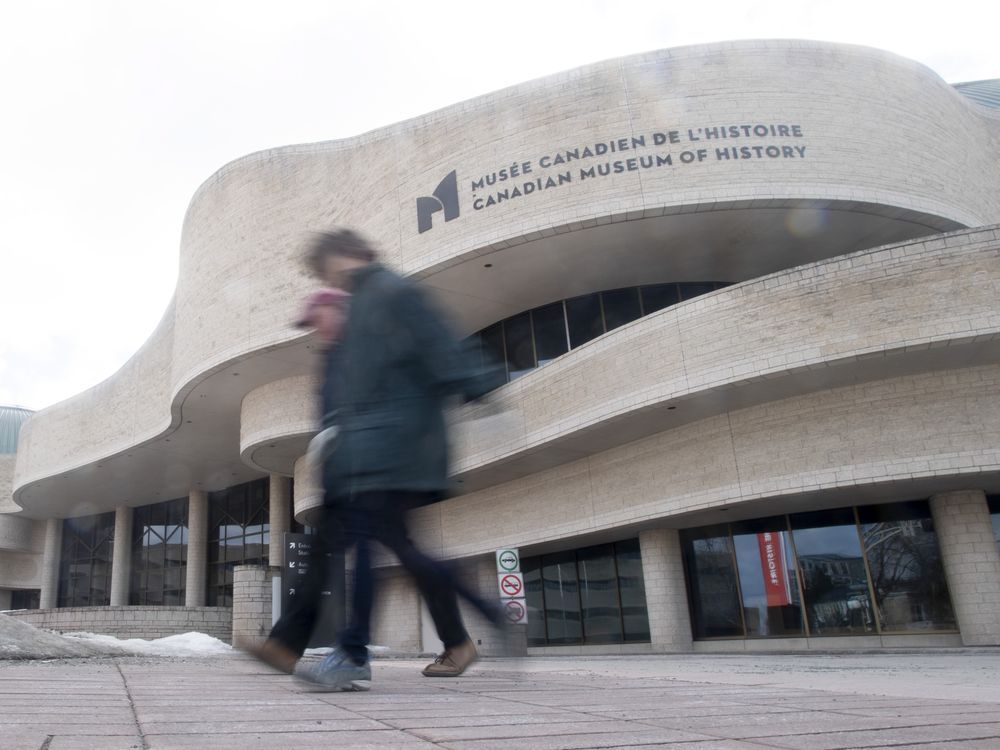
Museum curators in eastern Ontario say staff cuts at two local museums are just the latest blow to a beleaguered sector, as museums of all sizes scrounge for funding.
The Canadian Museum of History and Canadian War Museum are trimming their staff by dozens of positions as part of the federal government’s spending review.
Michael Rikley-Lancaster, executive director and curator of the Mississippi Valley Textile Museum, said the cuts come amid lean times for museums funded by various levels of government.
“I think we’re probably in one of the biggest struggles we’ve seen in history,” said Rikley-Lancaster, who is also president of the Ontario Museum Association.
The Canadian Museum of History, the Crown corporation that oversees both the national museums of history and war, said this week it’s slashing 18 per cent of its permanent workforce.
Those cuts will amount to a staff reduction from 371 to 304 workers, including a 24 per cent cut in the managerial ranks.
In an email, spokesperson Avra Gibbs-Lamey said the cuts are due to reduced spending under the government’s “comprehensive expenditure review,” as well as efforts to address the museum’s own structural deficit.

Budget 2025 requires the Museum of History to cut spending by $17.7 million over the next four fiscal years, starting with $2.4 million in 2026-2027.
Gibbs-Lamey said the decision follows “a careful review of operations” to reflect “more modern and efficient ways of working.”
“We remain firmly focused on our national mandate, and we will continue to advance research, develop world-class exhibitions and public experiences, and present new and innovative ways for Canadians to engage with their history,” she said.
A spokesperson for Canadian Heritage referred questions to the museums themselves.
The Canadian Museum for Human Rights in Winnipeg and the Canadian Museum of Immigration at Pier 21 in Halifax are also affected by the spending cuts, though haven’t yet disclosed any potential job losses.
Other national museums in Ottawa were spared.
What services will job cuts affect?
Ruth Lau MacDonald with the Public Service Alliance of Canada (PSAC) said union members who work at the museums are expecting “sweeping cuts’ to take effect gradually over the coming years.
“It means that entire programs may be slashed,” said Lau MacDonald, PSAC’s regional executive-vice president for the National Capital Region.
Lau MacDonald didn’t give an exact breakdown of which positions were affected but said “collections management,” for one example, was losing two of seven members, a significant hit for a team responsible for millions of items.
“If you consider the sheer size of the collection, there’s bound to be impacts,” she said.
Rebecca MacKenzie, communications director with the Canadian Museums Association, said she reacted to the cuts with “deep regret.”
Nearly all museums, even national institutions with wide mandates, operate on “a shoestring” budget, she said.
Although she couldn’t speak to the specific circumstances at the museums of history and war, MacKenzie said when museums undergo downsizing, the first areas to suffer tend to be programming and interpretation tours.
In the long term, lower funding may lead to decaying infrastructure.
“This is the part where it gets really insidious,” she said. “You’ll see a decline in capital investment. You’ll see a decline in important — sometimes important — maintenance.”
MacKenzie also raised concerns over a lack of funding set aside in the budget to help museums repatriate Indigenous artifacts, such as the century-old kayak
returned from the Vatican to a temporary home in the Museum of History
in December.
‘Frozen-in-time’ funding
Meanwhile, smaller museums across the region are also feeling financial pain.
Now retired, Cathy Molloy worked in museums for decades, including as a curator at the Markham Museum and director of the cultural centre in Aurora, Ont.
Over the course of her career, she witnessed a “slow deterioration” of the field, particularly a decline in support for smaller community museums.
“Our funding has gone down, and that’s, I would say, at almost every museum,” she said.

Rikley-Lancaster said a provincial grant for community museums, which helps support more than 160 such facilities across the province, has been frozen since 2009, dropping further in value with each passing year of inflation.
At the same time, some municipalities are pulling back support as they deal with their own spending crunch, and potential donors are feeling the demands of a higher cost of living.
“We’re in a really stagnant, frozen-in-time funding (period),” he said.
Presenting a further challenge to the industry: Algonquin College’s applied museum studies program is among
30 programs that may be on the chopping block
.
Rikley-Lancaster is a graduate.
Ultimately, he worries the hollowing of professional expertise could be detrimental to the long-term care of collections.
That work, according to MacKenzie, is particularly meaningful in the current political climate.
“This is really where the national identity is formed and questioned and agreed upon, is through museum spaces,” she said.
Related
Our website is your destination for up-to-the-minute news, so make sure to bookmark our homepage and sign up for our newsletters so we can keep you informed.