

In just a few days, the Olympic flame will be lit in Cortina d’Ampezzo — seventy years after the small mountain town first hosted the Winter Games in 1956.
For many, Milano–Cortina 2026 is about medals and competition. For others, especially within Canada’s Italian-Canadian community, it is something far more personal. It is about memory, family, and a story that never truly ended.
“I love hockey,” says Bernie Tomie, simply. At 93 years old, his voice is calm and understated — much like the way he has always spoken about his past.
“Seventy years ago… my God,” he says, pausing. “It was a long time ago.”
When Italy came calling
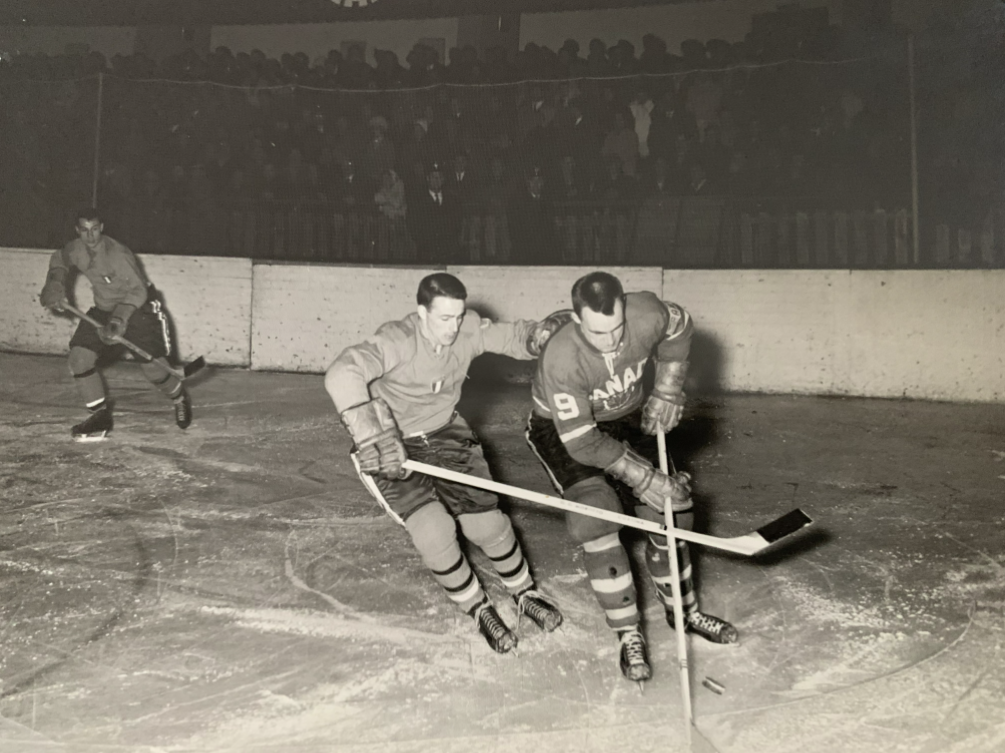
In 1956, Italy hosted the Winter Olympics for the first time. Hockey was still a young sport in the country, and the national federation looked across the ocean for help — to Canada, and to the children of Italian immigrants who had grown up on frozen ponds and indoor rinks.
“These guys didn’t go to Italy for the money — even though the money was good,” explains Bill O’Donnell, who has spent the last few years reconstructing their story.
“They went for the love of the game. By playing together, travelling together, they became a team.”
Tomie was one of six Italian Canadians selected to wear the Azzurri jersey in Cortina.
Alongside him were Aldo Maniacco and Carmen Tucci from Sault Ste. Marie, Ron Furlani from Sudbury, Carlo Montemurro and Reno Alberton from Niagara Falls.
They would later become known as the Cortina Canadians.
“I did all right,” Tomie says with a small smile. “I played a lot of hockey. Good guys I played with.”
Italy did not medal in 1956, but finished seventh — still the best Olympic result in the history of Italy’s men’s hockey program.
At the time, few realized how historic that moment would become.
Life after the Olympics
When the Games ended, the spotlight faded quickly. Some players stayed in Italy, building long careers as professionals and coaches.
Others, like Tomie, returned home.
“When I came home,” he says, “I built a house for my parents.”
There is no drama in the sentence. Just a fact.
For his family, hockey was something he did — not something he bragged about.
“My dad was a private guy,” says Michael Maniacco, son of Aldo Maniacco.
“He wasn’t the type to say, ‘Look what I did.’ If you asked him, he’d talk about it. Otherwise, he just moved on.”
For decades, the Cortina Canadians’ story quietly slipped from public memory.
It wasn’t until recent years — through O’Donnell’s research — that their contribution was fully rediscovered.
“They didn’t just fill roster spots,” O’Donnell says. “They helped shape Italy’s hockey identity at a crucial moment.”
In 2024, the six players were inducted into the Sault Ste. Marie Hockey Hall of Fame.
“It was emotional,” Maniacco says. “None of that would have happened without that research.”

A new chapter on the same ice
As Cortina prepares to host the Olympics once again, Italian hockey is being shaped by a new generation — this time through the women’s game.
Laura Fortino, born in Hamilton, Ont., to Italian parents, grew up balancing Canadian hockey culture with Italian family traditions.
“I come from a very traditional Italian family,” Fortino says.
“My nonna and nonno lived with us. We kept all the Italian traditions alive.”
She represented Canada at two Olympic Games, winning gold in 2014 and silver in 2018.
Now, just days before Milano–Cortina 2026 begins, she will step onto Olympic ice wearing the Italian jersey.
“To be able to represent my family and my heritage means everything to me,” Fortino says.
For Tomie, watching from afar, the connection is impossible to miss.
“They’re fast,” he says, laughing softly. “I’m watching on TV.”
More than a medal count
For the families of the Cortina Canadians, the return to Cortina brings mixed emotions.
There had once been hope of bringing the surviving players back to Italy for a ceremony — a symbolic closing of the circle — but time had other plans.
“It’s sad,” says Michael Maniacco. “Things change so quickly. But I’m grateful they were recognized. That matters.”
As the Games approach, Tomie continues to watch, quietly, from home.
The Olympic moment may have passed for him — but its meaning never did.
Seventy years later, Cortina is once again at the center of the Olympic world.
And through memories, families, and the game itself, the Italian-Canadian hockey story lives on — still skating forward, across generations and oceans.

