

The Olympics promise two perennial joys: The dopamine rush of becoming deeply invested in sports you’d never even heard of two hours earlier, and the spectacle that comes as the world’s athletes stride en masse into the opening ceremony wearing their matching team kits.
The Milan Cortina Winter Olympics is the second Games in a row to be hosted in a fashion capital. Paris 2024 set a high sartorial bar, with sharp Berluti tuxedo tailoring for the home team, and an exceptionally elevated take on athleticwear by Michel & Amazonka for the Mongolian squad.
In 2026, the athlete’s village sits in the shadow of the Fondazione Prada arts centre, and the Games are sandwiched between Milan Fashion Week collections by Armani, Gucci and the like; men’s just before, women’s just after.
At the opening ceremony on Feb. 6, we’ll be treated to entertainment by divas including Mariah Carey, Andrea Bocelli, Laura Pasini, the first Italian woman to win a Grammy, and “White Lotus’ star Sabrina Impacciatore, who will deliver “a moment of powerful impact,” per organizers.
It’s hard to predict precisely which niche winter sport will suck you in this time — consider skeleton, where athletes plunge headfirst down an icy track, or biathlon, where they ski and also shoot guns (also, please sign our petition to bring back ski ballet) — but we can offer a preview of what each country’s athletes will be wearing.
And in the spirit of global competition, we’re ranking the team kits from most to least alla moda, from fashion medal-worthy to so pedestrian you’ll probably out-chic them in whatever 500 layers you’re wearing to compete in your own personal winter sport: surviving February in Canada.
1. France
Brava! France has nailed the encore to their chic summer games kit. Inspired by 1970s sporting attire and designed by Le Coq Sportif, this take on winter gear feels polished and elegant — especially the fitted polos and co-ordinating knit pants — exactly the sort of thing you’d be proud to apres-ski in somewhere swanky in the French Alps. The palette of warm winter white and cornflower blue with the slightest touch of desaturated red is a welcome, unexpected take on France’s tricolor.
2. Norway
The best Olympic kits tell us something about the place they’re representing, and you can’t beat the storytelling from Team Norway. Exactly 70 years after Norwegian skiers went to the Olympics wearing Dale of Norway sweaters — in Cortina, no less — they’re back wearing custom knitwear from this local brand. (If you’re looking for a collecting area, Dale of Norway has made sweaters for every Olympics since 1956, and they’re all fantastic.)
The 2026 iteration is everything you’d want from Nordic knitwear: Bold geometric pattern, bright colour and covetable warmth.
3. Mongolia
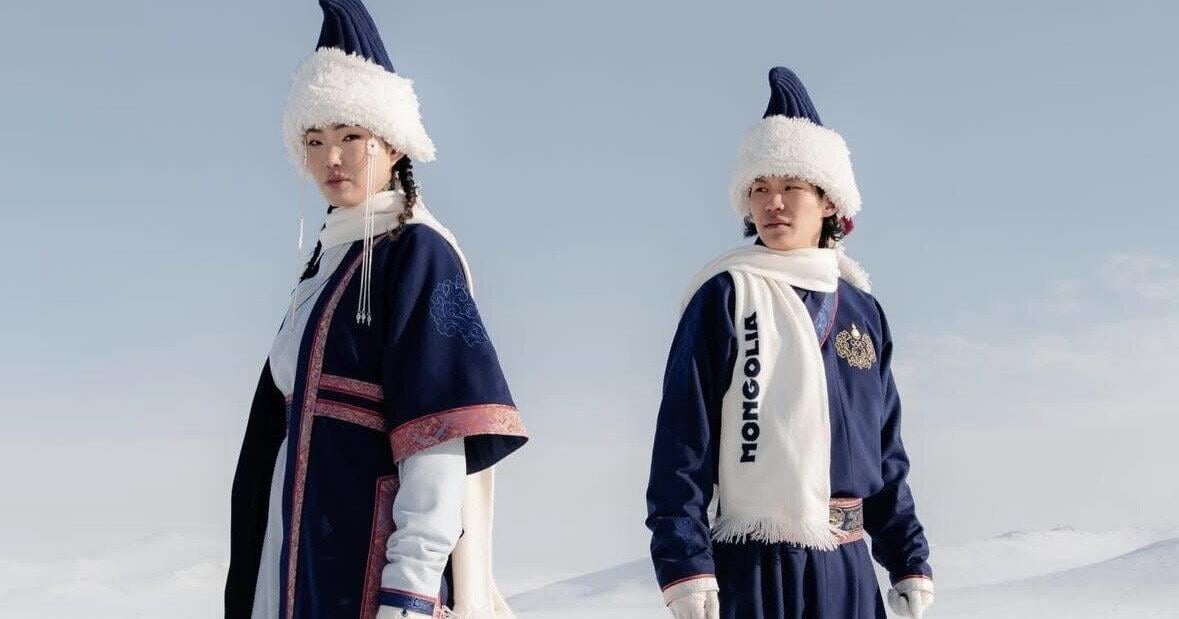
Given Mongolia’s track record, we had high hopes for its team kit this year. It’s a collaboration with Goyol, purveyors of sumptuous Mongolian cashmere, long worn by the country’s nomadic people to stay warm through some of the harshest winters on earth.
The collection includes reinterpretations of ancient deel robe garments (seen at the top of this article) worn in the 13th century; all eyes will be on these athletes when they walk into the opening ceremony.
4. USA
Ten consecutive Olympics in, there’s a reason Ralph Lauren is still outfitting the American athletes. To mark a decade of this stylish partnership, the brand has done a cheeky take on nostalgic Americana.
Think fair isle turtlenecks with intarsia Olympic rings, and a cream peacoat paired with pleated wool trousers and brown boots. It’s luxe sportswear with a wink.
5. Great Britain
No quiet luxury here; Great Britain has leaned into a “loud cosy” esthetic. Colour us charmed by the team’s collab with diver Tom Daley, who’s famous for knitting between gold-medal-winning dives; he created the scarves and hats the team will wear in the opening and closing ceremonies.
The clothing was designed by British label Ben Sherman for the fourth Olympics in a row, and walk a fun line between twee and cool with Union Jack jumpers (that’s sweaters to North Americans), and knit zip-ups in cream, red and navy.
6. Italy
Italy’s impeccably minimal kit proves the adage that luxury often whispers. The details are subtle, for instance the word “Italia” is embroidered on the jacket, but it’s done in tonal white-on-white so it’s only visible close at hand. It was designed by Emporio Armani EA7, the fashion house’s athletic line; founder Giorgio Armani, who died last September, said that the almost exclusively white palette was intended to create “harmony with the snow-covered peaks.” He is set to be honoured during the opening ceremony.
7. Canada
For its third Olympics kit, Canadian brand Lululemon worked directly with athletes to design pieces that suit their specific disciplines and needs. They’ve worked hard to incorporate a lot of Canadian signifiers: maple leaves, topographic maps, and colours that represent various aspects of our geography.
It’s an admirable effort at breadth and inclusion, but shoehorning all of those motifs into a single collection means the final result lacks coherence and even reads cheesy. (Looking at you, giant quilted maple leaf vest that can also be worn as a … skirt.)
8. Australia
Aussies are known for not being the most winter-fluent people — despite the fact that they do, in fact, get snow in some parts. Their athletes will never beat those charges in this opening ceremony outfit designed by high street brand Sportscraft. The cream cable knit topped by a white blazer with gold buttons looks more suited to watching the cricket on a spring day than parading into the Winter Olympics.
There are thoughtful details, though: the names of every Australian who’s competed at a Winter Games are embroidered into the lining.
9. Sweden
We had high hopes for a Scandi-meets-Japanese kit created for team Sweden in collaboration with Uniqlo, but alas!
The retail phenom is all about simplicity done well, but there’s so little imagination at play in these looks that it feels as if the Swedish team just raided their nearest Heat-Tech department, slapped on some Swedish flags and called it a day.

