

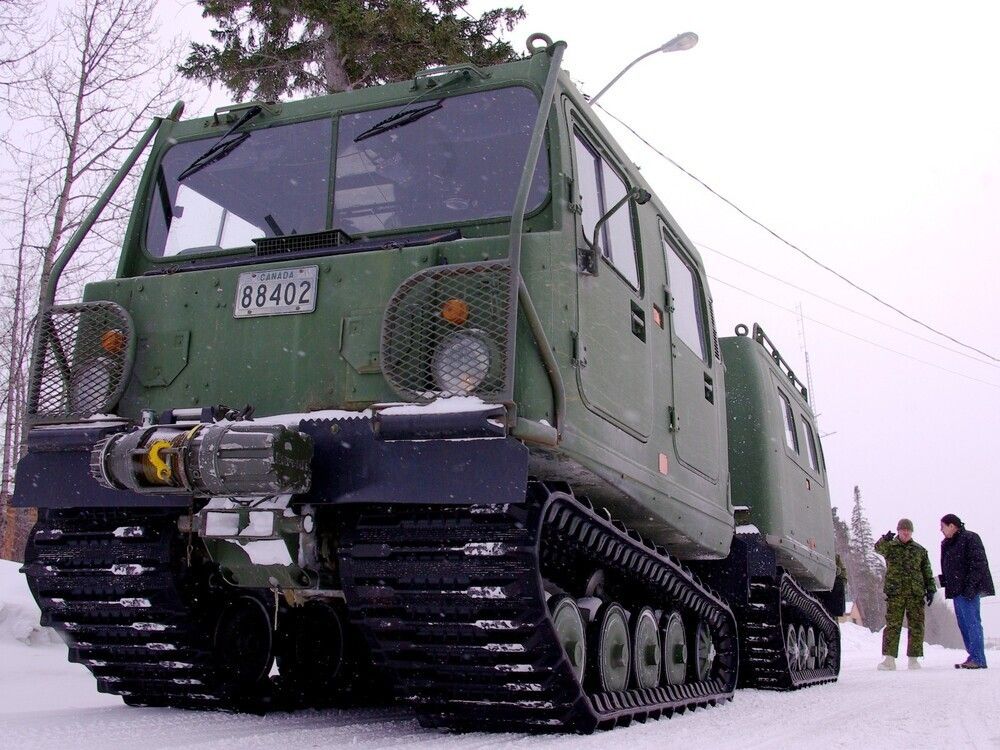
The upper range of the budget estimate for a new fleet of Arctic vehicles has jumped from $249 million to $1 billion in less than a year, the defence department has confirmed.
Defence industry representatives were told in April 2025 that the budget for the project to buy the 170 vehicles would be between $100 million and $249 million.
But
the Ottawa Citizen reported
Jan. 31 that a Department of National Defence website now listed that budget as being between $500 million and $1 billion.
At the time DND declined to comment but the department has since confirmed the updated figure in an email to the newspaper. “Schedule and budget estimates for this project have been refined and continue to be adjusted as detailed planning is finalized,” DND spokesperson Cheryl Forrest explained in an email when asked about the jump in price.
She noted that the figure from less than a year ago was based on early cost assumptions. “The Defence Team is committed to proper stewardship of taxpayer dollars and seeks to generate the most effective capability at the best value for Canada,” she added.
Neither DND nor the Canadian Army, which is acquiring the new vehicles, provided a breakdown of the proposed budget.
The significant increase in cost comes as Prime Minister Mark Carney has committed to spending billions of dollars more on defence in the coming decade.
The Canadian Army’s Domestic Arctic Mobility Enhancement (DAME) project would replace the aging fleet of BV-206 tracked vehicles purchased in the 1980s from a Swedish company and currently still in service.
The Canadian Forces hopes to accelerate delivery of DAME, Forrest added.
A request for proposals has yet to be released for the project but DND did not have any details when that would happen. DND did not provide details on when a contract would be announced.
Defence industry representatives in Ottawa were told by army officers that a request for bids would be issued in 2027, according to an April 2025 briefing obtained by the Ottawa Citizen.
But in a September 2025 article in Canadian Army Today, a publication associated with the army, military officers stated that the request for bids was set to come out sometime in 2026, followed by a contract in 2027.
DND spokesman Nick Drescher Brown stated in an email that the DAME project has been identified as a high priority for the department and procurement will be managed by the new Defence Investment Agency.
Drescher Brown said initial operating capability for the new vehicles is currently planned for 2030-2031. Full operating capability is planned for 2031-2032, he added.
The new vehicles would be operated by a crew of two and be able to carry eight soldiers. The vehicles would have a range of 300 kilometres and be capable of operating without support for 72 hours.
The project would deliver a vehicle in four different variants: command post, troop carrier, cargo carrier and ambulance. A number of trailers would also be bought, according to the briefing for the defence industry. In addition, the project would include a long-term maintenance package.
Army officers have said that the current fleet of BV-206s is on its last legs. DND spokesperson Andrée-Anne Poulin told the Ottawa Citizen in May 2023 that the Canadian Army had 18 BV-206s still operational and the Royal Canadian Air Force had 15 such carriers in use. A small number of BV-206s were also on loan at that time to other DND organizations, she added.
But another 55 BV-206s were being stripped for spare parts and then disposed of, according to Poulin. “The DAME project is a priority for the Army,” she added in an email in 2023.
A number of companies are preparing bids for the project,
according to Esprit de Corps
, a military magazine.
There has been renewed focus on Canadian defence in the Arctic, with that initially being fuelled by increased interest from Russia and China in the resource-rich region.
But, with U.S. President Donald Trump’s threats to take control of Greenland from NATO ally Denmark, there has been a shift in the view that the Americans are also be an emerging threat to Canadian sovereignty.
“Recent weeks have indicated that the Arctic is no longer a low-tension region, and it is increasingly the front line of strategic competition,” Foreign Affairs Minister Anita Anand told an Arctic conference in Ottawa on Jan. 28. “The international discourse around Denmark and Greenland have highlighted this.”
Anand also said that “defending Canada’s Arctic sovereignty is an unquestionable national security priority of this government.
Carney has
highlighted his government’s proposed investments
in Arctic security, including earmarking $420 million so the Canadian Forces can have a greater presence in the north. Carney has also highlighted the spending of $6 billion on a new Arctic Over-the-Horizon Radar.
The radar system, to be based in Ontario, is seen by the federal government as a key component of its North American Aerospace Defence Command (NORAD) modernization plan and is expected to provide advanced early warning and enable faster detection of threats.
The radar system,
to be based in Ontario
, is seen by the federal government as a key component of its North American Aerospace Defence Command (NORAD) modernization plan and is expected to provide advanced early warning and enable faster detection of threats.
It could also be offered to the United States as a contribution to
Trump’s proposed Golden Dome
missile shield. The radar is supposed to detect incoming missiles over the Arctic. It could also track aircraft and surface ships.
David Pugliese is an award-winning journalist covering Canadian Forces and military issues in Canada. To support his work, including exclusive content for subscribers only, sign up here: ottawacitizen.com/subscribe
Related
- Defence spending increase could mean Canada buys more than 88 fighter jets, says RCAF general
- Canadian Army looks to buy new tracked vehicles for Arctic use

