

About 60 more students at five downtown Ottawa schools will soon become eligible for school bus rides after the transportation authority cited safety concerns for those along walking routes near “hazards” such as shelters and supervised consumption sites.
The
Ottawa Student Transportation Authority
, which oversees bus services for Ottawa’s English-language school boards, has designated new “community hazard zones” within the boundaries of five elementary schools, citing “ongoing social and environmental concerns.”
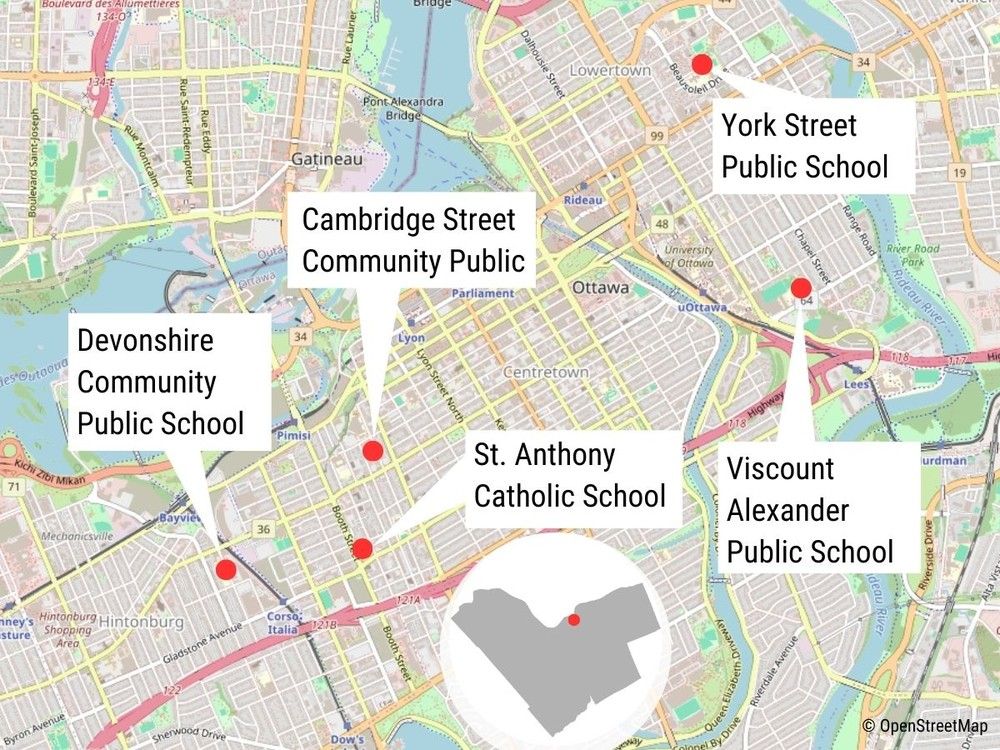
Students at Devonshire Community Public School, Cambridge Street Community Public School, York Street Public School, Viscount Alexander Public School and St. Anthony Catholic School who were previously ineligible for buses, but whose school walking routes are through the identified community hazard zones will be able to take buses as of March 9.
While exact boundaries differ based on the designated walking zones for each school, the community hazard zones are mainly located in proximity to the Chinatown neighbourhood near Somerset Street West and in Lowertown near the Rideau Street and King Edward Avenue area.
According to the transportation authority, areas may be classified as community hazard zones based on factors including proximity to shelters and drop-in centres that primarily serve individuals accessing emergency or transitional support services, supervised consumption sites and addiction treatment centres that distribute safe consumption supplies.
“Traditional hazard zones typically focus on physical infrastructure like busy intersections or railway crossings. However, we understand that safety also encompasses the social environment,” OSTA wrote in an email addressed to parents and guardians.
“This new designation takes into account specific challenges affecting your school community that may pose a risk to student security and peace of mind.”
Some parents and local politicians are frustrated by the designations, arguing that they don’t solve the larger problems of homelessness, addiction and community safety in downtown neighbourhoods.
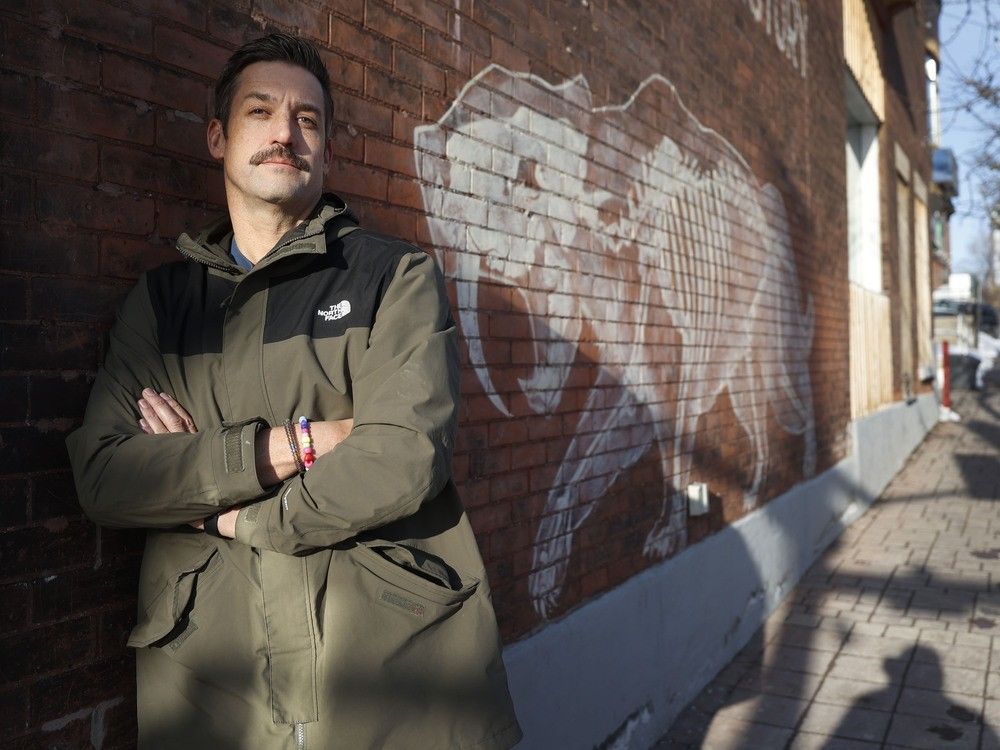
Mike Chatham, the parent of a five-year-old and an eight-year-old attending Devonshire Community Public School, said the community hazard zone designation was “a formal, institutional acknowledgement that our neighbourhood has been abandoned by the city and by the province.”
“With this community hazard zone, they’re basically saying, ‘It is not safe to walk your kids to school.’ Instead of fixing the problem, they’re going to bus them to school. It’s basically saying they’re not going to do anything,” Chatham said.
While his kids would become bus-eligible since they live within the community hazard zone for Devonshire, Chatham said he’d continue to make the 10-minute walk with them to and from school every day and wouldn’t be putting them on the bus.
“I’m in the hazard zone, but my kids and I are walking to school, and I’ll protect them on the walk if I need to from whatever hazards come their way,” he said.
“I think the sentiment from everyone in this new hazard zone is that we’re not going to put our kids on buses … when all we want to do is be able to walk safely with our friends and family in the community.”
With his daughter in Grade 3 now reaching the age where she could independently walk to school, Chatham said he’d been having conversations with other families in the neighbourhood about whether it was safe to send her to school on her own.
“If we were living in Hintonburg or even Westboro, for sure, she’d be walking to school by herself,” he said. “But we’re not at a place where we’re ready to let her go. Especially not when she’d be walking through what the province determines to be a hazard zone.”
Chatham added he hoped the new designations created more visibility on social issues in the neighbourhood.
“That would be the only good thing, that it’s kind of mobilizing more of the neighbourhood and more of the community,” he said. “No one is happy that this is happening, but hopefully this will be the catalyst that will actually spark some change.”
What are local politicians saying?
Somerset ward Coun. Ariel Troster said the decision to designate new community hazard zones due to social factors and put more kids on the school bus was “a Band-Aid solution that’s not really a solution at all.”
“I understand what they’re trying to do, which is to keep kids safe, but I would argue that to keep kids safe we need to ensure that people with addictions and mental health issues are properly cared for,” she said. “Instead of solving a real problem, it just feels like a Band-Aid solution that’s actually very stigmatizing towards communities that are actually wonderful to live in for kids.”
Catherine McKenney, the MPP for Ottawa Centre, has also heard from many residents expressing shock and disappointment about how the new community hazard designation “paints a picture of an unsafe neighbourhood.”
“We don’t live in an unsafe neighbourhood — we live in a walkable, diverse downtown neighbourhood. It has its challenges, no doubt, but to suggest that a community hazard zone should include shelters and drop-in centres that serve people who are accessing emergency support services, quite frankly, is disturbing,” they said.
Troster and McKenney both said they hadn’t heard any residents asking for extended school bus coverage for their kids.
“I have not heard a request to put children who live a very short distance from school on a school bus,” Troster said. “It’s actually contrary to everything we’re trying to do as a city — we want people to use active transportation. We want our streets to be safe.”
According to OSTA, the decision to introduce community hazard zones was made “in response to increasing safety inquiries from parents and school administrators regarding complex social and environmental conditions on certain walk routes.”
“This decision was not sparked by a single incident, but by a documented increase in safety concerns and a need for an objective, equitable standard that removes the burden of case-by-case advocacy from families,” an OSTA spokesperson told the Ottawa Citizen.
Specific boundaries for the community safety zone were decided based on “concrete areas where activity and congregation are recurring and predictable during school times,” the spokesperson added.
McKenney said they “don’t want to downplay” that there’d been an “absolute spike” in open drug use in the area
since the closure
of the safe consumption site at the Somerset West Community Health Centre in 2025.
“Since its closure, we have seen an increase in these pop-up clinics where people are not being well-monitored. They’re not being supervised,” said McKenney, who continues to push for the
closure of New Dawn Medical
, a private safe-supply clinic on Somerset Street.
McKenney and Troster released a joint open letter in December calling on the College of Physicians and Surgeons of Ontario to investigate New Dawn Medical, alleging issues such as how the amounts doctors prescribed were large enough to allow “diversion,” meaning people could trade or resell the drugs for stronger opioids like fentanyl.
Despite the ongoing challenges in the neighbourhood, Troster argued that extending school-bus access was not where funding needed to go.
“We’ve been begging for solutions, more supportive housing, more services for people, more funding to be able to get people to health care that they need or the supports in their own housing, and there’s a spillover effect on our streets,” she said.
“I’m not going to deny that it can be very stressful, but the solution is not to put our kids who live a block away from school on a school bus as far as I’m concerned.”
OSTA said it would “continue to monitor and re-evaluate” the zones in collaboration with the school communities as the urban environment evolved.
Related
Our website is your destination for up-to-the-minute news, so make sure to bookmark our homepage and sign up for our newsletters so we can keep you informed.

