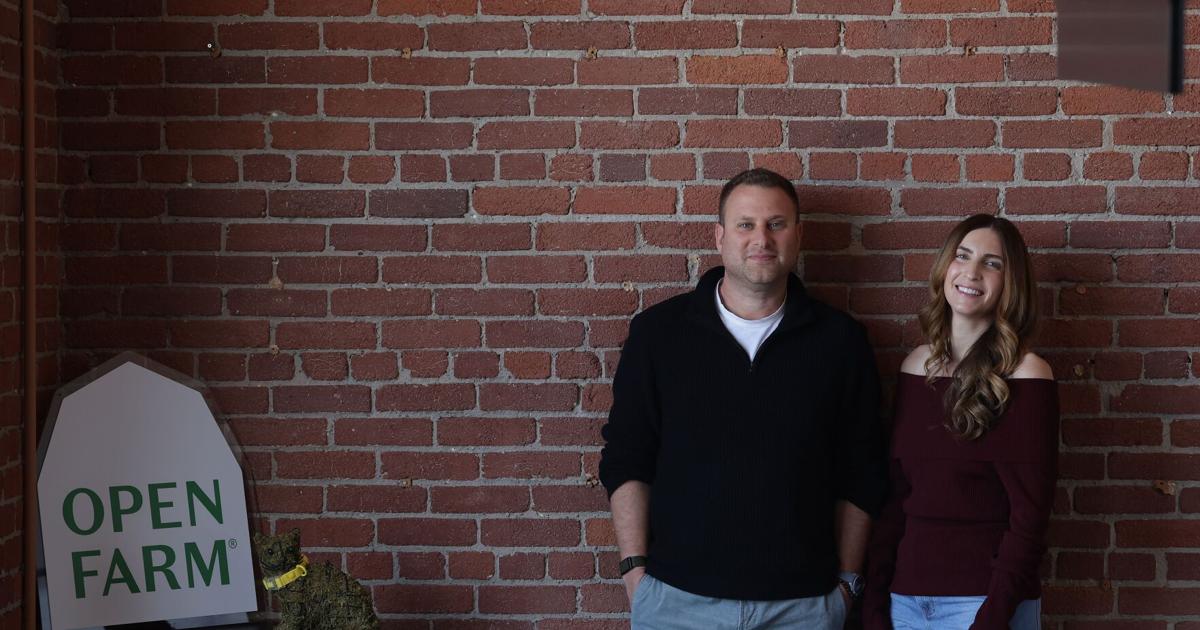
Many pet owners are as concerned about their furry friends’ diet as their own. Count Isaac Langleben and Jacqueline Prehogan among them.
The husband and wife duo launched Open Farm in 2014, offering nutritious food for cats and dogs made with sustainable ingredients after struggling to find quality options for their three pugs.
“At that time, we were very focused on what we were eating; Jacqueline was a vegetarian and we were very much the Whole Foods kind of shopper,” says Langleben. “When we went to the pet store, there were really no options that were filling that value proposition, and we saw an opportunity.”
Prehogan, who earned a CPA at Queen’s University, had already dropped out of law school to launch dog apparel brand, Canada Pooch, in 2011.
“Our industry is known for being very opaque,” she says, explaining that at the time brands were inspecting competitors’ products and filing lawsuits over misrepresenting ingredients. “There was a lot of damage to consumer trust.”
During her first venture, Prehogan was financially supported by Langleben, who had earned degrees in commerce and law from McGill University, and worked as a consultant for Boston Consulting Group before moving into private equity.
After expanding into pet food, Langleben quit his day job to became CEO while Prehogan became chief brand officer while staying on with Canada Pooch, first as CEO and later as an adviser.
Open Farm has since introduced innovations that are now industry standard, like recyclable packaging, ethically sourced traceable ingredients and recipes developed by a board-certified veterinary nutritionist.
Today, Open Farm offers some 300 unique products for cats and dogs — including treats, meals and supplements — sourced from more than 2,500 farms in North America, Europe and Australia.
Their products are available at some 8,500 stores in eight countries — including Canada, the U.S., China and the UAE — on Amazon, and on its website, which shipped more than a million orders last year.
The B-Corp certified company was founded in Toronto with manufacturing in Canada, the U.S. and Iceland. It employs 116 staff and has been growing by more than 60 per cent annually for the last three years.
Prehogan and Langleben were recently named EY’s Canadian Entrepreneurs of the Year for “their dedication to conscious business practices.”
The Star recently spoke with the couple from the company headquarters in Little Italy about their shared love of pets, the benefits of better food for animals, their owners and the planet, and their response to those who think we’ve gone too far coddling our fur babies.
Did you start as business or life partners?
Langleben: We were life partners first. Our parents were old friends from Montreal, and Jacqueline’s family knew my cousins growing up, but we never met.
Prehogan: There’s a lot of debate around how we met. My mom will say she had a master plan when she invited Isaac over for dinner, but we don’t know if we’re buying it.
We both had day jobs at the beginning of our relationship and then I started working full time on Canada Pooch while Isaac was supporting us.
Where did the idea for Canada Pooch come from?
Prehogan: I always wanted to have a career that revolved around animals.
We had just gotten our first dog, and I went to look for some winterwear for her, and I noticed there were no brands, and the products were basic. I realized that if people shop for brands that matched their style, they’re going to want the same for their pets, but that didn’t exist at the time.
We didn’t have kids, and Isaac was very supportive of me. I don’t think I would have done it if he didn’t encourage me and wasn’t able to support us financially.
How many pets have you owned together?
Langleben: When we met, I had a miniature poodle named Kobe.
Prehogan: I begged for a dog my entire life, but my parents both worked and were worried it was too much responsibility so instead they got me every other animal. I had turtles and birds, until finally they got me a dog at 14.
We got our first dog, Bella, who was a pug mix, then Maddie, who were both rescues. Then we got Duncan, a seven-year-old pug mix, so we had three pugs when we had our first child, and our second, which was insane. Sadly, we’ve since lost two dogs to old age.
Then we had our third child, and when she was eight weeks old, we got a Bernedoodle (Bernese Mountain Dog/Poodle cross) puppy, because we had just lost our other dogs. So, now we have three kids and two dogs.
How did you have time to start another business?
Langleben: We both had this desire to do something entrepreneurial, and when Jacqueline started Canada Pooch we both loved it. Our lives were crazy, but we were having a lot of fun.
We obviously love animals, and they’re a huge part of our lives, and we enjoyed being part of this industry. It’s huge, but it often lags trends. We realized the same consumers are buying products for their pets and their families, and there was just a huge gap between what was available for each.
We were seeing this farm-to-table trend, with natural food companies growing quickly. At that time, we were very focused on what we were eating; Jacqueline was a vegetarian and we were very much the Whole Foods kind of shopper. When we went to the pet store, there were really no options that were filling that value proposition, and we saw an opportunity to fill that gap.
What does Open Farm do differently?
Prehogan: The main thing we identified right off the bat was that there wasn’t a focus on ingredient quality, traceability and transparency. On top of that, we realized this industry is huge, and factory farming was having massive negative impacts.
We realized we could take a different approach to making pet food with a focus on where ingredients come from, how they’re grown and raised, with high animal welfare standards. We’ve partnered with leading animal welfare organizations from day one, 100 per cent of our meat is humanely raised and we have a robust, sustainable seafood program.
We were the first pet food brand to introduce TerraCycle, a way of disposing of nonrecyclable packaging, which has since been adopted by many major brands, and then we started converting our packaging to more recyclable substrates for curbside pickup.
We put QR codes on our packages, and you can scan any of our products to see every single ingredient, and where it came from, which is something nobody else was doing, not just in pet food but across consumer-packaged goods.
Overall, I think we’ve empowered consumers to demand better transparency, animal welfare and sustainability, which has become table stakes for a lot of pet parents.
Is it difficult being in the meat business as animal lovers?
Prehogan: It’s a great question, because I had been a vegetarian for 12 years before we started. After I had kids I started eating meat again, but I wanted to know where it came from.
It was absolutely a challenge when we started, but I eventually realized most people are going to eat meat, and there’s nothing wrong with that.
Pets need meat in their diets too, but we can have a big impact by moving the industry away from factory farming and towards better environmental and animal welfare standards.
I feel proud of what we’re doing, and I sleep well at night knowing we are raising that bar.
Higher standards come with a higher price tag. Has that been a challenge in this economy?
Prehogan: We provide a range of options to make our food accessible, understanding that every family has different needs, budgets and lifestyles.
Langleben: You could go with a fresh diet for $15 a pound at the high end or our Goodbowl offering, which lets you feed your dog with super high-quality nutritious food for a few dollars a day.
Consumer confidence has had an impact on the industry, but the phenomenon we’re seeing in pet food is that some are trading down to more value products, but there’s a whole group that’s trading up to ultrapremium products.
Pet food is still a small portion of household discretionary spending, and research shows it’s one of the last things people cut, even after food for their families.
What do you say to those who think we’ve gone too far in how we treat pets?
Langleben: Even if you have that perspective, pet food is responsible for 25 to 30 per cent of the environmental impacts of meat consumption in the United States, millions of packages end up in landfills every year, so the industry’s footprint is huge. Open Farm is bringing standards in line with other parts of the food economy.
Prehogan: About 60 per cent of Canadian households have a dog or cat, and 95 per cent consider them part of the family.
There’s extensive research that shows how food can make an impact on their well-being, whether you’re optimizing for nutrients or more functional diets for things like gut health, skin and coat. We have a board-certified veterinary nutritionist staying on top of that research as it evolves.
What’s next for Open Farms?
Langleben: We have some new releasing coming up, like Good Gut, which will be in stores in March, with has probiotics mixed in to promote good digestion, a trend you see already in consumer food. We’re also expanding our RawMix and Epic Blend collections in February.
Otherwise, the company is about innovation, not just in our products but in how we do business, so you’ll continue to see is raising our standards as we expand our presence with more retail stores and more international markets.