

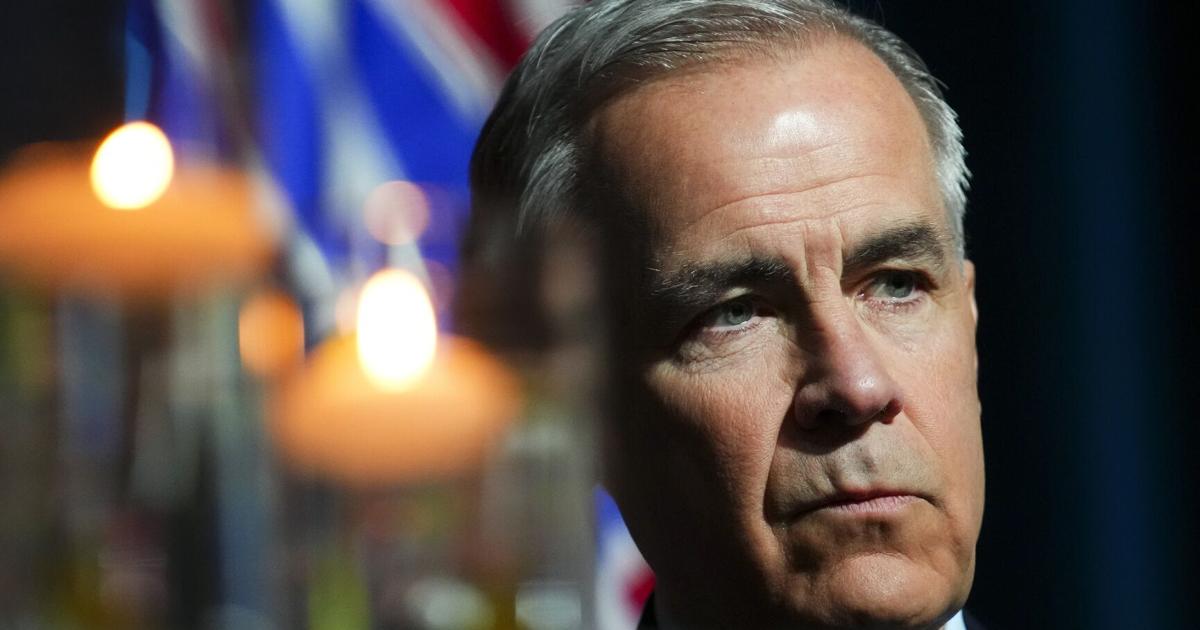
OTTAWA — Right before Quebec vigorously defended its law promoting state neutrality and secularism in public services, Prime Minister Mark Carney stood at a national prayer breakfast and declared religious values can and should frame how politicians act.
Carney’s display of his Catholic faith Tuesday stood in stark contrast with a heated debate about the value of state secularism that played out an hour later at the Supreme Court of Canada.
Where Carney quoted from the Gospel of Matthew and from Christ’s Sermon on the Mount to talk about the grace and generosity that politicians should channel, Quebec’s lawyers argued religious beliefs should not be on display by public officials, saying the state should be neutral, and public services delivered without signs of any religious belief.
At day two of a critical court challenge of Quebec’s 2019 ban on religious symbols worn by teachers, police officers or court workers, the provincial government argued that the controversial law is constitutional and none of the top court’s — or Ottawa’s — business.
Lawyers for the Coalition Avenir Quebec government led by outgoing Premier François Legault argued the province properly invoked a constitutional override power allowing it to bypass the Charter of Rights and Freedoms without requiring it to justify any limitations on rights on free expression, freedom of religion or equality rights.
The Carney government has taken no formal position on the notion of secularism in the law, but objects to how Quebec and other provinces are using the Constitution’s notwithstanding clause to override Charter rights pre-emptively.
Federal lawyers will make oral arguments as one of 51 interveners — a record high — in the case on Wednesday. In a written brief, Ottawa argues despite the override, judges retain the jurisdiction to declare whether rights and freedoms that are temporarily suspended by a government “have been unjustifiably limited.”
“The Constitution gives Parliament and the legislatures a wide margin to enact laws in the public interest within their respective jurisdictions. However, this latitude has never been absolute: the principle of parliamentary sovereignty has always been constrained by the Constitution,” argues the federal government.
Quebec got strong backing on Tuesday, however, from a group called “Pour les droits des femmes du Quebec,” which argued against religious symbols like a burqa, and head or face coverings like the niqab worn by some Muslim women in the name of modesty, saying those coverings in effect promote the inequality and inferiority of women.
Lawyer Christiane Pelchat, quoting experts and witness testimony, said the “moral obligation of wearing the head scarf is justified by the principle of modesty and the necessity of hiding the female body, considered as a source of temptation and dirtiness, which must be covered not to tempt men.”
She said such attitudes are mainstays of patriarchal religions around the world, and have no place in Quebec’s public life.
“We have to stop demonizing this law,” said Pelchat.
She said the state should not allow employees to display religious symbols while exercising public functions in the name of respecting religious beliefs because that would create a hierarchy of rights.
“Of course this is politically correct. Everyone wants to be nice to everybody else, but no, there are obligations that do exist,” said Pelchat.
The Quebec government claims it enacted the secularism law after years of debate, repeated attempts to reconcile religious freedoms with the desire for “state neutrality” and respect for women’s equality. It drew on recommendations of the Bouchard-Taylor Commission, said lawyer Samuel Chayer, adding the objective was “not to identify any wrongdoing, not to stigmatize anyone, it had to do with reconciliation and accommodation.”
The law also bans elected officials at Quebec’s National Assembly from wearing face coverings or displaying articles of religious faith, which some challengers say prevent minorities from holding public office.
Quebec argued the Constitution’s Section 33 only requires lawmakers to list the rights that are “suspended.” It does not require further justification or evidence the law is a “reasonable limit,” and once invoked, puts the law beyond federal or judicial reproach.
Often called an escape clause, the section allows a province to enact any law it deems necessary “notwithstanding” Charter of Rights protections for freedom of expression, religion, legal procedural rights, and prohibitions against discrimination based on race, national or ethnic origin, colour, religion, sex, age or mental or physical disability grounds. It cannot be used to limit mobility or democratic voting rights.
Isabelle Brunet, arguing on behalf of the attorney general of Quebec, said the text of the override provision is “very clear, and it is not up to the court to answer a political question that does not concern the courts.”
She and Chayer reminded judges that the override power unlocked a political logjam over Canada’s Constitution, leading nine of 10 provinces to eventually agree to patriate it and the new Charter of Rights and Freedoms from Britain in 1982 — “one of the most significant compromises in the history of Canada.”
It still carries the taint of Quebec’s refusal to sign on, even though citizens and laws in that province are covered by it.
Chief Justice Richard Wagner, picking up on arguments made a day earlier, asked Quebec to explain why the courts should not exercise judicial review powers, and examine whether a shielded law violates Charter rights, and issue a declaration to that effect. He asked how the court should handle a hypothetical future election of a “tyrant” who invokes the override to “eliminate basic rights of Canadians.”
But Quebec’s lawyers stood their ground, saying the override clause deserves respect as part of the Constitution.
“The guardians of the Constitution are not just the courts but also elected officials and the electorate,” said Brunet.
She pointed to an Ontario decision to reverse its 2022 decision to use the override power in back-to-work legislation for public school workers.
“It’s important to trust the democratic process,” said Brunet.
And if courts were to declare a law did violate rights but remained valid due to the existence of Section 33, judges would only create “confusion,” she said.
“It could lead people to think the act is illegitimate … so it might lead someone to wonder if they should respect the act, should they follow the rules in the act? That may end up undermining the rule of law.”
Several groups and individuals have challenged the secularism law, known as Bill 21, citing violations of religious, gender and minority language rights. However, lower courts have largely upheld the Quebec act.
Oral arguments at the Supreme Court of Canada continue Wednesday and Thursday. A final decision from the court is unlikely for several months.
Error! Sorry, there was an error processing your request.
There was a problem with the recaptcha. Please try again.
You may unsubscribe at any time. By signing up, you agree to our terms of use and privacy policy. This site is protected by reCAPTCHA and the Google privacy policy and terms of service apply.
Want more of the latest from us? Sign up for more at our newsletter page.

