

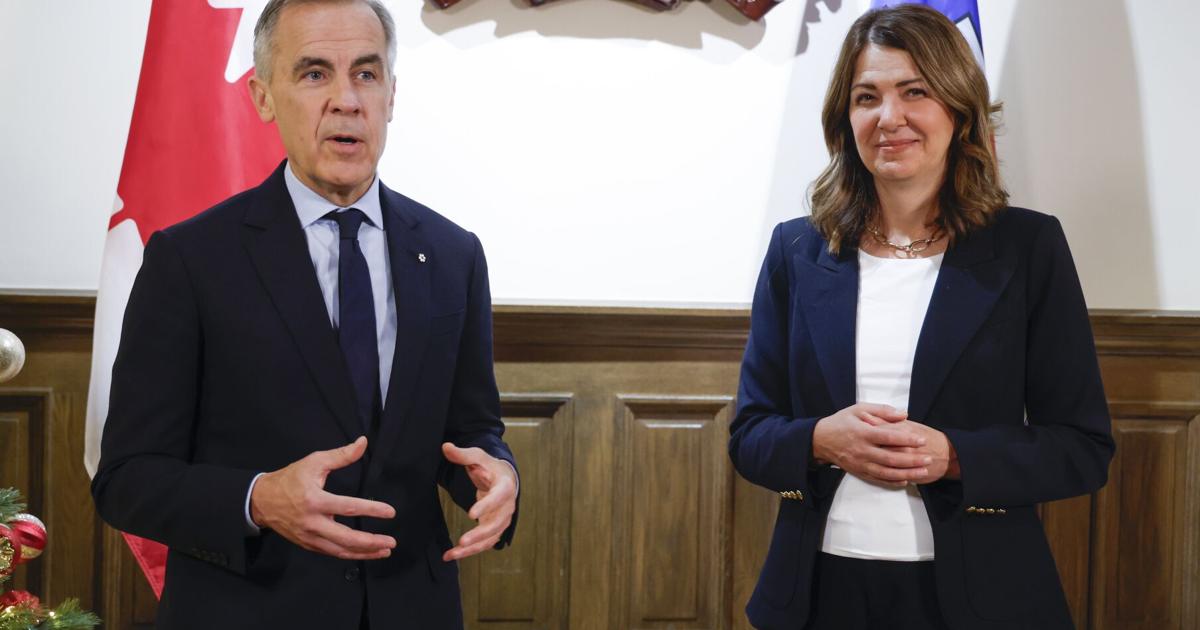
OTTAWA—A landmark deal between Alberta and the federal government will miss its first major deadline but Prime Minister Mark Carney said good progress is being made and a deal is not far off.
“I don’t think we’re going to announce an agreement tomorrow but I feel very good about the progress and the state of the discussions,” Carney said at an announcement of a new nature strategy in Quebec on Tuesday.
April 1 is the first major deadline in the memorandum of understanding that Alberta and the federal government signed last fall. That deal required Alberta to update its industrial carbon tax system and for the province’s oilsands companies to move ahead with a massive carbon capture project, while committing Ottawa to clearing regulations and making way for a west coast pipeline.
By Wednesday, the two governments were supposed to have agreed to an industrial carbon pricing system that would set a minimum effective carbon price of $130 per tonne on heavy emitters, phased in by 2030.
The two governments and industry were also supposed to have a deal by April 1 to build the Pathways project, a massive, proposed carbon capture and storage facility.
Those two items are still being sorted with Carney saying he spoke with Smith Monday afternoon. He said they’re focused on achieving a durable solution.
“We want to get it right. We want to have a framework that works,” Carney said.
A federal government source, speaking on background because they were not authorized to speak publicly, said carbon pricing is the big remaining piece to be worked out. The new industrial carbon pricing system is an essential component of the Pathways project that is being proposed by major oilsands companies. The minimum estimated $16.5 billion cost of that project would be offset by carbon credits from the Alberta system.
At a press conference Tuesday afternoon, Alberta Premier Danielle Smith said her province is committed to a carbon pricing system but the specifics are important.
“My conversations with the prime minister are figuring out that pacing, that benchmark, that threshold, because we have to make sure that our industry is strong and healthy,” she said.
Smith said there are a few more details left to be worked out about timing and stringency of the agreement, but she expects a carbon price agreement could be resolved within a few days.
The MOU’s deadline is coming as global energy prices have soared in the wake of the war in Iran, with oil trading well above $100 per barrel and gas prices across Canada soaring as well.
Carney was asked if he is considering lowering gas taxes in response to those increased costs. He didn’t rule out taking that measure, but said an answer would come in the spring fiscal update.
“We’ll have a fiscal event in the spring with the spring update and that would be the right time to fully answer that question,” he said.
The two governments have signed deals that were part of the MOU’s April 1 deadline; an agreement on methane reductions and an agreement on project reviews that is meant to accelerate major projects.
Alberta’s current industrial carbon pricing system gives companies credits for meeting emissions reduction targets, but because the targets are low many companies are easily meeting them and the market is flooded with credits that higher-emitting companies can buy. Despite a “headline” price of $95 per tonne, this oversupply means credits sell for as low as $20 per tonne.
Just days after signing the MOU last year, the Alberta government added new ways for companies to get credits, which further lowered prices according to Rick Smith president of the Canadian Climate Institute.
“Within a few days of those changes being announced last year, carbon prices crashed in Alberta because the market was flooded,” Smith said.
Smith said getting to a real $130 price per tonne will be a major victory and he hopes the two governments stick to what they promised in the MOU last fall.
“What has already been agreed to by these two governments is useful, so we look forward to seeing the details of how this is going to be achieved,” he said.
Smith said the very countries around the world that are looking to buy Canadian energy, countries like India or the United Kingdom are also strengthening their carbon pricing regimes.
“Increasingly, having a functional industrial carbon pricing system is the price of emission when it comes to global trade and countries that don’t have these systems are going to be dinged in the global markets.”
Error! Sorry, there was an error processing your request.
There was a problem with the recaptcha. Please try again.
You may unsubscribe at any time. By signing up, you agree to our terms of use and privacy policy. This site is protected by reCAPTCHA and the Google privacy policy and terms of service apply.
Want more of the latest from us? Sign up for more at our newsletter page.

