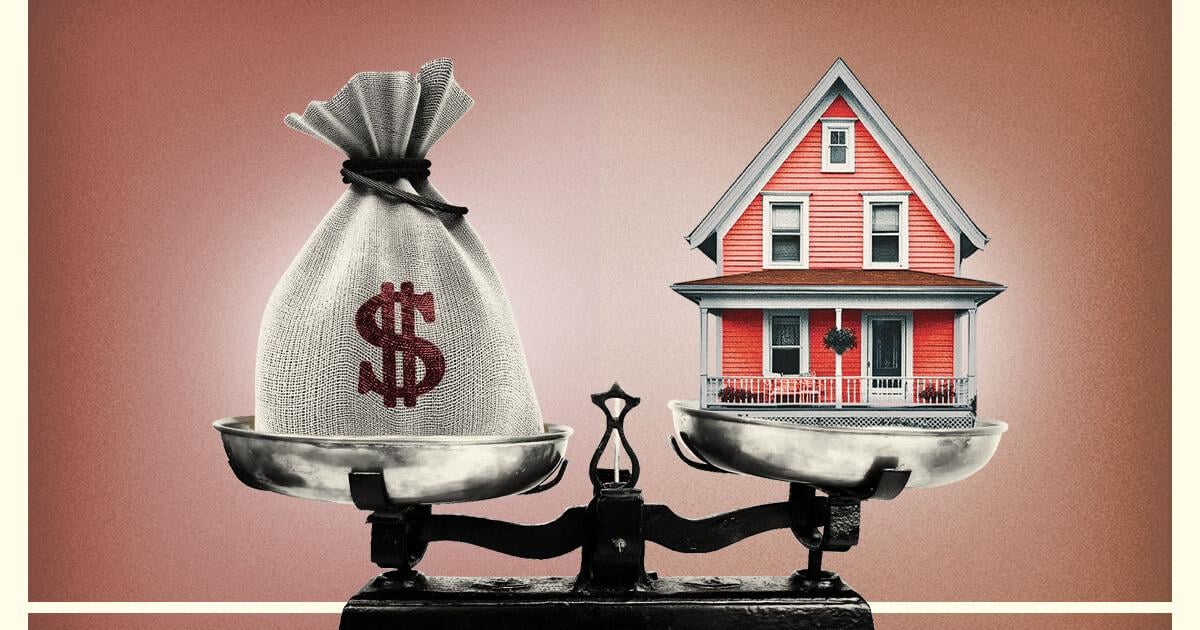
With household debt at a record $2.6 trillion, many Canadians are desperate for solutions to help cover their expenses, and some are using their homes as collateral to borrow the cash.
Last year, home equity line of credit (HELOC) debt grew to roughly $180 billion — the highest since 2019, according to Statistics Canada.
“The Canadian consumer is squeezed,” says Ron Butler, principal broker at Butler Mortgage. “There’s food inflation, there’s home insurance inflation, there’s property tax increases, and some people are getting renewals that are increasing their mortgage payments.”
Experts say the “squeeze” means many Canadians are now using HELOCs to pay for everyday costs.
HELOCs are great financial tools when they’re used to cover home improvements to increase the value of your home.
But there are risks associated with opening a HELOC that many Canadians aren’t aware of unless they’ve read the fine print. In a worst-case scenario, missing payments could mean losing your home altogether.
What is a HELOC and how does it work?
A HELOC is a type of loan that allows you to borrow against the available equity in your home — the appraised value minus the outstanding mortgage amount and other debts secured against it. It’s a revolving credit product, which means you can borrow up to the limit, pay it off, then borrow again.
Unlike a traditional line of credit, a HELOC uses your home’s equity as collateral, meaning the home serves as security for the lender. This type of credit also typically comes with lower interest rates than traditional forms of credit, and allows you to access larger amounts.
There are two types of HELOCs. One can be combined with a mortgage, where your available credit increases as you pay down your mortgage principal. This is also called a re-advanceable mortgage. The other type is a stand-alone HELOC, where the available credit doesn’t increase as you pay down the mortgage principal.
Most lenders only require borrowers to make monthly interest payments on the amount borrowed from the HELOC. There’s generally no set schedule for paying off the principal balance. You do have to pay back the principal if you sell your house or if the lender demands it.
HELOCs primarily have a variable interest rate, which is typically based on the lender’s prime rate plus 0.5 to one per cent. For example, if the lender’s prime rate is 5.85 per cent, your HELOC could have an interest rate of 6.85 per cent. Use $100,000 of your HELOC, and one can quickly see how paying that back could become unmanageable at that rate.
Your lender’s prime rate may change when the Bank of Canada changes its policy interest rate, which could mean higher monthly minimum payments. Some lenders will allow you to have a fixed rate on a portion of your HELOC with a structured amortization, similar to a mortgage.
To qualify for a HELOC, you generally need to have 20 to 35 per cent equity in your home, and you can borrow up to 65 per cent of the value of your home.
It’s tougher to qualify for a HELOC than a mortgage, says Dan Eisner, founder and CEO of True North Mortgage. “We want to make sure that the income ratios make sense to how much they’re borrowing.”
How should a HELOC be used?
A HELOC works for homeowners planning to renovate, Eisner says. “It makes sense to use that line of credit to actually improve the value of the house.”
People often use HELOCs to pay off debts with higher interest rates (such as credit cards), too, Eisner points out.
Some experts recommend having a HELOC as a low-cost emergency fund if something really went wrong (like if both earners in the family lost their jobs), Butler says. “It is a useful tool to that extent.”
In some cases, Canadians are turning to HELOCs to fund wants over needs. Scott Terrio, certified credit counsellor and manager of consumer insolvency at Hoyes, Michalos & Associates, has seen people take out HELOCs to cover everything from kids’ hockey expenses, trips to Disney and even an exotic pet turtle.
Read the fine print
A HELOC is a demand loan, Butler explains. That means it’s a one-way contract where the lender can decrease the limit or demand repayment at any time.
Banks use predictive credit models that look at increasing HELOC use and payments shrinking to the minimum, which can lead them to reduce your limit without any notice.
If you miss a few payments and the lender becomes worried, they have the right to demand that you pay off the entire balance of the HELOC, Butler says, though that rarely happens. Instead, they could convert the HELOC to an amortizing loan that needs to be paid off within 20 years. That means you would have to start paying interest plus principal.
Missing a HELOC payment is not like missing a credit card payment, explains Terrio. “You’re at the mercy of the bank. If you miss a HELOC payment, they’re going to send you a letter. If you miss two, they’re going to send you a sterner letter. And if you miss three, they have every right to take your house in a power of sale.”
Create your own repayment schedule
Before taking out a HELOC for $100,000, Terrio says you should make sure you’re absolutely certain about your income for the next five years.
If you’re using a HELOC to cover home renovations, Eisner suggests coming up with a plan to pay off the balance, especially if you’re planning to use tens of thousands of it.
For someone struggling to meet everyday costs who is uncertain about being able to keep up with regular payments, a HELOC isn’t a good solution. In those situations, Eisner says, you’re better off looking for cheaper rent or selling and moving to a less-costly home.
In over your head?
If you have a HELOC and you’re feeling unsure about how to pay it off, Terrio suggests speaking to a licensed insolvency trustee who can provide a free consultation. “Trustees are debt experts,” he says. “You can’t bring a scenario to a trustee that they haven’t either seen or know how to deal with, frankly, no matter how bad it is.”
His biggest tip: Don’t wait. “The sooner you talk to somebody, the better.”