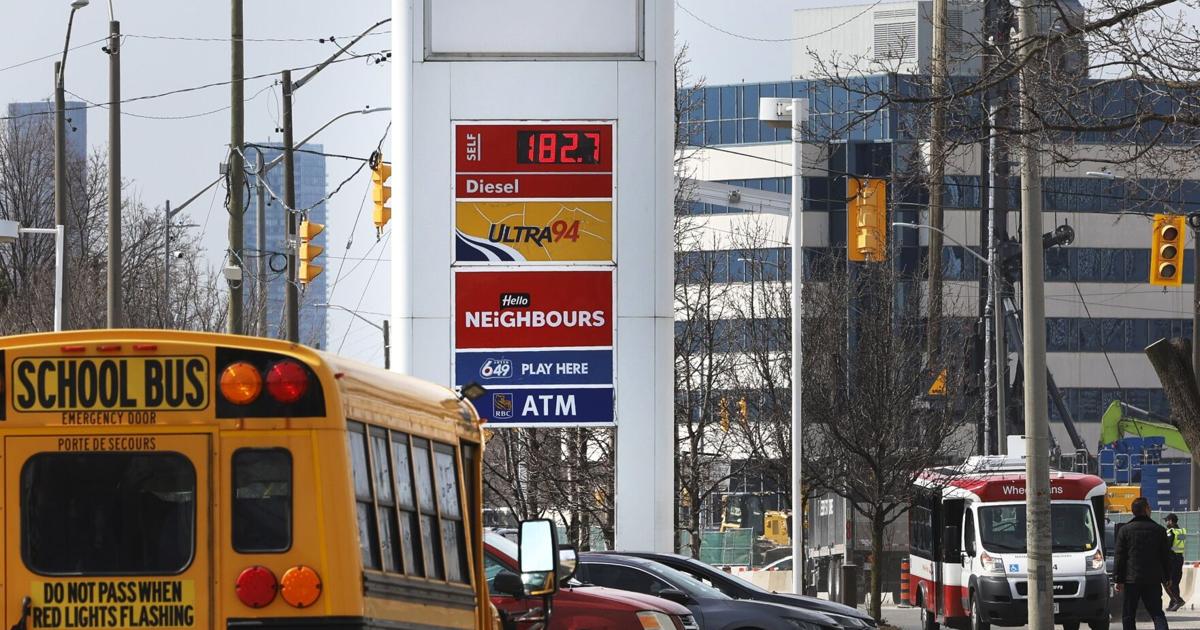
If you don’t like roller-coasters, you’re going to hate the price of gasoline for the next few weeks.
That’s the message from oil and gas analysts, who say the leaky ceasefire in the Iran war isn’t exactly going to keep things stable.
“At some point, the Strait of Hormuz reopens fully, and that’s when the yo-yo stops,” said long-time oil industry analyst James T Williams. “But right now, we’ve got this partial opening with no evidence of anything significant moving through it.”
Thursday, the price of crude oil was back on the rise again, a day after plunging more than 16 per cent as Iran said it would partly reopen the Strait of Hormuz, which usually sees 20 per cent of the world’s oil passing through.
By 12:30 Thursday, West Texas Intermediate had risen $3.19 (U.S.) to $97.60 per barrel. Brent Crude was up 66 cents to $95.41. Since the war began with the Israeli and American attack on Iran Feb. 28, WTI has spiked 46 per cent, and Brent has risen 31 per cent.
According to Williams, a rise or fall of $1 (U.S.) a barrel of crude typically translates into roughly a one cent per litre (Canadian) rise in the price of gasoline at the pumps. At gas pumps in the GTA, the average price of filling up your tank has gone from $1.339 a litre to $1.847 since the war began, according to Gasbuddy.com data.
With talks to end the war coming in fits and starts, Williams says we’re stuck with volatility for the foreseeable future. Even once the Strait of Hormuz opens up more fully, oil and gasoline prices likely won’t drop back to where they were before the war, he added.
“I certainly don’t see us dropping below $80 a barrel for at least a month or two,” said Williams, who pointed to two main reasons: A risk premium that the war could restart, and increased buying from countries who’ve depleted their strategic oil reserves.
“Wiping everything in Iran out that could stop shipping is really difficult,” said Williams. “You’ve got the whole shoreline there which you could send drones from, and you could send a mine out there in a speedboat.”
U.S. President Donald Trump agreed to a two-week ceasefire negotiated by Pakistan at the 11th hour Tuesday after threatening that “a whole civilization will die tonight,” in the absence of negotiations.
The deal was supposed to halt fighting and reopen the strait that is vital to world oil supplies.
But Iran has reclosed the shipping channel after Israel pounded Lebanon with air strikes as it targeted Iranian-backed Hezbollah. Iran said the ceasefire included Lebanon while Israel and the U.S. disputed that claim.
Iran has also drawn pointed criticism for demanding the right to collect tolls as a precondition for reopening the strait.
The Iran war is darkening the outlook for the world economy — whether or not a fragile ceasefire holds, the head of the International Monetary Fund warned Thursday.
IMF Managing Director Kristalina Georgieva said the fund will downgrade its forecast for the world economy next week.
“Had it not been for this shock, we would have been upgrading global growth,” Georgieva said in remarks ahead of next week’s IMF-World Bank spring meetings. “But now, even our most hopeful scenario involves a growth downgrade.’’
With files from The Associated Press
More to come …