

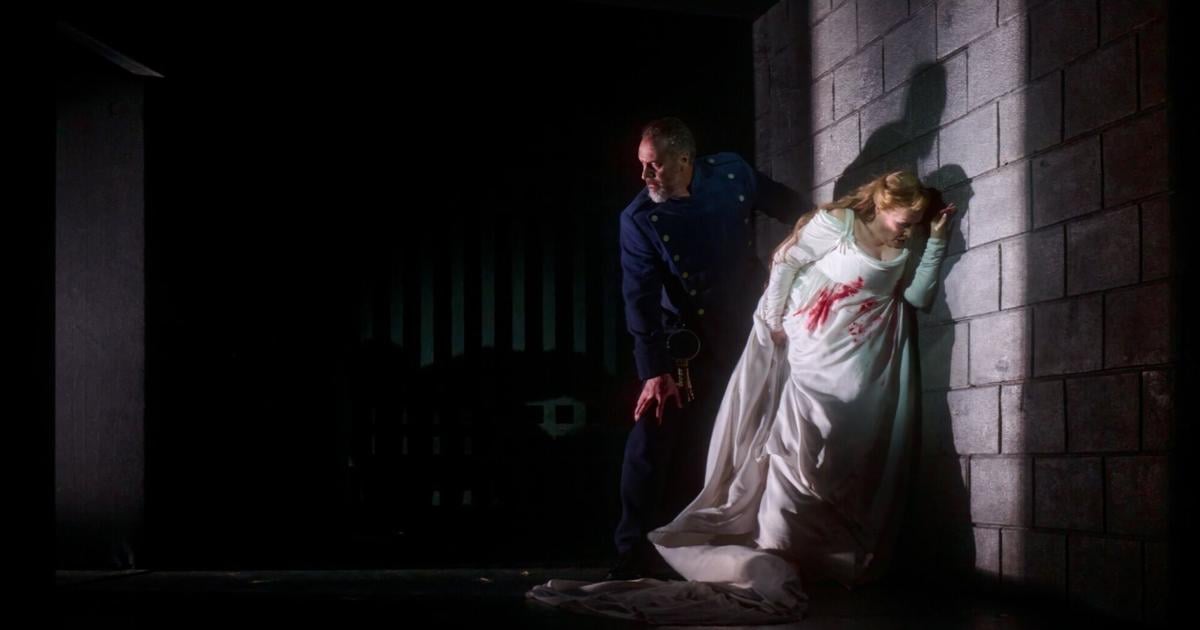
If you’re planning to attend the Canadian Opera Company’s (COC) latest revival of “Bluebeard’s Castle/Erwartung,” arrive early. There are new security measures in place at the Four Seasons Centre for the Performing Arts after a recent bomb threat led to the cancellation of several Shen Yun performances earlier this spring. And these measures are tighter than anything I’ve experienced outside of an airport.
Metal detectors line the entrance of the opera house. Police are stationed off to the side. Security guards check every bag and purse that comes through.
Lines snaked out the main doors on opening night. And even though the performance was delayed by 15 minutes to give people extra time to enter, it still looked like there were many stragglers who couldn’t make it in on time.
But you certainly don’t want to miss any part of this show. Returning to the COC for the first time since 2015, Canadian director Robert Lepage’s production remains a one-two knockout combo — a blink-and-you’ll-miss, doozy of a double bill, dripping with so much blood that it could give Nicole Scherzinger’s Norma Desmond a run for her money.
That Lepage’s staging still works as well as it does, even more than three decades after it premiered in 1993, is a testament to his ability to mine the richness of these modernist works, and mould them into a cohesive program.
What’s most intriguing about Lepage’s interpretation is how he intentionally revels in ambiguity. In “Bluebeard’s Castle,” it could be tempting to stick close to the original French folk tale. In that ur-text, Bluebeard is clearly the villain, a man who lures his wives back to his castle, before killing them off one by one.
Béla Bartók’s operatic adaptation, featuring a libretto by Béla Balázs, has always been far more ambiguous than the original. Is the real villain here Bluebeard (Christian Van Horn) or his newest wife, Judith (Karen Cargill, brilliant), who insists on prying open every door in her husband’s abode? Does the blood dripping down the walls of this castle belong to his former wives or to Bluebeard himself, a symbol of his torment and suffering? Bartók and Balázs let audiences answer these questions.
But Lepage’s production, remounted by revival director François Racine, injects further ambiguity into this story. Van Horn’s Bluebeard is at times ferocious but in other moments carries himself with childlike innocence. When he cries out to Judith, pleading with her to “love me,” it’s impossible not to doubt his sincerity.
It’s clear that Lepage isn’t interested in the dichotomies of good and evil, right and wrong, salvation and condemnation to the extent of the original material. Instead, he’s more concerned with presenting deeply flawed, psychologically tormented characters, slowly picked apart and eaten away from the inside out.
Similarly, in “Erwartung,” Lepage immediately turns Arnold Schoenberg’s monodrama on its head. Whereas the 30-minute piece, as written, follows a woman (Anna Gabler) who is searching for a man, only to find him dead in the forest, Lepage sets the entire show within a psych ward. A trio of actors — Jordan Gasparik, Mark Johnson and Noam Markus — play the woman’s shrink and a host of other characters who pop up in the woman’s hallucinations. All this destabilizes Schoenberg’s modernist masterpiece, turning the woman, right off the top, into an unreliable narrator with whom we simultaneously deeply sympathize.
Lepage fuses these two works together with a consistent visual esthetic. Michael Levine’s set is framed with a golden proscenium. Inside, that gold gives way to a drab, grey monotony, with a slanted stage floor and an angled concrete wall creating the illusion of a hallway that goes on forever. It’s a crucible of psychological torment, and the perfect setting for these two works.
In the pit, conductor Johannes Debus draws out an impressive sound from the COC orchestra — filled with taut harmonies and clashing dissonances, turbulent held notes from the strings butting up against the roiling brass. On stage, too, the music-making in this revival is exceptional. Van Horn’s bass-baritone has the sleazy richness of an impenetrable fog. He’s well paired with Cargill, a mezzo-soprano with a bright, agile tone.
Then, there’s Gabler, a formidable presence on stage with an unflagging, silvery instrument to match. She’s on stage and singing non-stop for all of 30 minutes. Come the curtain call on opening night, she made a cheeky gesture of relief, as if she were flicking sweat off her brow. But she made it look easy — when these two works are anything but.
Error! Sorry, there was an error processing your request.
There was a problem with the recaptcha. Please try again.
You may unsubscribe at any time. By signing up, you agree to our terms of use and privacy policy. This site is protected by reCAPTCHA and the Google privacy policy and terms of service apply.
Want more of the latest from us? Sign up for more at our newsletter page.

