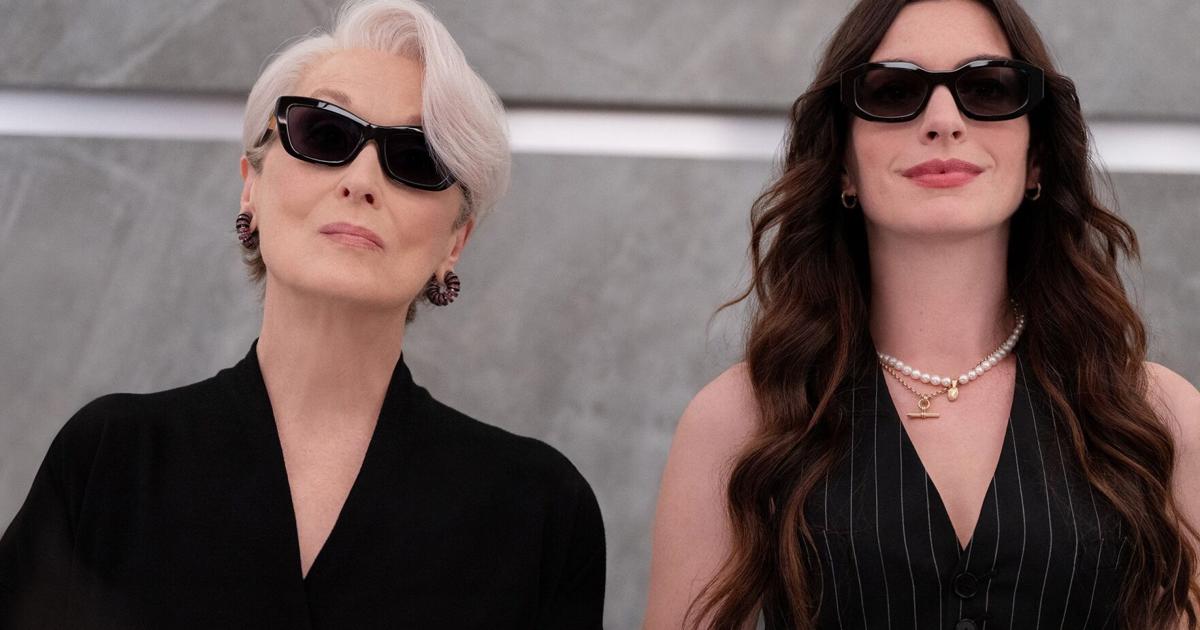
In “The Devil Wears Prada 2,” strutting into theatres May 1, Meryl Streep wears earrings from CVS. No, that’s not a gritty new downtown label — it’s the American drugstore known for selling Advil and laundry detergent. Apparently, it’s also where you find jewelry fit for an Oscar winner, or a fashion magazine editor-in-chief.
“Meryl came in the first day of her fittings and said, ‘Stop what you’re doing! I’ve found the perfect silver hoop … It’s from CVS,’” the film’s costume designer Molly Rogers told me in during a press junket in New York City in April. The instruction to the crew was immediate: “Don’t anybody lose it.”
In the 2006 original, Streep’s character Miranda Priestly’s hoops were kind of a big deal. Besides being beyond chic, they were a shorthand for her untouchable status at the fictional magazine “Runway.” They were timeless, expensive and — as Stanley Tucci’s Nigel warned us — reason enough to gird our loins. And while I love the mental image of Meryl Streep shopping in CVS, I can’t help but feel this costuming quirk encapsulates what the highly anticipated and marketed sequel gets wrong about the franchise: This should be “The Devil Wears Prada,” not The Devil Wears Primark.
Famously, the first movie is based on a 2003 novel by Vogue editor Anna Wintour’s former assistant Lauren Weisberger. A thinly veiled workplace revenge fantasy, it centred on Andy Sachs (Anne Hathaway) and her journey as an assistant to the imposing Miranda Priestly. For those in the industry, it was a smart and sharp examination of a glossy world with no sense of humour. For those outside of it, it was a frothy fantasy; a peek behind the Chanel tweed curtain and into an exclusive arena that until that point was as secretive as it was exclusionary.
Because of that, “Prada” isn’t just a movie — it’s a manifesto. Endlessly quotable and rewatchable, the film holds a special place in the cultural lexicon, especially for millennials. It became a call to arms for every disgruntled underling who had a terrible boss. It later evolved to represent unapologetic female ambition, as the decisive visionary Miranda came to be seen not as a villain, but a hero.
And thanks to the cerulean monologue (which to this day is one of the best distillations of the fashion system I’ve ever heard), it gave the industry legitimacy. The number of Gen Zs at the sequel’s press junket who said it inspired them to become journalists was staggering.
But a lot has changed in 20 years — and not just the price of Andy’s Chanel boots (which have nearly tripled). In 2026, magazines are flailing, competing with influencers for content, access and relevancy. We’ve seen a power reversal between advertisers and editorial; where brands once used to beg to be included in those glossy pages, publications are now fighting over scraps and offering up a buffet of coverage in the process.
For better or for worse, “Prada 2” reflects this reality. Returning director David Frankel reintroduces us to Andy, Miranda, Nigel and Emily (still a scene-stealing Emily Blunt, now an executive at Dior) as worker bees who’ve all been hit by the current media climate in their own different ways.
The story follows Miranda Priestly as she navigates this new terrain alongside cancel culture, nepo babies and the attention economy (if the digital metrics aren’t there, did you really even write a story?). These are truths I’m all too familiar with as a fashion editor, but it’s still depressing to see it play out onscreen. And that’s where the film loses some of its magic.
The movie does not shy away from the time gap; it embraces it. But interestingly, Rogers (who also worked on the first film as an assistant to Sex and the City costume legend Patricia Field) said it was “extremely important” to her that the film’s wardrobe feel timeless versus trendy. “When I watch the first one, I do not know what year it is and that’s what I hope to achieve in this movie — that we could all enjoy it 10 years from now and it would stand the test of time,” she said.
Rogers estimates that Streep has about 30 costume changes, while Hathaway has closer to 50. It shows: Seemingly every minute there’s a new montage of frocks, each more decadent than the last. Both actors were deeply involved; Rogers described Streep as “generous to a fault” with the time and energy she dedicated to all the fittings (hence the delight in finding the CVS earrings).
“It has to be collaborative,” Rogers said of the costuming process. “I would not feel as proud of the clothing if I had handed (the actors) things and said, ‘You’re wearing this.’ No, it’s a give and take. And when Meryl makes a comment about something, you’re going to listen.”
Hathaway has said that for the sequel, she and Rogers developed a backstory where Andy — older and wiser from her time at “Runway” — has curated a wardrobe of designer pieces found in consignment shops during her travels.
Rogers’ deck of inspiration images for the director described Andy’s style as “feminine menswear.” The inspiration for this came from Patricia Field, who saw Hathaway’s Andy as an “Annie Hall”-type. This manifests in the sequel as something I am calling “newsroom-core,” complete with waistcoats, ties and pinstripes.
Streep’s costumes are less on the nose and show surprising sartorial range. The exquisite tailoring, sophisticated jewels and crisp button-downs remain, but now we’re also treated to seeing Miranda in sparkles, sequins and the Dries Van Noten tassel jacket, a wink to all the fashion disciples who went gaga when it first appeared on the brand’s Fall 2025 runway.
The marketing is a little less sophisticated. Unless you’ve been trapped in a Louboutin box, there’s been no escaping the relentless press tour currently sweeping the globe that has seen the leads gracing every major cover and red carpet from London to Tokyo, plus a massive merchandising blitz. The iconic red stiletto is suddenly everywhere — on Amazon mugs, Old Navy tees and even a Tweezerman eyelash curler. Brands are tripping over themselves to be part of the moment, and with the Disney machine now running the show, “That’s all” isn’t in the vocabulary.
Call it the “Barbie” effect. Few films have reached the cultural phenomenon status of Greta Gerwig’s 2023 hit that saw audiences, mostly women, flocking to theatres in head-to-toe fuchsia and creating a literal worldwide shortage of pink paint. It was a masterclass in community-driven marketing, and it’s no surprise that Disney has attempted to copy-paste the strategy in hopes of a cerulean drought.
The trouble is, “Prada” and “Barbie” are not the same. Where “Barbie” is coded with friendship, nostalgic girlhood and hope, “Prada” is built on elitism. It’s rooted in that iconic Miranda dismissal: “Everybody wants this. Everybody wants to be us,” with the silent, pointed addendum: But not everybody can be.
The movie and the world it invites us into is unapologetically luxurious and snobby, problematic and strictly for the privileged. If we were true to the source material, we wouldn’t be wearing cerulean tops to the cinema. We’d be in the front row with razor-sharp bobs to match our razor-sharp tongues, wearing Gucci sunglasses in the dark and refusing to speak to anyone. The mass marketing misses what made the original so compelling. It may be selling the film — but it’s also cheapening the brand.
Ultimately, perhaps, those CVS earrings are the most honest thing about “Prada 2.” If the 2006 movie was about the untouchable high-fashion fantasy, the sequel is about the savvy required to keep that dream alive in the digital age. It’s a reflection of a world where the Chanel tweed curtain has been pulled back, and we’re all — Miranda included — learning to navigate the unglamorous realities of a career in fashion in 2026.
For that reason, it’s unlikely this sequel will pierce the zeitgeist like its predecessor, though it will certainly make a boatload of money. (It’s predicted to earn over $175 million USD globally in its first weekend alone.) Now that the devil shops at the drugstore, the mystery is gone — but the branded mug, T-shirt and tweezer business is booming. It’s not the dream we were sold 20 years ago, but it’s the one we’ve got.
That’s all.