

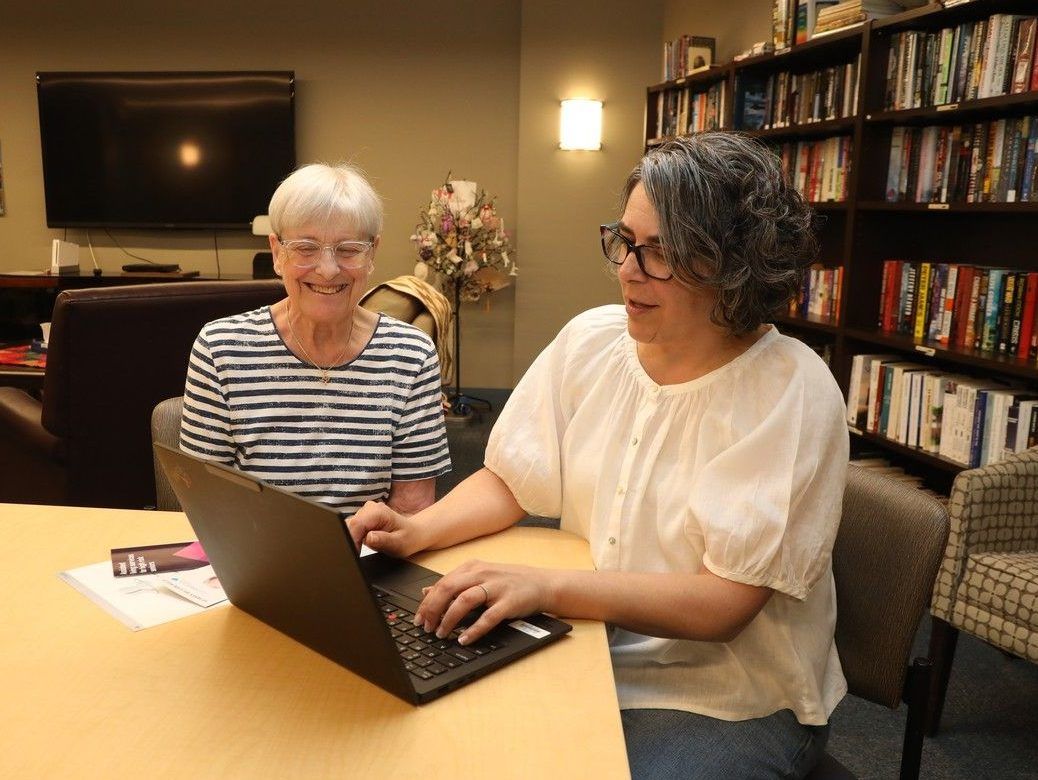
Researcher Suzanne Dupuis-Blanchard had a lightbulb moment when she began looking into why older adults often struggle to remain in their homes.
Surprisingly, it had nothing to do with the medical side of aging. The director of the Centre for Aging Research at the University of Moncton and her team kept hearing from older adults that it was smaller issues, mainly social, that would force them to relocate — the need for healthy meals, social connections and transportation, the struggle to open a jar, to name a few.
“It really made us think that we were looking at this all wrong,” she said. “(Their reasons for relocating) were never for anything medical. It was always sort of what we call the grey zone, often things we take for granted, but after a certain age they become vital to deciding whether you are going to stay at home or not.”
In occurred to Dupuis-Blanchard that many communities already had services in place that might help people stay in their homes – and often those services were associated with nursing homes.
“What if nursing homes could do something about aging in place?” she began asking.
The result of her research is Nursing Home Without Walls — a program developed in New Brunswick that is now expanding across the country. Ottawa is poised to become one of the first communities in Ontario to pilot the program, based at Perley Health.
AdvantAge Ontario, the provincial association that represents hundreds of not-for-profit, charitable and municipal long-term care homes, is leading the Ontario pilot projects at Perley and two long-term care homes elsewhere in the province.
Like many long-term care homes, the waiting list to get a bed at Perley Health is long. At times there have been up to 1,200 people waiting for one of the home’s 450 beds. Even so, Perley is aiming to double the number of people it serves by 2035 by offering services to those living in the community. The Nursing Home Without Walls program is key to achieving that goal.
The program will expand on what Perley is already doing to become a hub for older adults living in the community, said Tanya Mac Donald, director of senior living and community programs at Perley Health.
“The sole focus is to support people to age at home or in place. This is a more upstream program focused on health promotion and wellness,” she said.
The program will also help seniors navigate supports that already exist in the community such as meals on wheels, health and fitness programs, or transportation.
Nursing Home Without Walls has been expanding in New Brunswick since federal funding helped set up a pilot project there in 2019. There are now 36 programs in the province and the program is expanding to other parts of the country.
Each program is slightly different, said Dupuis-Blanchard, depending on local needs and existing services. Some Nursing Home Without Walls programs offer health promotion services to seniors living at home. Others offer visits including for home maintenance or to help arrange meals. At least one program brings seniors living in their homes into the nursing home for bathing, foot care and other personal hygiene, things that might be difficult for them to do on their own.
“They refer to it as going to the spa,” said Dupuis-Blanchard.
She and her team are beginning to look at the impact of the program and are seeing positive results – including helping people to stay longer in their homes.
“We have seen people say it will allow them to age at home, it has an impact on reducing social isolation and loneliness and they feel more connected and engaged,” said Dupuis-Blanchard.
A key finding is that even people who will end up in long-term care were able to remain in their homes until then because of the program. That should help reduce the number of people who end up in hospital as ALC, or alternate level of care, patients waiting for more appropriate care. That can make a huge difference in their physical condition and quality of life, she said.
It could also take some pressure off hospitals. Reducing ALC patients in hospitals can improve emergency department wait times and hospital crowding. As of late December, there were more than 4,500 ALC patients in Ontario hospitals.
Lisa Levin, CEO of AdvantAge Ontario said Nursing Home Without Walls helps solve some existing problems.
“We have an aging population which is rapidly growing and we have limited resources available in the community for people. Because of that, people are going to emergency departments when they don’t have to, or others become socially isolated. It creates physical and mental health issues.”
She noted that other programs exist to help older adults remain in their own homes. That includes home care, which the Ontario government is expanding with a recent $1.1 billion investment. But services available in the community are often fragmented and difficult to access which can lead to avoidable trips to emergency departments.
Nursing Home Without Walls represents a shift from reactive care to a more proactive, integrated model, said AdvantAge Ontario – one that is evidence-based and will help more people stay home longer which reducing avoidable hospitalizations and delaying long-term care admissions.
Perley Health is still getting the program up and running. It has developed a website where people can go with questions and is in the process of hiring a program coordinator, said Mac Donald.
She previously worked with Healthcare Excellence Canada, the not-for-profit agency that is funding the rollout across Canada (along with the Canadian charity The Waltons Trust). Through that connection, Mac Donald saw examples of how the program worked for individuals in New Brunswick.
In many cases, people were encouraged to go to nearby nursing homes to participate in activities there. In one case, a recent widower who had never cooked for himself went for cooking lessons, which helped him to remain in his home.
For Dupuis-Blanchard, an academic who is a nurse by training, seeing the program take off across Canada has been a dream.
“This simple idea has had the impact we were hoping for. I am so thrilled.”
Related
- OCDSB enrolment projected to drop, Catholic board predicts increase
- Candidates and hot-button issues: A 2026 municipal election primer
Our website is your destination for up-to-the-minute news, so make sure to bookmark our homepage and sign up for our newsletters so we can keep you informed.

