

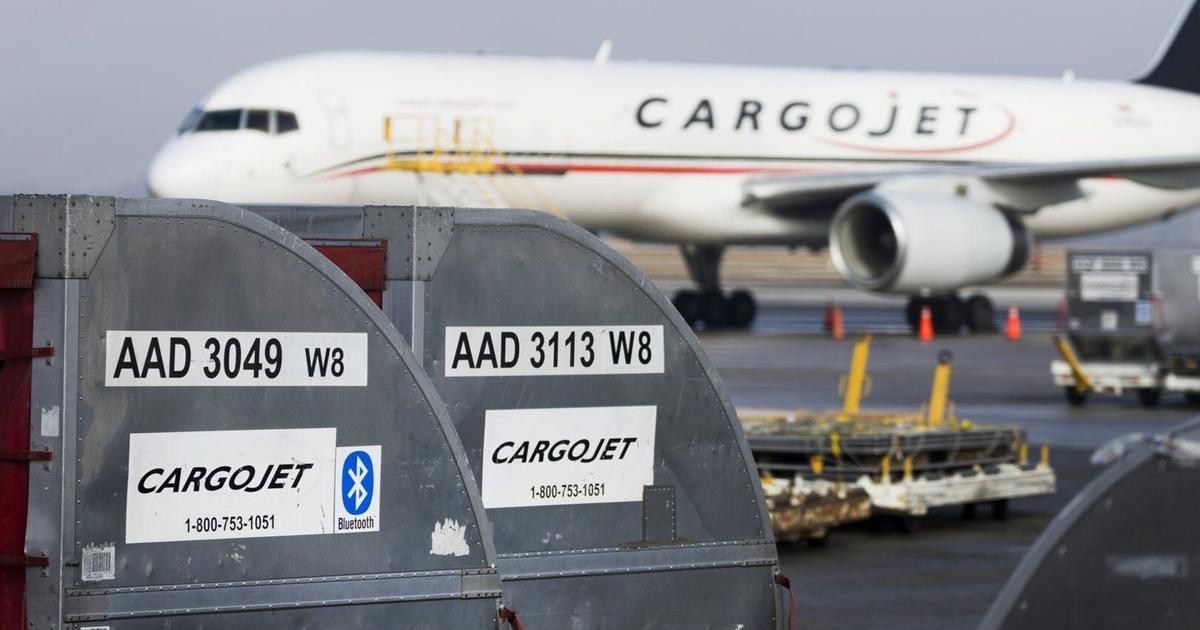
Cargojet Inc.‘s top executive says its mitigation strategies are helping to insulate the company from the effects of higher jet fuel prices.
Pauline Dhillon, CEO of Cargojet, said on the company’s first-quarter earnings call Tuesday that the period saw significant global disruption with the war in Iran reducing global air cargo capacity and affecting key hubs across the Middle East.
“At the same time, disruptions to oil supply routes drove a sharp increase in fuel prices, with volatility remaining elevated and visibility limited. Fuel prices have increased materially during the quarter,” she said.
“Importantly, we have a well-established fuel surcharge mechanism in place. While there is a small time lag, this structure allows us to recover these increases and remain generally cost-neutral. This is a critical advantage in managing through periods of volatility.”
The high jet fuel prices caused by the effective closure of the Strait of Hormuz following the U.S.-Israeli attack on Iran in late February have weighed on the aviation industry.
On Saturday, U.S.-based Spirit Airlines announced it was shutting down immediately in the face of soaring oil prices. Last week, Air Canada suspended its guidance for the year amid volatile jet fuel prices and an uncertain outlook for those costs in the latter half of the year.
Going forward, Dhillon said the global trade and geopolitical environments remain unstable.
RBC analyst James McGarragle said in a note on Tuesday that Cargojet’s most recent results were positive.
“We see the results as impressive especially within the context of global trade uncertainty that continues to pressure ACMI (aircraft, crew maintenance and insurance) results,” the note reads.
Earlier Monday, Cargojet reported net earnings of $4.1 million during the first quarter, down from $48 million last year. That amounted to diluted earnings per share of 27 cents during the quarter, down from $2.87 a year earlier.
Cargojet said the decline in net earnings was due to several factors, including a decline in gross margin of $12.4 million and higher expenses.
Cargojet says its revenue reached $254.7 million during the period, rising year-over-year from $249.9 million.
The company said its domestic revenue remained flat year-over-year and was a bright spot during the quarter.
“Our core domestic overnight network delivered a strong and stable performance, with revenues in line with the first quarter of last year, despite an unusually strong comparison driven by tariff-related demand pulled forward in early 2025. Matching that elevated level reinforces the strength and the resilience of our domestic franchise,” Dhillon said.
Aaron McKay, Cargojet’s chief financial officer, said the company’s domestic network revenues benefited from growing e-commerce demand in Canada and generated $104.8 million in the first quarter.
Dhillon said April is trending to be another strong month.
“I think that you’re going to continue to see e-commerce growth in this country. Canada lagged the rest of the world when it came to e-commerce, and while you do see increasing fuel prices and maybe consumers moving away from restaurants or travel, the shift has come to buying patterns, where consumers are now buying online. Shopping has changed,” Dhillon said.
“We don’t anticipate, nor have we seen, any slowdown in domestic overnight consumer demand.”
Cargojet’s business hinges on air delivery of e-commerce goods on its fleet of 41 planes.
This report by The Canadian Press was first published May 5, 2026.
Companies in this story: (TSX:CJT, TSX:AC)

