Canadian director Alain Gauthier, it seems, has a bone to pick with serial modernizers — that is, those directors whose first instinct is to stage every classic work they touch in modern dress.
As Gauthier writes in the program for his new revival of Jules Massenet’s “Werther,” returning to the Canadian Opera Company (COC) for the first time in more than three decades in a major co-production with Opéra de Montréal and Vancouver Opera:
Nowadays, the attempts to ‘modernize’ lyric repertoire works has become almost a reflex … The classics do not need to be ‘modernized’ to speak to the present. Their power lies in their universality. Our task is not to translate them at all costs into our modern-day language, but to create the stage conditions that will allow this timeless voice to resonate, here and now, in all its depth.
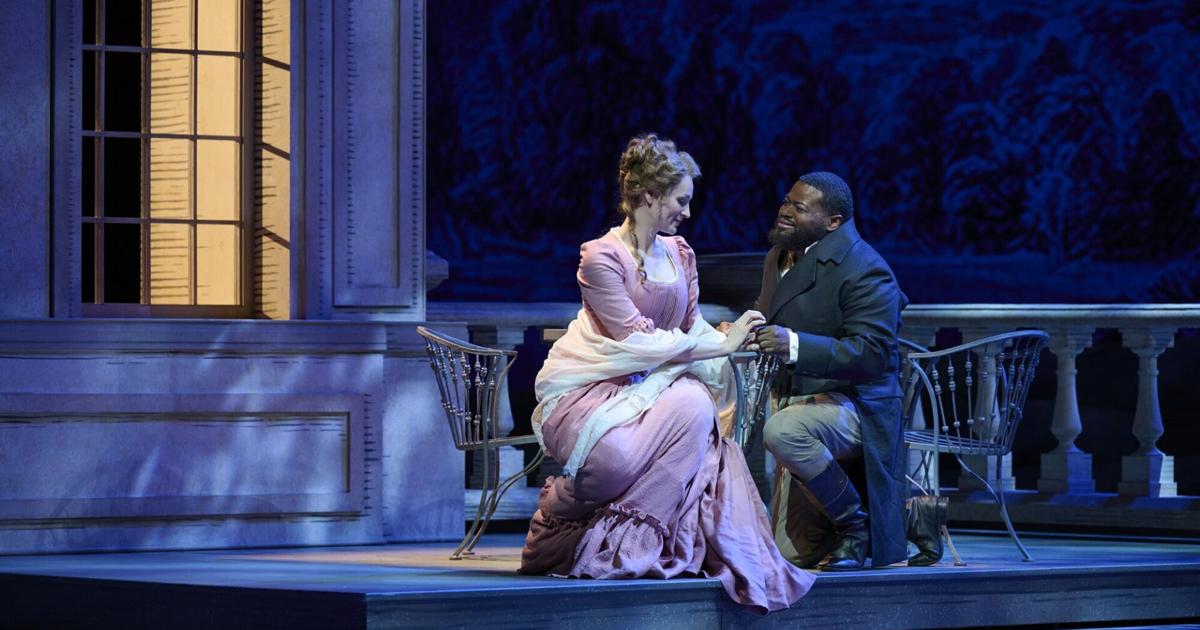
In the often mind-your-manners world of opera, those are some fighting words, if I have ever read them. No surprise then that Gauthier’s new revival is set squarely in the late 18th century, with frock coats and pastel-coloured gowns. (The costumes are designed by Lëilah Dufour Forget.) That, of course, is when Johann Wolfgang von Goethe’s epistolary story “The Sorrows of Young Werther,” from which this opera draws its inspiration, takes place.
However, Gauthier’s production ultimately falls into the same trap as those modern-dress revivals which he lambasts. Whereas some directors modernize a classic work just for the sake of it, as a rejection of a more traditional interpretation, this staging feels, in my eyes, much the same: a period piece just for the sake of it, meant simply as a rebuke of the modern-dress productions that have become so ubiquitous.
Yet doing something merely as a rejection of something else is rarely a good idea. Opera is a living, breathing, ever-evolving art form. And staging a work in its original setting should not be an automatic reflex, just like placing a piece in modern dress shouldn’t be the default either.
Every staging demands a clear directorial vision, and just because a production is set in its original period doesn’t relieve a director of having to answer the question about why the work needs to be placed in this particular setting.
With his “Werther,” Gauthier never justifies his setting. In fact, this baffling revival demonstrates a loose grasp of the material itself.
Olivier Landreville’s set lacks a cohesive esthetic, resembling a hodgepodge of elements hastily pulled together. A two-dimensional tree branch that hangs from above looks borrowed from a production of “Norma” — if it were directed by Tim Burton. (Its only function is to show the passage of time.) A black-and-white backdrop featuring a church in the foreground (nodding to the fact that the world of “Werther” is a society guided by strict moral rules) looks ripped from the pages of a Charles Dickens novel. And isn’t that the terrace from the latest touring production of “The Sound of Music” that recently swung through town?
What’s most lacking in this production, particularly in its first half, is any sense of passion, even though “Werther,” as written, is a heavy-handed melodrama, oozing passion in every breath. Massenet’s music, especially the orchestrations, is sensuous, filled with emotional, lyrical swells in the strings and boisterous lines in the brass. (The COC orchestra, led by music director Johannes Debus, delivers a supple, perfectly balanced sound.)
At the centre of it all is a story of unrequited love: its title character (tenor Russell Thomas) falls deeply for Charlotte (soprano Victoria Karkacheva) and is met with nothing but frostiness. This tale’s tragedy lies in the fact that Charlotte always did love Werther but could never return his feelings because she felt duty-bound to her fiancé, Albert (Gordon Bintner).
The success of “Werther” ultimately hinges on how its first two acts are staged. The audience must believe in both Werther and Charlotte.
In this production, Gauthier stages many of their early scenes as if they’re intended for an audience of uncorrupted preschoolers. There is no spark between the two. There is no chemistry. The most physical contact they’re afforded is when Werther’s pinky briefly brushes Charlotte’s hand. So, that Werther’s love for Charlotte feels unbelievable here makes it all the more difficult for us to follow their journey in the latter stages of the opera.
Some could give Gauthier the benefit of the doubt. You could argue that he chose to stage those scenes so mildly because he wanted to stay true to the moral sensibilities of the late 18th century. But Massenet’s “Werther,” which premiered in 1892, was never a work that trafficked in realism, instead favouring schmaltzy sentimentality. (I mean — spoiler — you have a character who literally shoots himself in the chest and then manages to sing his face off for an entire act. Even by operatic standards, that feels like a bit much.)
Thankfully, this cast somewhat manages to elevate some of Gauthier’s staging. Thomas and Karkacheva blossom brilliantly after intermission — their duets brimming with full-throttled intensity. On opening night, the Russian soprano demonstrated effortless breath control, even if she occasionally swallowed some consonants. Thomas, meanwhile, conveys all the angst, pain and anger of Werther’s character, his instrument gliding so seamlessly between head and chest voices.
Bintner, the always impressive Canadian bass-baritone, rightfully avoids turning Albert into an archetypal villain, which could be easy to do in this operatic adaptation, which, unlike Goethe’s original story, glosses over Werther’s long friendship with both Albert and his fiancée. His voice is lithe without ever compromising depth and is augmented by beautiful phrasing. As Charlotte’s sister Simone, Canadian soprano Simone Osborne is luminous — sweet and youthful though never cloying. And as their father, the Bailiff, Le Bailli, lends stern authority to the role of the grieving widower.
But this casting aside, Gauthier’s long-awaited production rarely lives up to the material’s potential. And if Gauthier’s goal was “to create the stage conditions that will allow this timeless voice to resonate,” he never quite achieves that. Instead, what we’re left with is a disappointing end to an otherwise strong COC season.
Error! Sorry, there was an error processing your request.
There was a problem with the recaptcha. Please try again.
You may unsubscribe at any time. By signing up, you agree to our terms of use and privacy policy. This site is protected by reCAPTCHA and the Google privacy policy and terms of service apply.
Want more of the latest from us? Sign up for more at our newsletter page.