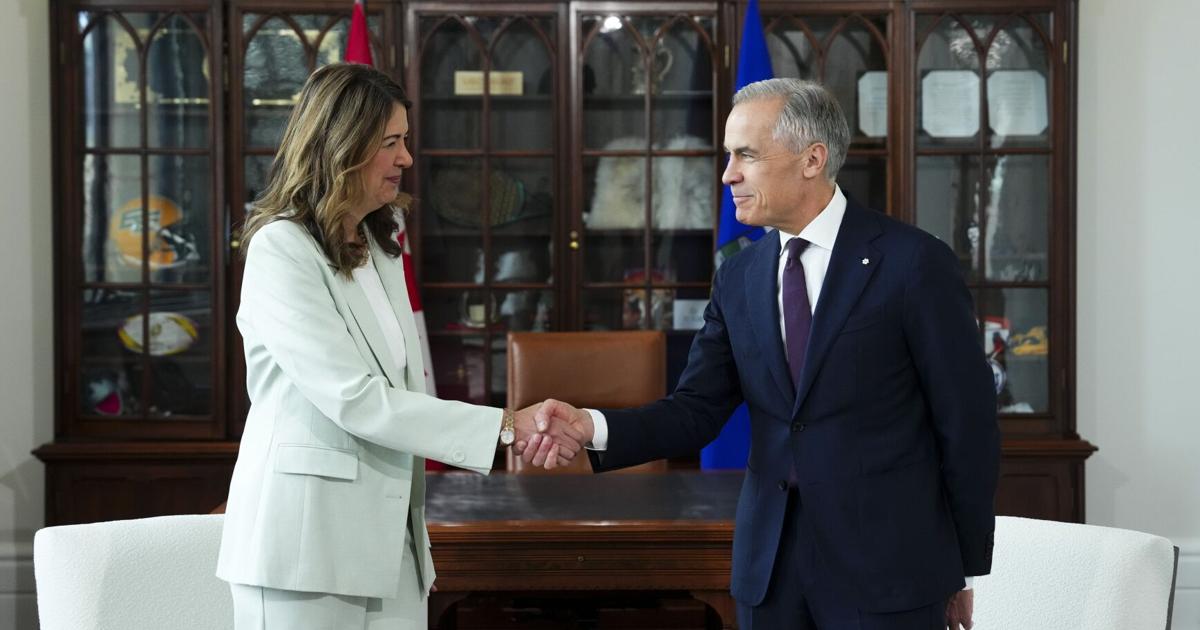
OTTAWA — The federal government and Alberta will try to clear the way for construction of a major new oil pipeline to the Pacific coast by September 2027, as part of a new deal that showcases Prime Minister Mark Carney’s softer approach to fossil fuel emissions in a bid to boost economic development.
Friday’s “implementation deal” follows the memorandum of understanding signed last November that scrapped, suspended and watered down major national climate policies created under Carney’s predecessor, Justin Trudeau.
Updating that accord, Friday’s deal spells out how Edmonton and Ottawa intend to work together to increase fossil fuel production and get Premier Danielle Smith’s desired million-barrel-per-day pipeline built through British Columbia, with fast-tracked approval under Carney’s controversial major projects regime.
Environmentalists panned the deal, with the think tank the Canadian Climate Institute declaring the country’s climate targets under the international Paris Agreement — as well as its goal of “net zero” greenhouse gas pollution by 2050 — will now be “firmly out of reach.”
Speaking to reporters after a signing ceremony with Smith in Calgary on Friday, Carney said the deal would lead to emissions reductions even with expanded production of oil for a new pipeline, and described the plan as “climate action” combined with “energy security.”
“This is Alberta and Canada coming together,” Carney said.
Julie Dabrusin, the federal environment minister, told the Star on Friday that the government is still “committed to those Paris targets as stressed how the focus is on actions like methane regulations and building electricity capacity and making sure policies like the industrial carbon price actually work and reduce emissions.
“We’re continuing to take real action rather than having plans on paper,” she said.
The deal sets Sept. 1, 2027 as the target date to start construction, and reveals the Carney government intends to rapidly approve the project under its Building Canada Act by designating it as a “national interest” development by October. Officials who briefed journalists about the deal Friday morning said oil could possibly start flowing, if all proceeds as planned, in 2033 or 2034.
Alberta, which remains the proponent while efforts continue to get the private sector involved in the project, plans to submit its official pipeline proposal for consideration before Canada Day.
And while Carney has repeatedly stressed that his government won’t support the pipeline unless a group of major oilsands companies builds their long-discussed “Pathways” carbon capture project, Friday’s deal includes no time frame for when that development would need to start construction. Instead, it outlines how Pathways would need to result in annual emissions reductions of six megatonnes from the sector by 2035, and another 10 megatonnes per year by 2045.
That’s much less than the 22 million tonnes of annual emissions reductions previously contemplated by 2030.
At her own news conference, Smith billed the deal as a win for her United Conservative government, claiming Ottawa’s agreement to weaken the federal industrial carbon price will save companies in her province $250 billion in “compliance costs” by 2050.
That marks a significant departure from a major plank in the previous Liberal administration’s plans to slash Canada’s greenhouse gas pollution, which Alberta, federal Conservatives and fossil fuel businesses had long blamed for constricting investment and hampering economic growth.
Smith also argued those policies helped fuel the separatist movement in her province, as she pledges to go to court to help preserve the chance of activists staging an independence referendum.
“We’re trying to win people back, decision by decision, to understanding that the country can work,” said Smith, who argues for a “sovereign Alberta” within the Canadian federation.
“This is a good day for us to have done that. It’s a good day for Alberta, and it’s a good day for Canada.”
The industrial carbon price was originally designed to crank up the cost for emissions from oil extraction and big factories from $110 per tonne this year to $170 per tonne in 2030.
Last fall, however, Alberta and Ottawa agreed to redesign the industrial pricing system after regulatory changes in the province helped drive the “effective price” down, in some cases to below $20 per tonne in recent months.
Now the two governments have agreed to give Alberta a longer runway to increase its industrial carbon price from a minimum of $60 per tonne in 2030 to $110 per tonne in 2040.
The goal is to ensure the actual “effective price” hits $130 per tonne that year, officials explained Friday, through methods like design changes in the provincial system.
Carney later confirmed that other provinces can adopt the new industrial carbon pricing levels too, with consultations to begin to ensure “consistency” across Canada.
Alberta and Canada also agreed to each put up $600 million over 10 years for “contracts for difference” — agreements to pay out companies that invest in ways to reduce emissions if the actual industrial carbon price doesn’t go up as high as its supposed to.
For example, if a company spends money assuming the price will be $130 per tonne in 2040, but it’s only at the floor price of $110 per tonne, the governments will pay them out for the difference in those two prices, government officials explained Friday.
Another change in the deal is that the “stringency” of the industrial carbon price for oilsands operations — the level at which an operation’s emissions are subject to the tax — is going to increase at a slower rate.
Before the deal, large oilsands operations were facing annual increases of four per cent stringency by 2029-30, officials explained. Under the new deal, the stringency will go up two per cent per year between 2027 and 2030, and one per cent per year until 2040 if the Pathways carbon capture project goes ahead.
Taken together, the changes are the latest in a series of decisions by the Carney government to remove or soften major climate policies at the federal level.
Last year, the government scrapped a planned emissions cap for the oil and gas sector, and cancelled the national consumer carbon tax-and-rebate scheme. It also ditched plans for mandated sales of zero-emission vehicles, and signalled it will change national electricity regulations to allow for more gas-fired power plants.
Error! Sorry, there was an error processing your request.
There was a problem with the recaptcha. Please try again.
You may unsubscribe at any time. By signing up, you agree to our terms of use and privacy policy. This site is protected by reCAPTCHA and the Google privacy policy and terms of service apply.
Want more of the latest from us? Sign up for more at our newsletter page.