

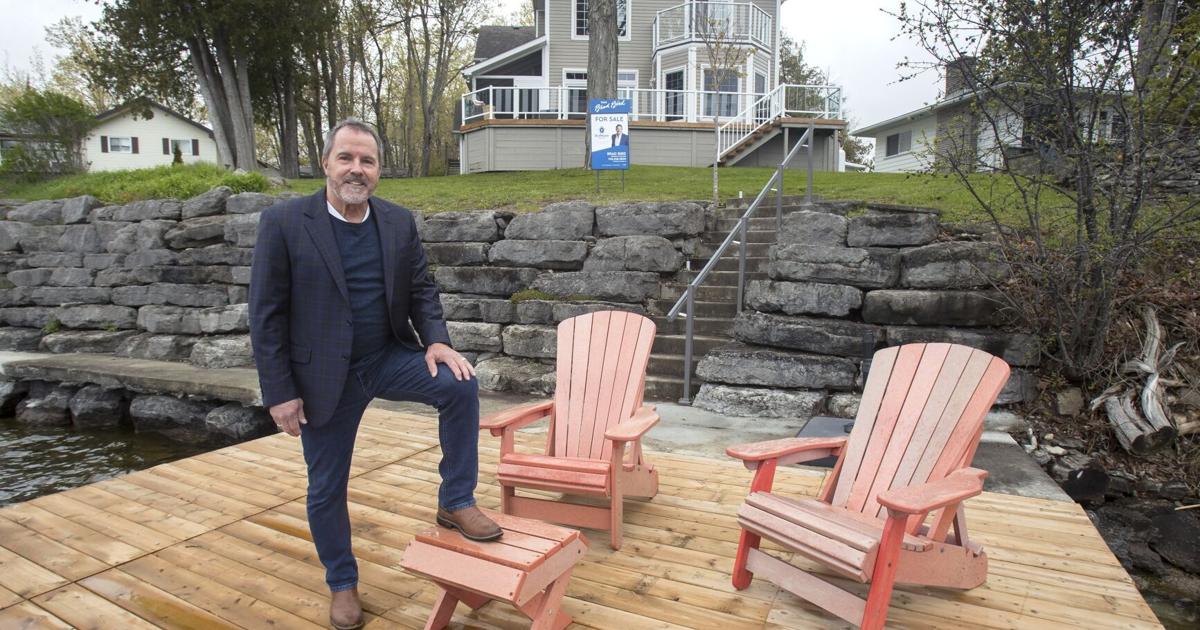
Over the May long weekend, veteran realtor Brad Bird is showing 10 waterfront properties in the Kawartha Lakes to an American on the hunt for a cottage.
The buyer, who is from the Atlanta, Ga. area, told Bird she’s being drawn north to spend more time with family in Ontario, and the strong U.S. dollar makes buying here an economically savvy decision.
She’s been preapproved for a mortgage and is looking for a property in the $800,000 to $900,000 range.
“She’s definitely a serious buyer,” said Bird, who has almost 40 years of real estate practice under his belt. “Over the last year we’ve been getting more calls from people in the U.S. looking to buy.”
While Americans have long been invested in Canada’s cottage country, recent political upheaval since U.S. President Donald Trump’s second presidential term began, combined with a weak Canadian dollar, has led to increased interest in Ontario’s sought-after major scenic lakes and idyllic cottages.
So far, the spring market in Ontario’s cottage country has been quiet or what one realtor called a “grinding market.” That’s where some demand is returning but excess supply is leading to a “low saturation rate,” said John Fincham, broker at RE/MAX Parry Sound Muskoka Realty.
While there’s hope prices for the recreational market are near the bottom, the economic uncertainty from trade tension with the U.S. and rising oil prices from the Iran war are continuing to hold buyers back, he added.
But even in the quiet spring market, around 25 per cent of real estate experts in Ontario reported an increase in the number of American buyers inquiring about cottages in their area over the last year, according to March report by Royal LePage.
While Canada introduced a ban on foreign homebuyers to combat housing supply and price challenges, most recreational properties are exempt from the ban, helping to sustain international demand in these regions.
“We’ve always had interest from U.S. buyers because of our nice, clean lakes, the fishing and the scenery, but I noticed in the last year we’ve gotten more calls from people in the U.S. from all the commotion down there,” Bird said.
“And we try to promote our listings for U.S. buyers as well.”
Noticeable traction from American buyers
Bird will also be showing some properties to Americans in June.
“Two buyers are looking at cottages and another one is looking at what he’s calling a summer house, and he’s a big golfer. They get more of everything for the dollar,” Bird said.
While it’s unlikely interest from American buyers will impact the market in a significant way, the trend is worth noting in a soft market.
Jessica Fay, broker with Royal LePage Team Realty who services the Ottawa Valley, said she’s seen a 20 per cent increase in calls from Americans since Trump was elected.
“The strong U.S. dollar is going to continue to influence savvy inventors to purchase cottage properties in Ontario,” she said, adding that most inquiries are for waterfront properties.
“We did see quite a few waterfront sales last year, and I mean, our average sale price for those came in at $662,000 so when you convert that to U.S. dollars, it’s a significant difference.”
At Friday’s exchange rate — which had the loonie trading at 0.728 USD — that would translate to around $481,500 USD.
The rise in calls from Americans was noteworthy to broker Jeff Bauer, who said interest from U.S. buyers died down during the pandemic and a few years prior as recreational property prices skyrocketed. But now that prices have dropped, Ontario’s pristine lakes and natural beauty are once again attractive holiday investments.
Bauer, owner of Royal LePage Heartland Realty, which services Huron and Perth County areas, noticed that after the U.S. presidential election in 2024, the inauguration, and again after the ICE shootings in Minnesota, there were upticks in calls.
“I think it was a lot of fear and maybe just worry about safety prompting those calls and looking at Canada as a viable option,” he said.
The buyer-seller price gap
Fincham said that in the first quarter of 2025, waterfront properties in Muskoka sat on the market for 63 days on average and shot up to 95 days in the first quarter of 2026. And average months of inventory (the time it would take to sell inventory based on current demand) rose from 14.4 months to 17.5 months — a balanced market is closer to five or six months, he said.
There are a number of factors at play, Fincham said, because while “demand is coming back” and his phone has been ringing more this year compared to last, the number of listings are 50 per cent above historic averages and the spread between seller’s expectations and what buyers will realistically pay also impacts sales.
“Sellers are testing the market, then taking their properties off the market and relisting at a lower price,” he said. “They’re trying to find that equilibrium.”
Around one-third of Ontario waterfront properties are still overpriced, Fincham added, but the rest are priced to the current market.
Jack Janssen, founder of The Janssen Group, a multi-service real-estate team serving Muskoka and Ontario’s cottage country, said he works specifically in Lake Rosseau, Lake Joseph, Lake Muskoka and the perimeter lakes that are the hub of the “more expensive area of cottage country,” he said.
But it’s too early in the market to see how well, or not, those areas are performing, he added.
This year, there’s high water levels in the region following higher-than-expected spring snowmelt and recent rainfall delaying any momentum in the market.
For the high-end properties, there are also many deals done exclusively and not listed on the Multiple Listing Service (MLS), Janssen said.
For example, amid last year’s recorded low sales, there were 17 private sales over $10 million, which was a record around the big lakes such as Lake Rosseau and Lake Joseph, indicating that the MLS doesn’t capture the full picture of sales activity, he added.
The lower priced properties will likely experience some minor price erosion this year, Fincham said.
“I think you’ll see a small amount of price erosion on the sub-$3 million properties, but not a lot. I think we’re close to that floor but properties over $3 million, and certainly over $5 million, will hold very well,” he said, adding those buyers are more immune to economic volatility and interest rates.
Since the 2022 price peak, the small lakes, which are classified as “tier two lakes,” have seen a price drop of roughly 25 per cent, but the “tier one lakes” such as Lake Muskoka have remained relatively stable.
“People still want cottages but have been reluctant because of the price, which ran up drastically during the pandemic, and the economic uncertainty,” he said.
While U.S. instability is driving Americans north, local demand is still hampered and it won’t improve until there’s economic and geopolitical stability.
“The shadow (economic instability) casts on buyer sentiment can’t be ignored,” Fincham said.
“Cottages are a discretionary purchase. If you don’t know with a degree of certainty that you’ll have a job next year you’re not going to spend $1 million on a cottage. Once that sorts itself out, we’ll see that compressed demand jump.”

