

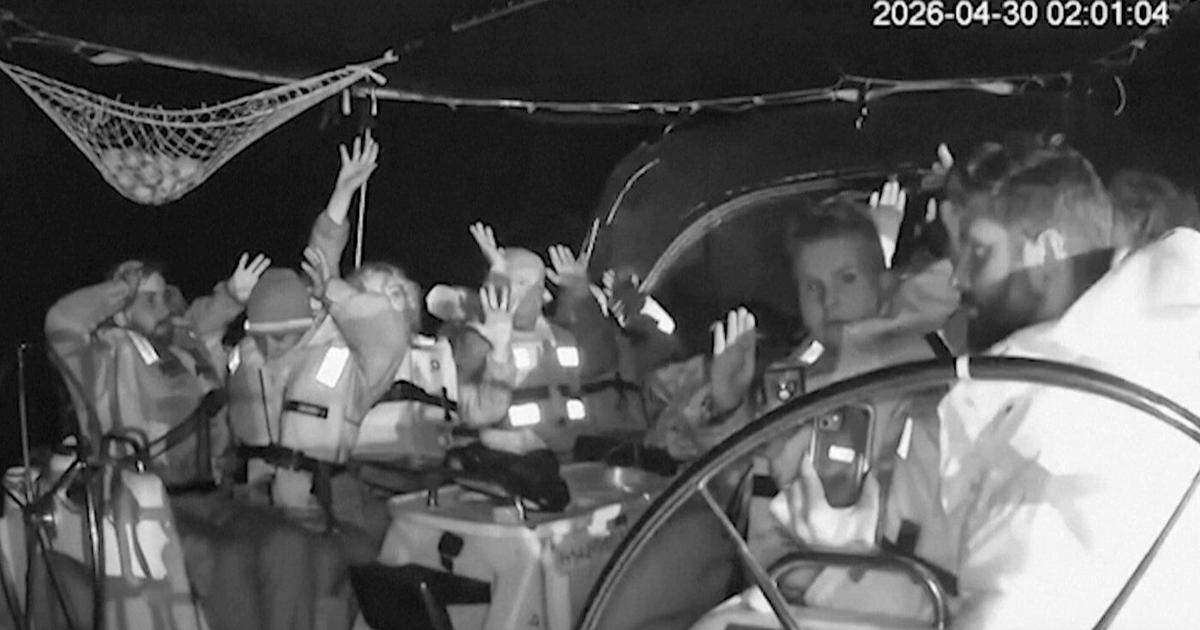
As an unmarked speedboat approached the ship that had been her home for two weeks, Luiza Ravalli heard a voice over a loudspeaker issue an ominous command: “Turn back or you’ll be boarded.”
Ravalli, a primary care nurse from the Greater Toronto Area, and her crewmates were ferrying supplies including diapers, menstrual care products and bottled water as part of a flotilla attempting to break Israel’s naval blockade of Gaza. They made no move to alter course, she said.
The nurse heard three shots ring out in their direction, followed by a fourth that hit the metal hull of their boat, inches from her ribs and the crewmate next to her, she said.
“We put our heads down just out of instinct. But I remember when I had my head down like this, I just looked up slightly and there were sniper dots right there above our head,” she said in an interview after her return to Canada.
Ravalli and two other Canadians who took part in the flotilla recalled a night navigating pitch black Mediterranean waters, culminating in a violent interception by Israeli forces off the coast of the Greek island of Crete.
Two of them were detained and brought aboard an Israeli ship, where they said they were dragged and assaulted by Israeli soldiers and made to sleep on a floor that was flooded at night. They also witnessed others get beaten, they said.
The three activists spoke to The Canadian Press days before another interception off the coast of Cyprus that flotilla organizers said led to the detention of 11 Canadians.
Global Sumud Canada, the Canadian chapter of the Global Sumud Flotilla movement, said Monday that only one Canadian activist remained on the mission after the latest Israeli action. There were initially 12 Canadians among roughly 500 activists on the 54 boats that set sail from Turkey last week, it said.
The group said Tuesday it had lost contact with the detained Canadians and could not provide an update on their situation.
In an emailed statement Tuesday, Global Affairs Canada said it is tracking developments related to the flotilla. The department said it is aware Canadians are participating in both the Global Sumud Flotilla and the Freedom Flotilla Coalition, and that Israeli forces continue to intercept attempts to breach the naval blockade.
“Consular officials continue to monitor the situation closely. They are in contact with local authorities and stand ready to provide consular assistance to Canadian citizens who request it,” the statement said.
For Ravalli, the April 29 interception ended with Israeli Defense Forces members destroying the ship’s onboard engine and navigation systems and leaving the activists adrift at sea, the nurse said.
“We were left with no comms, no radio … no ability to navigate. Our mayday calls went nowhere,” Ravalli said. “We were absolutely set up to die at sea.”
The crew was adrift with a storm brewing around them for about 12 hours before they were rescued by Spanish NGO Open Arms, a sea rescue organization supporting the Global Sumud Flotilla, she said.
Meanwhile, it was just the beginning of a nearly two-day ordeal for Marie Tota and Umir Tiar, who were detained after their own boats were boarded by Israeli forces.
At the time, the Global Sumud Flotilla said about 180 activists were detained in international waters as the Israeli military intercepted 22 boats. All detainees were released soon afterward, except two from Brazil and Spain who were brought back to Israel and held for a week before being deported. The pair alleged they were tortured, which Israel denies.
Israel’s government did not respond to a request for comment regarding the April detention of Canadians.
Israel has previously called the flotilla “a provocation for the sake of provocation,” and denied detainees’ allegations of abuse by Israeli soldiers.
Tiar, a student from Quebec, was released after about 40 hours and chose to board another flotilla vessel in Greece, she told The Canadian Press on Saturday. She was detained again in this week’s interception, according to Global Sumud Canada.
Both Tiar and Tota said they were taken to a large Israeli ship where shipping containers topped with barbed wire were arranged to form a courtyard, with armed soldiers watching the activists from above.
An Israeli soldier ripped Tota’s prayer beads from her arm even though she flagged them as a religious item, she said. Others had their jackets and shoes seized, she said.
There wasn’t enough space for all the detained activists in the shipping containers, so many of them were left to shiver outside, said Tiar, who was one of them.
When some in the group yelled at the soldiers to return their jackets or provide blankets, they were instead met with a “river” of water flooding the floor where they were trying to sleep, Tiar said. They spent the night walking in circles to keep warm, she said.
At various times, people were pulled out of the group by Israeli soldiers, only to return with bruises and swollen faces, complaining of concussion-like symptoms, the pair said.
Others suffered from hunger and dehydration, Tota said, adding there wasn’t enough food or water to go around even though dozens of activists went on hunger strike.
Tota, an emergency medicine nurse, said she felt helpless as she tried her best to treat the injured with no medical supplies.
After about 40 hours, the detained activists were released in Crete and handed over to Greek authorities. But Tiar said the violence continued even as they stepped off the ship.
Six activists had been separated from the group, and the remaining detainees refused to move until the six were released, Tiar said. Soldiers tried to drag activists one by one, Tiar said, adding she saw five people get beaten in the process, including one who curled into the fetal position to try to shield himself from the soldiers’ kicks.
The Quebec student described getting dragged by the neck and arm and pushed down onto a table until she gave soldiers her name.
They were eventually led off the ship and onto a boat bearing a Greek flag, she said.
After being processed by Greek authorities, Tiar and Tota were taken to a nearby hospital where Tiar was assessed by a doctor and Tota went to observe the injured, they said.
Tota said 14 people needed treatment and three were transferred to a higher care facility.
“Some people had ribs broken, some had visible contusions and needed X-rays of their face and nose. Some people had spinal injuries,” she said. “There was one person that had been shot with a rubber bullet and had a wound on his leg.”
Still, she said, the treatment of the activists pales in comparison to the plight of Palestinians living in war-battered Gaza.
She said Canada’s handling of the war in Gaza has exposed the government’s hypocrisy when it comes to human rights.
“Canada is supposed to be a country where we stand up for human rights, where we stand up for human dignity. When I was growing up, as a kid, that’s what I learned Canada was supposed to be about. But clearly that’s no longer the priority of the Canadian government. And that’s sad to see us fall that far,” she said.
Global Affairs Canada said it maintains the government’s position that “UN co-ordinated humanitarian assistance into and throughout Gaza must be immediately scaled up to address the catastrophic humanitarian situation.”
Israeli authorities intensified the sea blockade of Gaza after the Oct. 7, 2023, Hamas-led attacks on Israel that killed around 1,200 people and saw more than 250 taken hostage.
Gaza’s Health Ministry, which is part of the Hamas-run government, says Israel’s retaliatory offensive after the Oct. 7 attack has killed more than 72,700 people. It does not give a breakdown between civilians and militants.
This report by The Canadian Press was first published May 19, 2026.
—With files from The Associated Press

