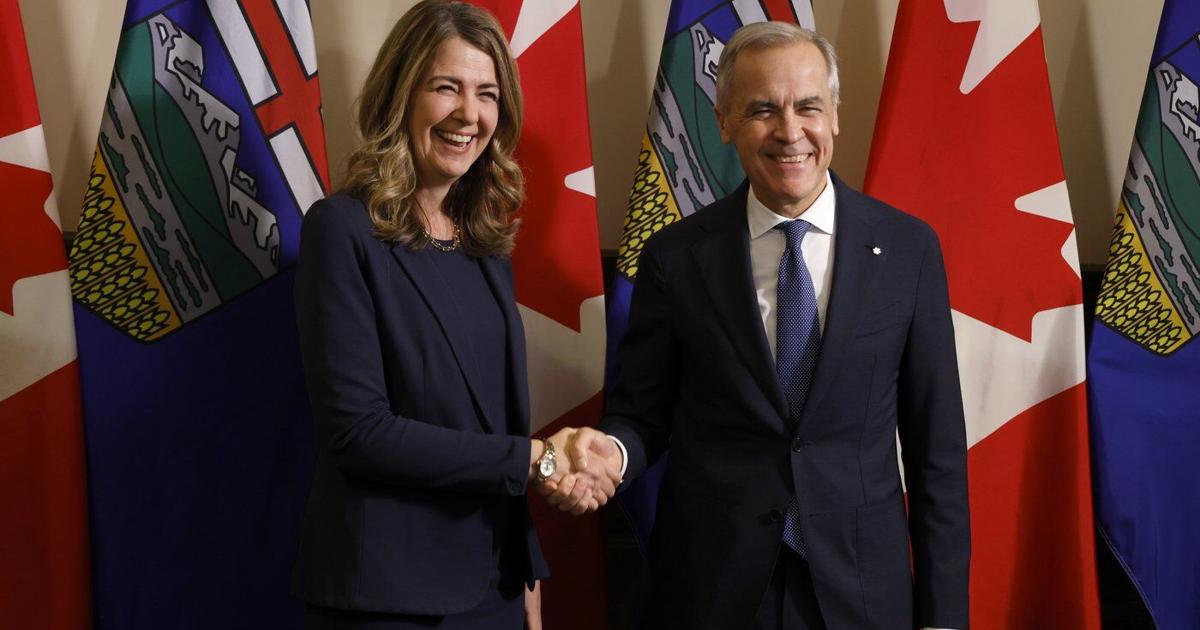
OTTAWA — Prime Minister Mark Carney says any referendum on Alberta’s separation from Canada would require a “clear majority,” and that a simple majority of 50 per cent plus one vote would not cut it.
Carney’s stark reminder that the Clarity Act, a federal law, requires a significantly higher bar to break up Canada is the second time in two days the prime minister weighed into the divisive debate unfolding in Alberta with sharp words. A day earlier, he warned that separatists who suggest it’s a chance to send a message to Ottawa are playing with fire.
“That is a dangerous bluff,” Carney said Monday.
Carney’s warning that a simple majority will not suffice has implications as well for a future referendum in Quebec, which the Parti Quebecois has promised if it wins power in the fall.
Carney told the Commons he received expert advice Tuesday which indicated that Alberta’s current plan to stage referendum on Oct. 19 — which includes “a question about a question” whether to trigger a subsequent vote on secession — doesn’t trigger the Clarity Act, yet.
“It’s explicit in the question that it’s not a binding referendum,” Carney said. That means Parliament does not have a role in determining the legality of a referendum question and result for the Oct. 19 vote.
Responding to Bloc Québécois demands that Ottawa ditch the federal “anti-democratic” Clarity Act, Carney made clear that any future referendum on secession requires a “clear expression of the will of a clear majority.”
In determining whether a referendum result meets the “clear majority” bar, Carney said, “it’s not 50 per cent plus one.”
Alberta Premier Danielle Smith again Tuesday downplayed the impact of her government’s proposed referendum.
It is “testing the waters,” Smith said, as she invoked the 700,000 Albertans who signed petitions which she claims compelled her to stage the vote.
Those include 400,000 who advocated remaining in Canada, largely in response to 300,000 who signed the “independence petition.” Smith said the province’s referendum is “structured in a way that allows us to get some indication from Albertans on policy. It’s not a Clarity Act question, it’s not binding.”
But Smith said her government will seek some further “clarity” of its own on what she calls an “anti-democratic” court ruling which declared May 13 that the Alberta independence petition was unconstitutional.
A judge quashed that petition saying it should not have been registered because Elections Alberta did not respect the duty to consult Indigenous communities.
Smith said she will appeal that finding all the way to the Supreme Court of Canada because the constitutional “duty to consult” only applies to specific project proposals, not to citizen-initiated petition on national unity. She also argues the petition’s advocates cannot be expected to undertake Indigenous consultations.
In an unusually public reprimand, Manitoba Premier Wab Kinew interjected to tell Smith “that is not correct.”
“A lot of what you just said there, Premier Smith, specifically — and we spoke about this, so I don’t mind repeating this — it is not up to the petition gatherers to fulfil the duty to consult. It is up to you, as the Alberta government, to fulfil the duty to consult,” Kinew said at a joint news conference to close the western premiers meeting.
“And in this case, when there is clearly going to be an impact on well-established existing (Indigenous) hunting and fishing rights by putting up an international border, if some would have their way, the judge ruled and I would agree with the judge’s ruling that is going to infringe on rights, and so there is a duty to consult,” Kinew said.
Kinew told reporters he had met with First Nations chiefs in Alberta, and delivered that message to Smith at the meeting.
B.C. Premier David Eby said he conveyed his alarm about the referendum vote clearly to Smith. “I disagree profoundly with Premier Smith’s referendum. I think it is a huge mistake, and Premier Smith disagrees with me profoundly about issues related to a pipeline of the North Coast and North Coast tanker ban.”
But Eby and Kinew underscored that they believe Smith is open to discussing their concerns, and that the Carney government is making significant efforts to accommodate different provincial demands and interests.
Pressured by separatists in her own United Conservative Party who vowed to eject her, Smith unveiled last Thursday the plan to add on a question to the Oct. 19 referendum. She said it will ask, “Should Alberta remain a province of Canada, or should the Government of Alberta begin the legal process required under the Canadian Constitution to hold a binding provincial referendum on whether or not Alberta should separate from Canada?”
The province’s official website hasn’t been updated to reflect Smith’s announcement or the exact wording of a 10th question.
On Parliament Hill, the issue has fired up the separatist Bloc Québécois. BQ House leader Christine Normandin challenged Carney Tuesday, saying it is solely up to Alberta, Quebec or any other province to determine the will of a population, not up to an “anti-democratic” federal law.
Carney replied: “The Clarity Act is clear but at the same time, we respect the will of Quebecers,” which he asserted is “to build a strong resilient Quebec in a strong, resilient, independent Canada.”
The Conservative Official Opposition, including leader Pierre Poilievre, have not asked Carney any questions in the Commons on how the federal government will approach the referendum.
But in news conferences, MPs including Poilievre have blamed Carney and Liberal policies of the past decade for deterring investment in Alberta’s energy sector, and fuelling “legitimate grievances” of Albertans.
Error! Sorry, there was an error processing your request.
There was a problem with the recaptcha. Please try again.
You may unsubscribe at any time. By signing up, you agree to our terms of use and privacy policy. This site is protected by reCAPTCHA and the Google privacy policy and terms of service apply.
Want more of the latest from us? Sign up for more at our newsletter page.