

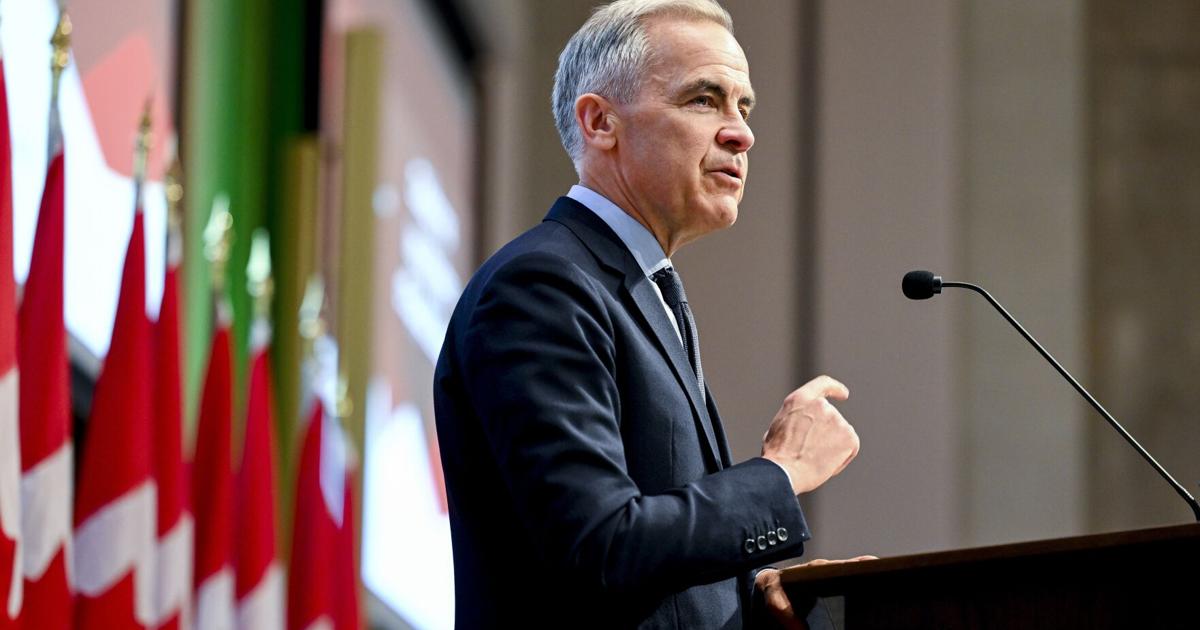
OTTAWA — Prime Minister Mark Carney is taking his Canada-is-open-for-business message to Wall Street Thursday as trade talks remain stalled, and industrial leaders say the future of the battered autos, steel and aluminum sectors must include integration with the U.S.
Catherine Cobden, head of the Canadian Steel Producers Association, said in an interview, “Canada and the U.S. are each other’s most important customers. We are fighting common foes with respect to global overcapacity, mostly from China. I think the core message that we feel is appropriate is that we are stronger together than apart.”
“We may want to diversify our economy, and we may want to create new trade agreements, et cetera,” said Cobden. “But that should not be done in a way that’s at odds with the United States.”
Flavio Volpe, head of the Automotive Parts Manufacturers’ Association, said, “This is the prime minister’s opportunity to remind the New York audience — which is not a political audience — that Canada matters and that … in his experience and opinion, the U.S. matters.”
In Manhattan, Carney will deliver a major speech to the Economic Club of New York and meet private-sector executives, but he doesn’t plan on any meetings with Trump administration officials.
The prime minister stressed that this — his first U.S. trip since the acclaimed Davos speech with its rallying call to middle powers — is not a trade mission. That falls to his Canada-U.S. Trade Minister Dominic LeBlanc, who is expected to travel to Washington “soon” to attempt to kick-start trade talks that are in limbo, the minister confirmed Wednesday.
Rather, Carney sees his trip as an “efficient way” to tell American investors about the pitch Canada is making to the world. He suggested U.S.-based investors are newly willing to listen.
“These are with a series of institutions that are either heavily invested in Canada (or) interested in investing in Canada,” said Carney.
“And a lot has changed in Canada,” the prime minister said at a major defence fair where he announced plans to buy a Swedish surveillance aircraft — an example of his government’s rapid ramp-up of military spending and equipment purchases.
“We’re moving forward at speed. Half a trillion dollars of defence-related investment in the course of the next decade in Canada,” said Carney. “Even in New York, that’s real money.”
It remains to be seen if Carney will dial back his Davos “rupture” rhetoric.
In January, Carney told the World Economic Forum that middle powers must recognize the old international rules-based order isn’t coming back, and they must work together during a time of “intensifying great power rivalry, where the most powerful pursue their interests using economic integration as coercion.”
The Davos speech, all the “elbows up” talk in Canada, the provincial bans on U.S. alcohol, and Ottawa’s talk of diversifying economic and defence ties have angered U.S. President Donald Trump, who said after Carney’s speech Canada wasn’t “grateful” enough.
Recently, Carney has rejected any notion that he set out to lead any kind of new middle power alliance against the U.S.
“What’s happening in the world is that a series of like-minded countries are looking at deepening their relationships across various strategic sectors, defence, cyber, artificial intelligence … space, critical minerals, more conventional energy, obviously food security, those areas,” he told a Vancouver business audience last week.
“There’s no middle power alliance which is about to happen, just to be absolutely clear.” It’s about striking agreements, including with partners like Korea, Japan, Australia, and more broadly, ASEAN countries, where common interests align, he said.
And in Toronto, Carney told the Global Progress Action Summit that “Canada, like Mexico, remains open to deeper integration, including options for Fortress North America in selected sectors. To be clear, those offers are on the table.”
“If that route is not ultimately possible, we will invest heavily in new markets and products. We’ll reward those who build, buy, and produce in Canada, and we will build new partnerships abroad,” he said then.
The prime minister has not elaborated since then about what he meant by “Fortress North America,” or what “offers” are on the table.
Nevertheless, to steel producers and auto parts manufacturers, the talk of “Fortress North America” is a welcome twist.
“To my ears,” said Volpe, “that means the need to diversify doesn’t mean we need to diversify away from the Americans and that he’s open to further integration with the Americans.”
Cobden hopes that is viewed as “helpful” and “constructive” by the United States.
Jean Simard, head of the Aluminum Association of Canada, said he hopes Carney’s speech underscores that “as a trade-driven country, Canada with its critical minerals, energy, world class AI ecosystem and stable democracy is a safe bet on the future.”
Former Conservative leader Erin O’Toole, who sits on the Canada-U.S. trade advisory council to Carney’s government, said in an interview he expects Carney to convey three things in New York: that there’s a new government in charge; that approval times are accelerating for major projects and capital investments will earn a return faster; and that Canada is and always will be a key “reliable” strategic partner that helps the U.S. become more prosperous and secure.
Carney doesn’t have to walk back the Davos speech, O’Toole said. “It was the U.S. that decided to change things. It wasn’t us,” and so he expects Carney to stress the reliability of traditional systems and alliances, and “if they’re resistant to that, we have to and will diversify.”
Meanwhile, formal trade discussions between Canada and the U.S. are “pretty firmly stuck,” said Steve Verheul, Canada’s former lead trade negotiator on the 2018 Canada-U.S.-Mexico Agreement (CUSMA).
Testifying at a senate committee Wednesday, Verheul, a private trade consultant, said ultimately a deal will likely be reached, but it will take a long time.
“The U.S. is blaming Canada for the lack of movement, but the U.S. is putting Canada in a position where it has little room to move. Issues like U.S. concerns over dairy and provincial bans on U.S. liquor sales will be able to be resolved at the end of the negotiation, but not as a down payment to get to the table,” he said.
“At the same time, the U.S. is showing no flexibility on issues like tariffs on steel, aluminum, and autos, fundamental breaches of the agreement,” he said. He urged Canada, to “hold its ground,” saying that “as uncomfortable as it may be,” pressures on the U.S. to reach a resolution will only increase.
And Verheul said that despite the formal launch of talks between Mexico and the U.S. this week, “I’m hearing from contacts in Mexico that things are not going quite as quickly as the U.S. was portraying it.”
In the meantime, he said, American efforts to have companies reshore production to the U.S. “have had limited success so far.” U.S. manufacturing starts were “down last year, not up. And the trade deficit in goods increased, it didn’t decrease.”
Trump’s goal of reshoring production to the U.S. on a large scale “would take years to achieve, be highly expensive, create manufacturing jobs for which there is limited interest in the U.S. and would leave the U.S. much less competitive in world markets,” Verheul added.
Laura Dawson, head of the Future Borders Coalition, agreed talks are stalled, saying, “I don’t see an end in sight,” but she warned against “performative nationalism” — referring to efforts like U.S. alcohol bans and travel boycotts.
“The real contest we face is not Canada versus the United States. It is whether North America can compete against faster, lower cost and increasingly co-ordinated economic blocs around the world,” she said.
Error! Sorry, there was an error processing your request.
There was a problem with the recaptcha. Please try again.
You may unsubscribe at any time. By signing up, you agree to our terms of use and privacy policy. This site is protected by reCAPTCHA and the Google privacy policy and terms of service apply.
Want more of the latest from us? Sign up for more at our newsletter page.

