There’s an unwritten rule that serious works of art need to be about big, weighty subjects: war, racism, abuse, decolonization.
But as Eboni Booth’s “Primary Trust” proves, none of that is necessary. This gentle, bittersweet look at one man’s stalled coming-of-age won the Pulitzer Prize for Drama in 2024. And it’s been granted a lovely production currently at Crow’s Theatre, which co-produced the show with London’s Grand Theatre.
Kenneth (Durae McFarlane) is a quiet, socially awkward 38-year-old Black man living in the fictional Buffalo suburb of Cranberry, New York. It’s the 1990s — Booth’s only stage direction about the time is that it is “before smart phones” — and the “action” begins when Kenneth, who’s worked at a bookstore for 20 years, is told by the owner that he’s closing up shop.
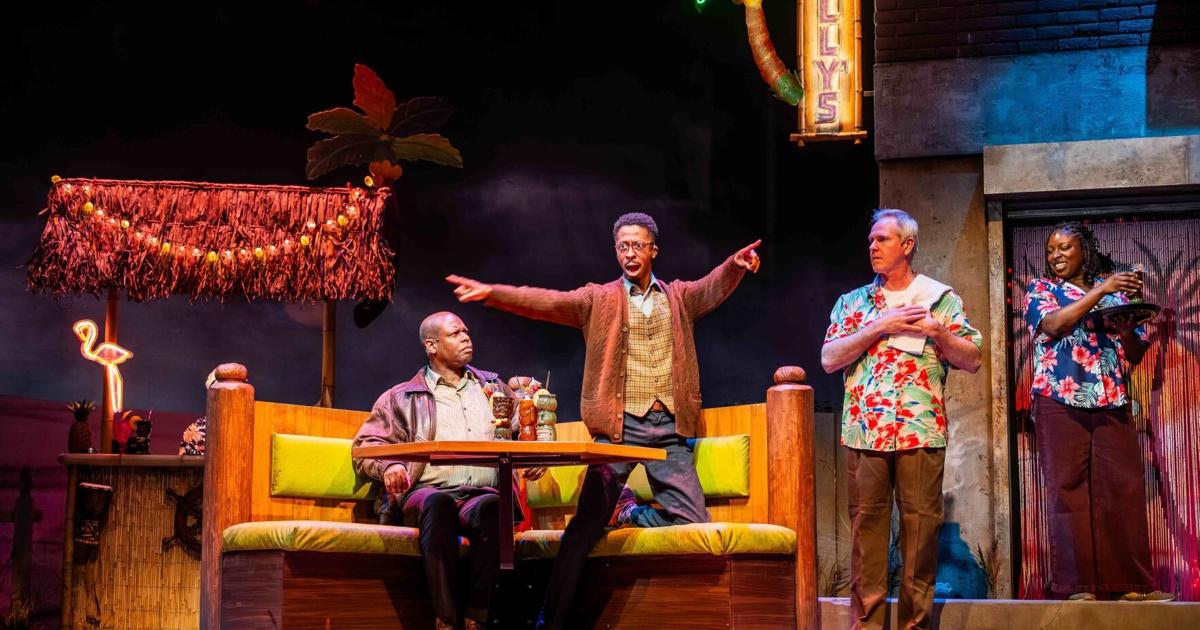
And so the youthful-looking man, who spends his leisure time downing happy hour mai tais with his pal Bert (Peter N. Bailey) at a tiki restaurant improbably called Wally’s, is left on his own, not knowing how he’s going to pay his bills.
Thanks to a kindly Wally’s server named Corrina (Khadijah Roberts-Abdullah), however, he gets a tip about a possible opening at one of the town’s two banks, Primary Trust, run by Clay (Ryan Hollyman). All of which goes fine, until something happens that upsets his routine and causes him to reassess what he’s doing with his life.
To say more about the plot would be to venture into spoiler territory, and Booth has carefully constructed the play to reveal its secrets slowly and unrushed — rather like Kenneth adding up the credits and debits for his former employer’s business.
In the script, she indicates his gradual awakening with time jumps, which director Cherissa Richards dramatizes with pings of a service bell — the kind you might find at, say, a store or motel where the staff is in the back. The significance of this detail becomes clearer later on, but I’m not sure it’s warranted as a unifying sonic device. Is it a wake-up call, something to get us to seize the day?
Richards also has some difficulty creating a sense of momentum and tension, making this modest 85-minute play often feel longer.
But she gets warm, generous performances from her cast. Hollyman and Roberts-Abdullah, besides playing, respectively, a former college athlete now stuck at a desk job and a free-spirited, empathetic server, get to wear multiple hats, often appearing as servers at Wally’s or customers at the bank.
Danilo Reyes plays a musician, but he’s a little underused. Bailey’s Bert is watchful and caring — fitting for someone who’s known Kenneth and his secrets for years.
But “Primary Trust” is a star vehicle for a special kind of actor. Off-Broadway, the role of Kenneth was played by “The Good Place” actor William Jackson Harper, who radiates a geeky kind of goodness.
McFarlane, who earned a Dora nomination a few years ago as a nerdy college student working as a movie theatre usher in “The Flick,” has a similar vibe. His voice quavering as he narrates his story, he makes a hugely sympathetic hero, someone we want to protect at all costs. Kenneth’s monologues about his past are some of the simplest, most heartfelt confessions you’ll see on a live stage this year. The surprising thing is there’s nothing sentimental about them.
The design is unobtrusive. Julie Fox’s set establishes various locations with a minimum of fuss. There are no big effects in Imogen Wilson’s lighting design or Thomas Ryder Payne’s soundscape. Rachel Forbes’s costumes are fitting for this ordinary slice of modern Americana.
What happens to Kenneth might feel unrealistic in today’s crushing economy and chilly social climate, where people are more interested in their flashing phone screens than what’s happening around them.
But that’s one of Booth’s points. Nearly 80 years ago, one famous theatre character declared that she always relied on the kindness of strangers. “Primary Trust” earnestly believes in that sentiment, and it makes us want to live in that world, too.