If you’ve got a window ledge, you’ve got enough space to grow your own food.
That’s the democratic ethos embraced by urban gardeners extraordinaire Char and Marv Lopez.
The Toronto couple recently became authors by publishing “The Compact Garden,” a comprehensive guide to growing your own organic veg at home. And they’re full-time vegetable content creators, using their Planted In The Garden accounts to entertain and educate more than 7 million social media followers with how-tos and harvest hauls filmed in their modest urban backyard. (A late spring “garden grocery store” post heralded red leaf lettuce and Purple Lady bok choy.)
But back in 2009, they were just college sweethearts throwing some cucumber seeds into a random corner of Char’s parents’ backyard to see what happened.
“I didn’t know what I was doing,” said Marv. “I just tossed them, hopeful that it would grow … but it didn’t.” Turns out, they’d picked the shadiest corner of the garden, not ideal for a vegetable that thrives in full sun.
While that first attempt was a failure, these two graphic designers caught the bug for growing their own food. As they moved around the city — from a basement apartment to a condo, to an apartment with a balcony, and then to their own home with a small yard in 2019 — the couple honed their green thumbs, learning from other gardeners and their own trial and error.
As with any good team, they play distinct roles in the garden. “Char is my adviser,” said Marv. “She’s the brains of this operation. She reads a lot, and anything she wants to try, I test.”
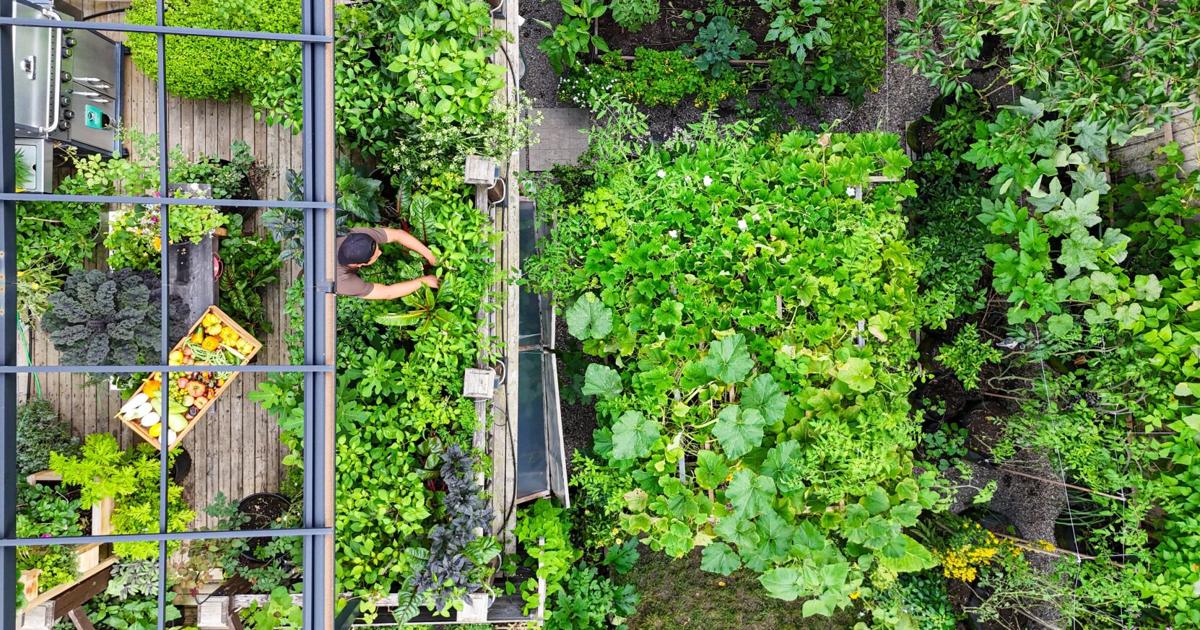
Case in point: The space-saving “vertical” garden in their backyard that maximizes productivity by growing up, not out. Think: Pumpkins hanging down from a beam, a wall that stacks tomato plants like books on a shelf, melons trailing up a trellis. “It’s really cool to experiment,” said Char, who relishes the thrill of figuring things out on the fly and overcoming challenges.
This scrappy, no-gatekeeping gardening ethos resonates in an era when more people are looking for ways to grow their own food, driven by rising food costs and a yearning to get off our screens and touch grass (or basil plants). At the same time, many Torontonians are living in condos — often without even a balcony — or limited to a small patch of earth if we’re lucky enough to have outside space.
The Lopezes take a no green space, no problem approach. “You may not be growing pounds and pounds of food, but you can still grow small amounts on a weekly basis to sustain yourself,” said Marv. “Microgreens, for example, are super easy to grow. They take less than a week, you can keep doing it over and over, and you can do it on a kitchen counter with minimal light.”
He also points to new varieties of plants that deliver the yield of much larger plants in pint-size packages perfect for the space-deprived.
“There’s something called a micro-dwarf tomato that you can grow in a tiny pot. You literally have it on your windowsill and it produces a handful of tomatoes for you,” he said. “If you grow multiples of it, it yields the same amount as a big eight-foot tomato plant.”
In the growing season, from April to November, Char and Marv’s garden produces so much bounty that they end up giving bags of it away to family and friends. They also make pickles and preserves to enjoy in the cold months, and turn a corner of their basement into a winter garden that produces a regular supply of fresh veg (lettuce, chiles, eggplant, beets), even in deepest February.
The Lopezes still shop at the grocery store, but 70 per cent of the vegetables they eat come from their own garden. By doing so, Char is modelling a different way of eating for their 10-year-old son, Marcel, than she experienced growing up.
“I don’t even remember us having much vegetables. We grew up on a lot of junk food,” said Char, whose family immigrated to Canada from the Philippines before she was born. “You relied on the grocery store, and you believed in things like Cheese Whiz, mac and cheese and spam.”
As an adult, she’s become passionate about what she and her family eat, and has developed an interest in medicinal plants that she turns into remedies. “I love being able to grow those herbs, test them and make these witchy crafts.”
Marv, on the other hand, grew up in a family of veggie connoisseurs in the Philippines; his Lola (or grandmother) was a vegetable vendor. “They would take me to the market to pick the vegetables to sell,” he said. “I lived in the city, but we did have family that had a farm and we’d go there maybe once a year.”
They’re both keen to emphasize that they weren’t born with some innate sense of how to grow things.
“I don’t think a green thumb really exists,” said Marv. “Everything can be learned if you just keep going at it.” One small — like, windowsill sized — step at a time.
Get growing: Marv and Char’s top tips for gardening, whatever size space you have.
Start small
“New gardeners can get overwhelmed, so just get used to growing something that’s manageable. Gardening doesn’t have to be a full-time job. Make it easy for yourself and go to a garden centre that has seedlings. I would go with zucchini, beans, tomatoes, peppers and eggplants. All of those can be grown in a container.”
Plant veggies you’ll actually eat
“You don’t want to plant something you’re not going to eat. Or, figure out a way to like it. And if you grow too much of one thing this year, you can change your mind and grow something else you might like (better) the next year.”
Embrace hardy, idiot-proof perennials
“Look for something that comes back every year, and you don’t have to worry about it. A raspberry will come back every year; we grow them in containers. Asparagus is another one: You just put it in the ground, although it takes about three years (to go from seed to harvest).”
Use your veggie scraps
“If you’ve got leftover potatoes that have sprouted, just put them in soil. The only thing I would add is compost. They just need sunlight and water after that. Even in a container, they’ll grow, and you can save them year after year.”
Accept the pests
“They’re going to come. You want to learn which pests are good, which ones are bad, and which ones will help you out. In terms of squirrels, sometimes they just need to drink. Part of the reason they will bite your tomatoes is because they’re thirsty, so lay out drinking water for them.”