

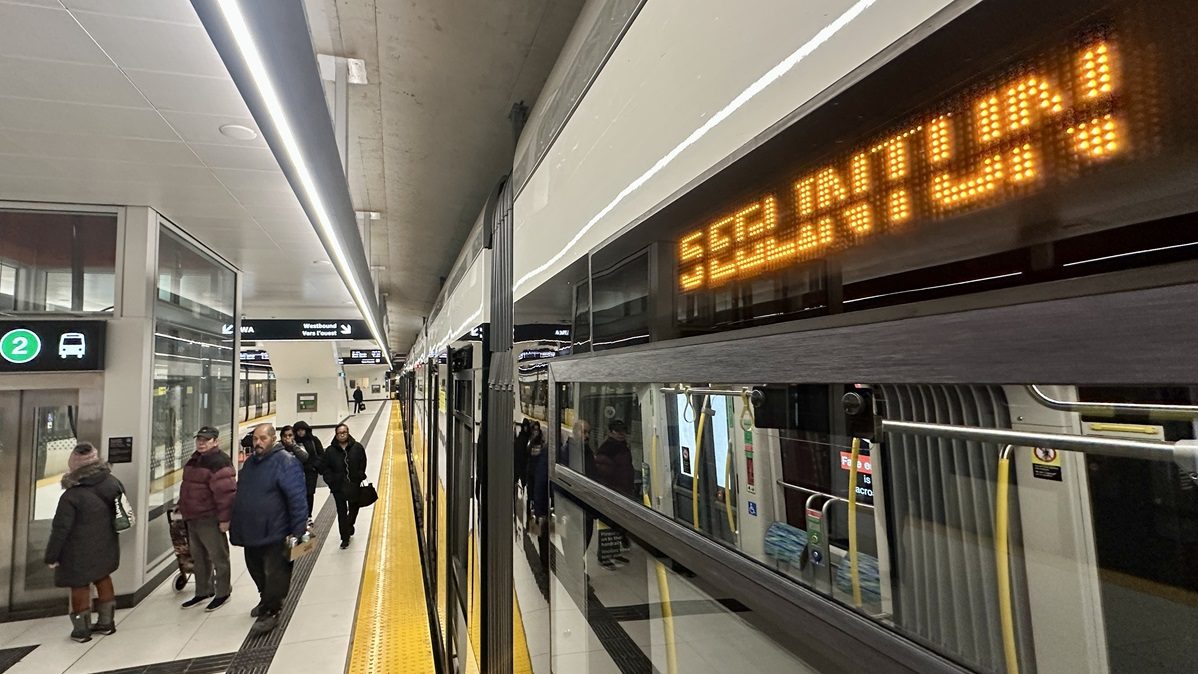
Work by the City of Toronto to improve Line 5 Eglinton and Line 6 Finch West LRT trip times has been ongoing for months and while there was progress ahead of a key end-of-May deadline, the full potential of transit signal priority measures isn’t likely to be realized until the end of 2026.
After being directed by Toronto city council to make several changes to speed up LRT trip times after complaints of slow service on Line 6 Finch West emerged at the end of 2025, work was split up into a few phases.
Under the first phase of the changes for Lines 5 and 6, left-turning vehicles now proceed through an intersection at the end of a traffic-light cycle versus at the beginning (dubbed “lagging left turns”), allowing LRT trains to move through an intersection seconds sooner after a light turns green from red.
Phase two involved traffic lights changing to green in real time as trains approach if necessary in a process called “rotational phasing / phase insertion.” The City’s general manager, Ashley Curtis, told CityNews through a statement in March that the measures would be in place on Lines 5 and 6 by the end of April.
“These changes significantly reduce the chance of trains getting stuck at red lights,” she said at the time.
The third phase involved “other measures, including signal re-timings” that should have been done by the end of May.
CityNews recently asked the City of Toronto for an update on those efforts to roll out the technological changes needed to speed up trains.
As of May 21, Curtis said enhanced transit signal priority measures have been installed at all street-level intersections on Line 6 as well as Line 5 with the exception of Leslie Street and Eglinton Avenue East.
On Line 6, she said six “major” intersections have rotational phasing while all of the remaining intersections have lagging left turns.
“Transportation Services and TTC teams will revisit the remaining Line 5 and Line 6 locations to implement enhanced rotational phasing / phase insertion with completion expected by the end of 2026,” Curtis wrote.
“The City and the TTC will continue to monitor both lines and make further adjustments and improvements as deemed necessary.”
She also referenced an upcoming report that will be considered by the City’s infrastructure and environment committee on Wednesday. It proposed a number of municipal bylaws that would formalize changes to traffic light turn controls, lane designs and parking restrictions.
Meanwhile, other changes have taken effect on Line 5 Eglinton. The speed limit in the tunnelled portion increased to 80 km/h from 60 km/h after operating crews got more familiar with the system.
However, there are still speed restrictions in certain areas along parts of the lines that advocates have called to be reviewed such as through street-level intersections.
In mid-March before the bulk of the enhanced transit signal priority measures took effect, CityNews tested both lines end to end. CityNews once again went end-to-end along Line 5 Eglinton and Line 6 Finch West recently to see how travel times have been improved.
During a mid- and late-afternoon journey along the Eglinton Crosstown LRT corridor, it took more than an hour and five minutes to go west between Kennedy and Mount Dennis stations. A similar trip right after opening in early February took around 55 minutes, which is around the average time stated by TTC staff for the initial phase of service. While there were unexplained pauses on the western end of the line, there weren’t any published service alerts affecting the line at the time. A return eastbound trip on a different train took just over 54 minutes with a brief, unexplained pause waiting to enter Kennedy station.
On the Finch West corridor during an evening test, it took almost 46 minutes to go westbound to Humber College station from Finch West station — roughly a minute quicker compared to a trip CityNews took in December shortly after opening. A return eastbound trip on a different train took more than 43 minutes and 40 seconds. According to a Metrolinx website on the Finch West LRT project, light rail vehicles were initially projected to take approximately 33 to 34 minutes to travel end-to-end.
Add CityNews Toronto as a trusted source on Google to see more local stories from us.

