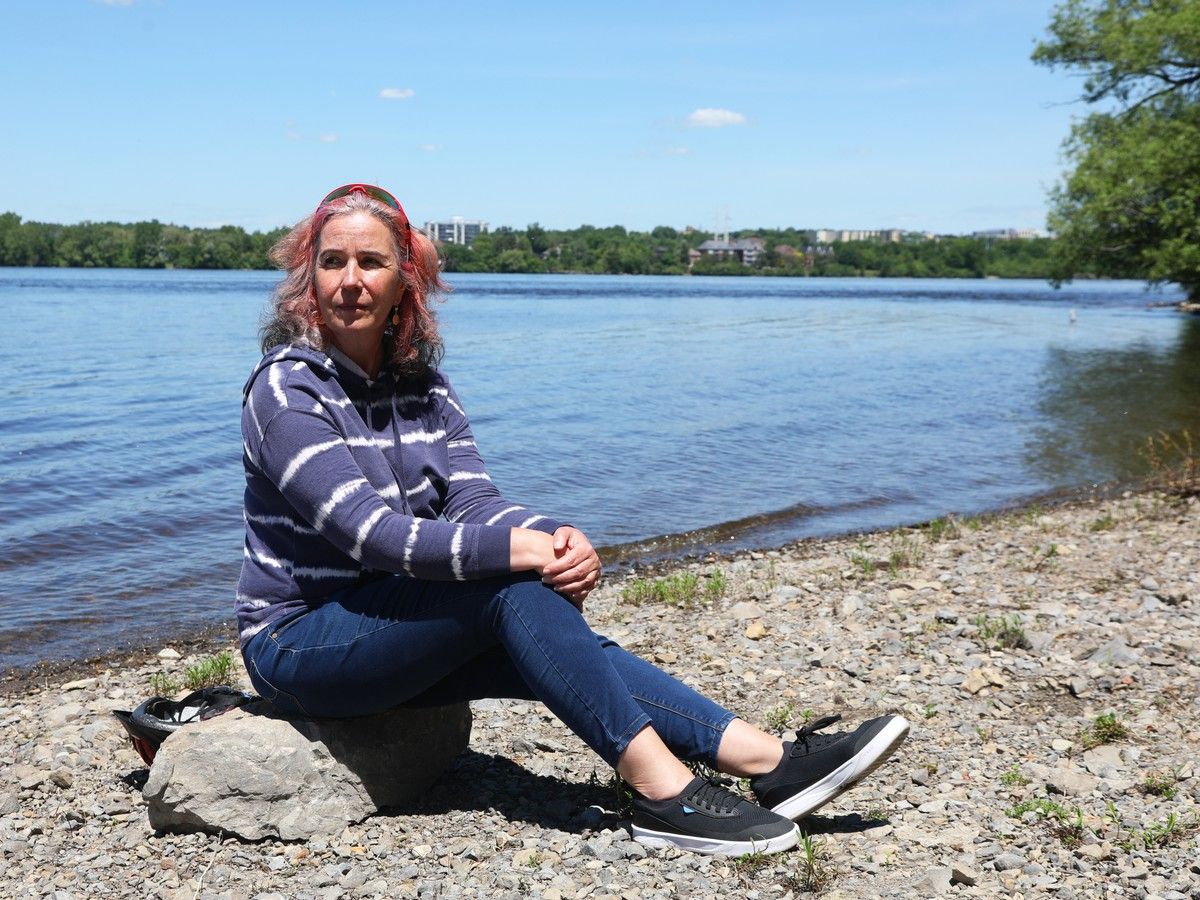
On their way back to shore, Tania Jewkowicz and four of her friends in the Britannia Yacht Club spotted something in the distance on the evening of May 30.
“We thought we saw a dog, and I told my friends, ‘We got to check this out, this does not look good.’ Somebody thought it was a kayak, and that someone was lying down,” Jewkowicz said.
As they got closer and the vessel turned out to be a paddleboard, Jewkowicz said the dog stood up. “The poor dog’s legs were shaking,” she said.
On board, she said, there were life-jackets, tethers, a water bottle and a dry bag.
“But there was no person,” Jewkowicz said.
The group rescued the dog and called police.
“When I spotted the board with the dog and no human, I was filled with dread. It was heartbreaking to see the dog all alone,” she said, adding that the water was cold, so the group feared there would be no happy ending.
“I will never forget that image of the dog floating in the distance. The silhouette is burned in my memory,” she said.

At about 8:30 p.m., Gatineau police responded to an Ottawa police request in the Aylmer area about a missing paddleboarder who entered the water from the Quebec side, Const. Patrick Kenney of the Gatineau Police Service said in an email. Gatineau police wouldn’t say whether that report mentioned a dog.
The next evening, Jewkowicz’s dread would prove correct, when Sûreté du Québec divers found the body of a missing 38-year-old paddleboarder.
The tragic death of the 38-year-old puts a spotlight on water safety as summer arrives and paddleboarding is erupting in popularity. But a lack of experience for those new to the sport puts many at risk on the open water.
Stephanie Bakalar, the lead spokesperson for the Lifesaving Society Ontario, said in an email that paddleboards were considered boats, so the same risks applied.
Over the past 10 years, there have been 13 paddleboard-related deaths in Canada, and fewer than 10 of those occurred in Ontario, Bakalar said.
Here’s what you need to know about the risks, and how you can keep safe when enjoying a paddleboard this summer.
Recent deaths highlight the danger of paddleboarding
There have been numerous deaths directly related to paddleboarding across Canada.
South of Squamish, B.C., the RCMP found the bodies of two paddleboarders on June 2 after a search.
Last June, a 40-year-old man died after falling into the water when paddleboarding in the St. Lawrence River west of Montreal. He was not wearing a life-jacket, according to Quebec’s provincial police.
Gatineau police did not confirm whether the recently-deceased man was wearing a life-jacket, and the Squamish RCMP did not respond to the same question about the men out west.
Exploding in popularity
Frankie Bellissimo, owner of Nepean-based paddleboard company Different Breed, says he’s seen a lot of new customers seeking paddleboards, but suspects most aren’t thinking about safety because of how easy it is to get into the sport.
“You get on the board, and you’re paddling right away. Your mind is swept away by how beautiful everything is. You don’t realize how things could turn quickly, pretty much in an instant. A lot of people could step on a paddleboard with no jacket on and get themselves into big trouble,” Bellissimo said.
Laura Zak, the owner of Ottawa Stand Up Paddleboard, said that, when her company first landed in the city, its rivers were much quieter.
“We’ve seen a huge amount of people coming with boards and seen how much it picked up. When we first got to the Rideau River 10 years ago, there were hardly as many paddlers. I’d say it’s picked up about 10 times in those 10 years,” Zak said.
The increase in paddleboarding’s popularity means more people are exposed to the dangers of open water, said Michael Stegemann, operations manager at Rescue Canada.
He says there’s also an increase in the recreational use of moving water across Canada, like rivers with currents.
“Whether that’s a paddleboard, a kayak, a raft. You see people just blowing up a tube and floating along the river,” he said. There are different risks on water with a current than on a still lake.
Stegemann — whose team trains Ottawa’s fire, police and paramedic services in boat, ice and swim water — is concerned about an increase in recreational open water-related injuries and deaths across Canada.
The problem is that recreational water-goers don’t have the necessary swimming or training abilities, so when the waters get rough, or equipment fails, for instance, people get exhausted and can’t make it to shore, Stegemann said, adding that this is when bodies are found.
Marc-Antoine Deschamps, the superintendent of public information at the Ottawa Paramedic Service, sees first-hand the effects of paddling without safety precautions.
“Obviously, a single one is one too many, because often this is preventable, and it’s an individual tragedy every time,” Deschamps said.

Wear your life jacket
Deschamps and Stegemann stress the same point to anyone heading out on Ottawa’s rivers this summer: wear a life jacket.
Although Transport Canada’s website says standup paddleboarders, for example, “must have a Canadian-approved life jacket or PFD on board which is available for immediate use,” Deschamps thinks that’s not good enough.
“In an incident, if a life jacket is not on you, you will not have time to put it on. I’ve been recommending that you see your life jacket like you see your seatbelt in your car. It’s not possible for someone without a seatbelt on, to see they’re going to get into a collision and then put it on,” he said.
Between 2010 and 2023, about three Ottawa residents died each year due to accidental drowning in natural water from April to October, according to Ottawa Public Health.
OPH also said that the highest historical rates of natural water drownings during warmer months were among residents from 15 to 24 years of age, and that across Ontario some preventable risk factors are not wearing a life jacket, swimming alone and being a weak or non-swimmer.
Lifesaving Society of Ontario’s website states that in the province not wearing a life-jacket is a factor in a greater percentage of fatal drowning among all age groups, as compared to the national average.
In almost 80 per cent of recreational boating-related fatalities in Canada from 2012 to 2021, a PFD was not worn by the person who died, according to the Drowning Prevention Research Centre Canada’s report, Recreational Boating-Related Fatalities in Canada.
Know your surroundings and get proper training
Aside from life jackets, knowledge is another essential component of being prepared for open water activities, said Bellissimo, who avoids paddling in Ottawa’s waters wherever rapids are present because he thinks it’s too unpredictable.
“I paddleboard in the river on flat areas, like Britannia Beach where there are no rapids. But you have to assess the situation. You always look at the water, the waves, and how the current is. That’s the first and foremost thing,” he said, adding that assessing the weather forecast and winds is also essential.
Stegemann thinks that recreational water-goers should take their knowledge one step further.
“Whatever you’re doing in the river, seek training, so you know how to swim in current, and can be introduced to the proper equipment you should be wearing. In other words, A PFD, or thermal equipment,” he said, adding that Rescue Canada specializes in moving water instruction, which differs from still water swimming lessons.
“The current is going to push you where it wants to push you, unless you have the training to know how to swim in it, to swim away from dangers, or with the current,” Stegemann said.
Michelle McShane, executive director of Paddle Canada, says the organization’s introductory courses in the Ottawa area teach all kinds of paddle sports and are only a single day’s commitment.
“At the very least, people should be taking our entry level courses,” said McShane, who also sits on the board of directors of the Canadian Safe Boating Council.
McShane says Paddle Canada’s courses include participants intentionally falling into water, or off whatever vessel they’re on, to learn how to get back on.
“There’s a bit of fear involved, but, when folks can do that in a simulated environment, they realize there’s a skill set involved in how to rescue themselves,” she said, adding that, if participants did that exercise without a PFD, they’d understand how difficult it would be.
Our website is your destination for up-to-the-minute news, so make sure to bookmark our homepage and sign up for our newsletters so we can keep you informed.