In debut novelist Liz Johnston’s “The Fall-Down Effect” (Book*hug Press), Lynn and Tom are home-schooling their three children — Sylvia, Fern and River — in the Pacific Northwest. For these environmentalists who fell in love on the protest line in Vancouver, starting a family has meant trading some political credibility for the stability and comfort of a permanent home. Until Lynn finds an opportunity to agitate against rapid deforestation efforts within her small community.
“He’d taught her the meaning of direct action,” Johnston writes. “He’d taken her to marches and sit-ins and showed her the power of the people. He’d taught her how to really love nature and how to defend it. But that was a lifetime ago, and she was losing hope that that guy would ever find his way back. She let her breath go, and something else dropped away with it. ‘Why are you so scared to do something that matters?’”
With this question, Lynn comes to believe that Tom’s apathy and easy adjustment to family life are the source of her marital problems. Tom, for his part, expresses regret over the children’s home-schooling and, after Lynn’s disruption of a logging work site puts the kids in harm’s way, enrols them in public school. There, they are branded as odd and must contend with their parents’ reputation as “crazy old hippies” who like to “tell everyone else how to live.”
When Lynn abruptly leaves the family to start a new life in Kelowna, the decision has far-reaching implications. Written in a sleekly naturalistic style, “The Fall-Down Effect” sympathetically explores the workability of peace activism and civil resistance, as well as the personal toll it can take.
Johnston is an editor of the literary journal Brick. Her writing has appeared in Fiddlehead, Grain and The Antigonish Review. She lives in Toronto.
What did you last read and what made you read it?
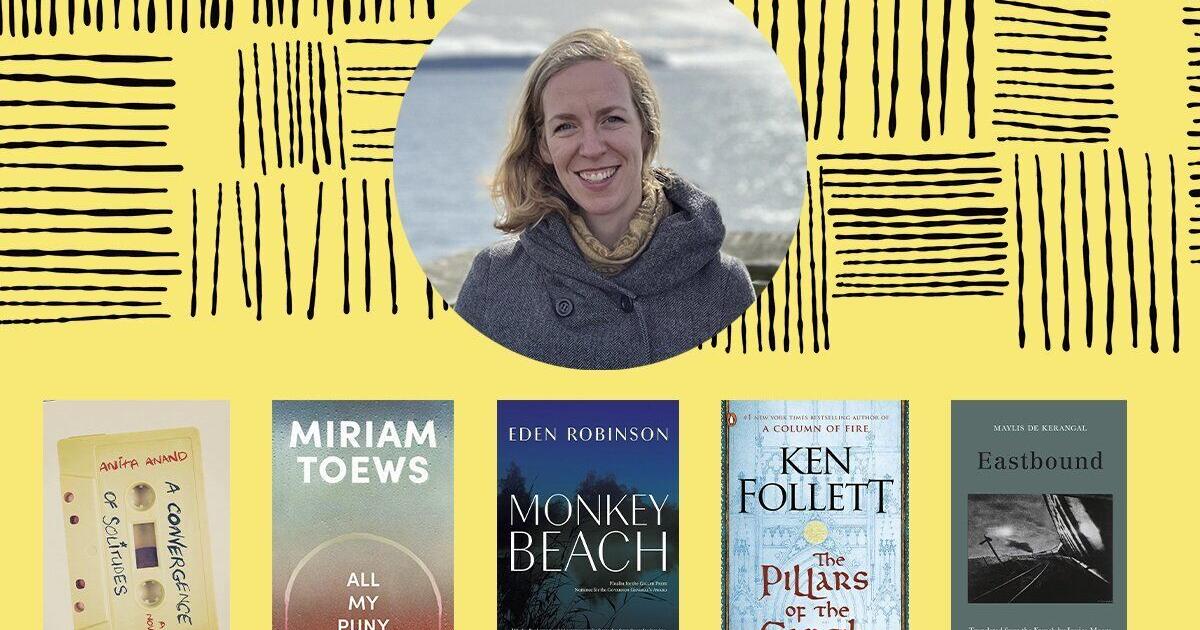
The last book I finished was “Monkey Beach” by Eden Robinson. I ordered it from the library because I wanted to read more Indigenous authors from B.C. and it’s a CanLit classic I’d never read. A bunch of my library holds came in at the same time, but that was the one that hooked me, both for its sense of place and for the relationship between the protagonist Lisamarie and her little brother Jimmy.
What book would your readers be shocked to find in your collection?
I’m disappointed to say I don’t have anything shocking in my collection. Perhaps some people would be mildly surprised to see all the Thomas Pynchon, since his postmodern play is so far away from my own style and the kinds of novels I tend to want to read now. But for several years there, starting in undergrad, I was obsessed. I haven’t read “Inherent Vice” or Pynchon’s new novel, “Shadow Ticket,” but I’ve read and own all the rest.
When was the last time you devoured a book in one, or very few, sittings?
I’m a slow reader, so even very short books tend to take me a couple sittings, but I remember flying through “Eastbound” by Maylis de Kerangal, translated from the French by Jessica Moore. Much of the story — about a deserting Russian soldier — takes place on a train, and reading it is like being on a train too, carried forward by a steady, propulsive rhythm.
Who’s the one author or what’s the one book you’ll never understand, despite the praise?
I was supposed to read “The Pillars of the Earth” by Ken Follet for a book club once. And I actually pushed myself pretty far through it, out of a sense of obligation to the friend who’d picked it. Probably just a case of “It’s not for me,” but it was the kind of book that made me irrationally angry as I read, thinking, “Why do so many people love this book?” The timeline and scale of the plot are impressive, sure, but for me that isn’t enough to explain the appeal.
What’s the one book that has not garnered the success that it deserves?
Far too many books, especially books from independent presses, deserve much more attention, more success, than they get — although I’m not sure how good my sense of a book’s success is. I was going to say “A Convergence of Solitudes” by Anita Anand should have garnered more success, but when I went to look it up, I see it’s been shortlisted for various indie awards and was gold-medal winner of the 2023 Independent Publisher Book Award for Multicultural Fiction. In any case, when I read it, it seemed like a kind of random pick I hadn’t heard much about, and then I absolutely loved it: the characters, the sentences, the structure, and the historical backdrop of the partition of India and the two Quebec referendums on independence, all just so beautifully done.
What book would you give anything to read again for the first time?
I’d love to read Avni Doshi’s “Burnt Sugar” again for the first time, to be surprised once more by its delicious ending.
When you were 10 years old, what was your favourite book?
I might have been in my Narnia phase then, though I can’t remember my favourite book in the series. “Prince Caspian,” maybe. And I loved “The BFG” by Roald Dahl. I think I got a box set of the Anne Shirley novels around then too. “Anne of Green Gables” is the first novel that made me cry. A friend and I were recently reminiscing about bawling our eyes out when Matthew dies.
What fictional character would you like to be friends with?
Maybe Anne, now that she’s on my mind. Or I’d like to be friends with both Lucy and Sasha from Anna Fitzpatrick’s “Good Girl” (a novel about a 20-something Toronto writer navigating friendships, work, dating and sex). I would insert myself in there as a third wheel. Well, maybe I’d want to time travel and be a younger version of myself and then insert myself into their friendship.
Do you have a comfort read that you revisit?
It’s been a long time since I’ve reread a book I wasn’t editing. I used to get so much pleasure from rereading, but I rarely allow myself to these days because all the books I’ve never read are calling my name. I reread “Do Not Say We Have Nothing” by Madeleine Thien because a friend chose it for a book club (a different club than the Ken Follet one) a year or so after I first read it. I wouldn’t call it a comfort read, but that’s a novel I expect I will go back to again to be with characters I cherish, even though I know what will happen to them.
What was the last book that made you laugh or cry?
I’m currently editing a novel by Sean Dixon, “Protector,” due out next spring from Freehand Books, which makes me do both, laugh and cry. Off on my own as a reader, I cried reading Shani Mootoo’s beautiful “Starry Starry Night.” And I laughed (and was moved too) reading Michael Redhill’s “The Trial of Katterfelto.”
What is the one book you wish you had written?
I don’t think I would want to have written anyone else’s book. But there are tons of books that accomplish things I’d like to be able to accomplish in my writing. The ending of Miriam Toews’s “All My Puny Sorrows” — I want to write an ending that can break your heart like that, make you weep and yet fill you up somehow, instilling a deep certainty that life’s joy and beauty is worth the pain.
What three authors living or dead would you like to have a coffee with?
The real answer is that I can be a bit socially awkward, so I’d like to grab a coffee with authors who are already friends, or at least acquaintances. But OK, let me try: Katie Kitamura, Kagiso Lesego Molope (I’m currently enthralled by her new novel, “We Inherit the Fire”), and, just to throw a bit of time travel in the mix, Emily Brontë.
What does your definition of personal literary success look like?
I want the characters I’ve created to stick around in readers’ minds like some of my favourite characters do. It’s not a very measurable version of success, as I’ll never know whose head my characters might be occupying (and I’ve sworn an oath to myself never to look at Goodreads), but still, that’s the kind of impact I want my stories to have.
Error! Sorry, there was an error processing your request.
There was a problem with the recaptcha. Please try again.
You may unsubscribe at any time. By signing up, you agree to our terms of use and privacy policy. This site is protected by reCAPTCHA and the Google privacy policy and terms of service apply.
Want more of the latest from us? Sign up for more at our newsletter page.