A group of community members, parents and children gathered in a boardroom on a Tuesday night at the Vic Johnston Community Centre in Mississauga, tucked away near the hockey arena snack bar. They weren’t there to hit the ice or cheer on a player. Their sport of choice doesn’t require pads, sticks or tape — just a single Rubik’s Cube.
They have been meeting once a week to practise their solving skills in the lead-up to their Guinness World Record attempt on July 11 in Brampton (alongside their fellow record-breakers, via video, all the way over in Hong Kong). Look closely, though, and you might notice something a little different: here and there, some of the participants have their eyes closed. And scattered on the table alongside the how-to printouts are simple black blindfolds. That’s because they’re not just going for a Rubik’s cube group solve record: this group is going for the new world record for most people to complete a Rubik’s cube — blindfolded.
This is their second world record attempt; in 2024, the group nabbed their first record, with 398 people completing the cube blindfolded. Now, they’re upping their goal to 550 people.
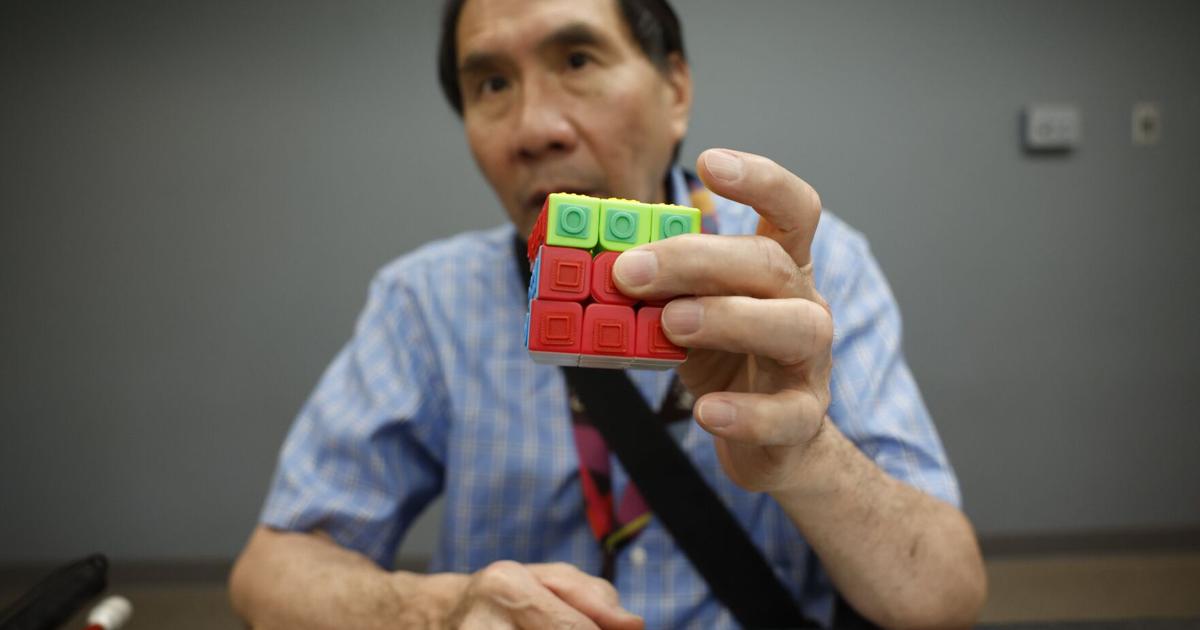
Thomas Wong brought the Brampton-based challengers together. After Wong’s church friend Ken Hua lost his sight, Hua lost his joy for everything else, too, staying inside for years at a time. Wong tried to draw him out (even offering up dim sum outings), but nothing worked. Then one day, Wong happened to have a Rubik’s Cube on him during a visit — and Hua became intrigued. Since Hua was unable to see the colours on the cube, Wong 3D-printed a tactile version with raised symbols on each colour for him so he could start to practice. It took Hua about a month to solve the cube for the first time. But then he was hooked.
Inspired by Hua’s love of the cube and their discovery via YouTube of a Hong Kong friend’s previous world record attempt, Wong started his own record-attempt group to have fun solving tactile cubes together, and to encourage sighted people to hang with non-sighted people…and perhaps get a little insight into what life without sight is like, especially for the younger members.
Organizing committee member and instructor Irene Chu feels that meeting more visually impaired people can especially help to normalize difference for children. “Small children, maybe, have never come across people that are a little different from us…but once they learn from the VIP (visually impaired person) instructors, they feel that they are not very different from us. Actually, we are equal,” she says. “Then when they see (people different than them), they don’t feel nervous and they don’t feel weird, and they will treat each other equally. This is what satisfied me the most.” The Brampton chapter is unique in that many of the training session attendees are children; the Hong Kong faction only allowed adults to participate. Once they learn the cube, many kids act as instructors as well, teaching other children how to solve it.
Wong is also hopeful visually impaired people will comprise at least 25 per cent of the world record challenge. Hua is now a regular attendee and instructor at the world-record training sessions. Today, he holds court at the table closest to the door, and everyone brings him the cubes people couldn’t solve; he sits there, slowly moving each square into place. Inside the bag at his side, he still carries the cube that Wong made for him.
Other visually impaired people have found the way of the cube life-changing, too, according to Wong. One of their visually impaired members went from being homebound to regularly attending cube sessions and now takes singing lessons; another struggled with learning things but found memorizing the cube algorithm helped him take on new challenges, like bible study.
They even have a Canadian speed-cube champion on board; Brennen Lin may have nabbed the 2023 title with his 4.14-second time, but today he’s more interested in teaching others the joys of the cube. He repeats part of the algorithm over and over again, until it almost becomes like a hum in the background: “0, 1, 9, 0, 1, 9.”
People often ask Rubik’s cube enthusiasts how fast they can solve the cube, organizing committee member Michelle Poon says, but for this group, it’s more just about getting it done at all. “Of course you can do it faster and faster and faster, but there’s different ways to do it. We want everyone to come together.” (Folks who want to participate in the challenge itself need to pass a trial to ensure they can complete the cube in the requisite hour.)
One of Lin’s eager pupils today is Avalina Ahilraj, 10. She also loves the joy that comes from teaching other kids how to get it done. “My first time I was teaching somebody to solve it, they were like, ‘oh, I can’t do it, it’s too hard,’” she remembers. “And I helped them and they solved it!” A giant smile spreads on her face. This year, she wants to beat her five-minutes-and-seven-seconds best during the world-record attempt.
One table over, seven-year-old Parthiv Perumana’s little hands work the cube, as Chu looks on. “Close your eyes,” she murmurs. He spins it, over and over. At last, the final colour clicks into place. “Good job!” his mother Praseena Prabhakaran says, administering a high-five. Chu promptly tosses him another cube, and soon, his tiny fingers are flying once more, faster and faster.