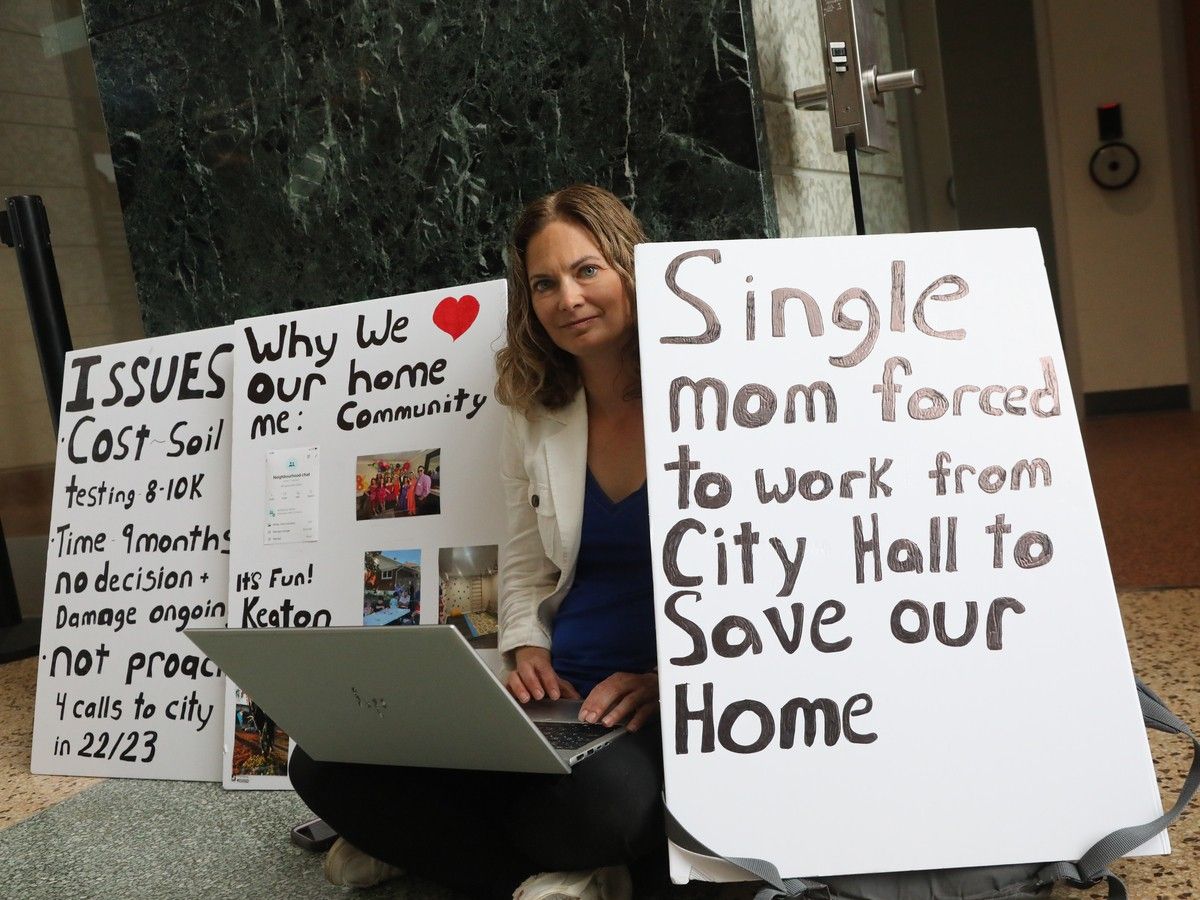
Nicole Robert doesn’t usually work out of Ottawa’s City Hall , but now she’s hunched over on the floor next to security, writing code on her laptop.
Robert doesn’t work for the city — she’s a statistical analyst for the Medical Council of Canada.
On a rainy morning on June 10, she’s sitting on the tile floor, sandwiched between three handmade signs that her nine-year-old son made.
One of them reads “Single mom forced to work from City Hall to save our home.”
She stops to pick up a phone call from her son’s school about a pizza delivery just as a group of visitors stops to photograph her.
If one of these curious passersby were to ask, Robert would say she’s at this makeshift office because it’s the only way she thinks the city will listen to her.
Shortly after purchasing her Copeland Park home in 2022, Robert found out that the roots of two city trees were damaging its foundation.
At first, she was sure it would be straightforward to remove the trees, since the red brick house she’d bought for her and her son was visibly cracking and crumbling, and a number of her neighbours’ homes were, too.
But the city’s tree protection bylaw from 2021 complicates this, Barrhaven East Coun. Wilson Lo says.
“A recent staff report noted that in a lot of parts of the city, tree canopy had decreased. So it seeks to advance some of those goals in protecting tree canopy ,” Lo says about why Ottawa residents going to the city to deal with tree root damage often receive unfavourable responses.
Though numerous homes in Robert’s area and Lo’s ward are experiencing foundation damage from city tree roots, its restrictive bylaw doesn’t serve the interests of the residents, who spend upwards of $100,000 in repair and damage costs to their houses, Lo says.
Lo already managed to get the city to look at damage in his ward as a single case. But in Nepean, Robert is still waiting.
Those sneaky trees
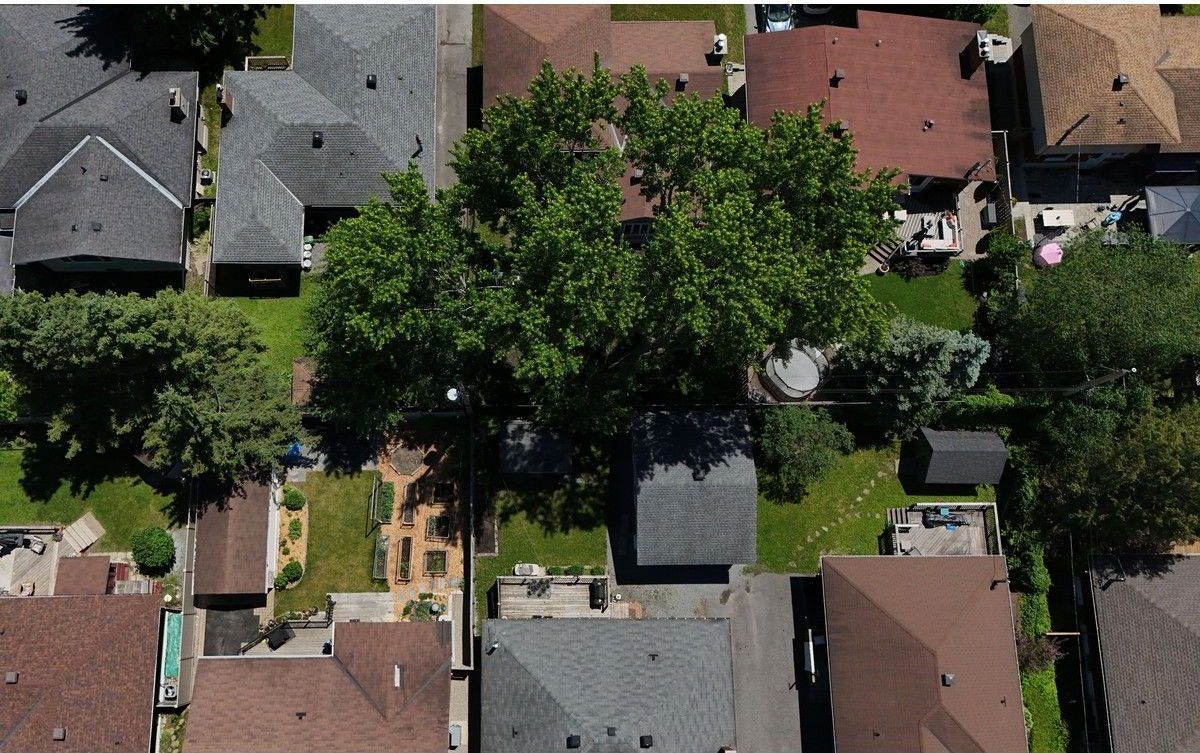
Sugar and red maple trees, especially those planted when Robert’s Copeland Park house was built in the early 1960s, are massive and beautiful. Sugar maples are Canada’s national tree, according to the Government of Ontario website.
But they can also be insidious and greedy.
Gerry Vlug, an arborist at the tree service company ArborXpert, says that in dry years (like 2025), trees require so much water that they spread way out to search for it.
“The way that trees do damage to foundations is that they go looking for more water because it’s drier, and they find water deeper down, near the foundation. They take that water, meaning the sand and soil around the house loses moisture, becomes lesser, and the house sinks,” Vlug says, adding that, while all trees can do this, there are a lot of maple trees in Ottawa.
Way out, in Robert’s case, means directly underneath her home. Roots from two sugar and red maples have sucked up the clay soil water under her house, drying it out and moving things around.
Now her front window no longer opens because it’s shifted so much from the roots, according to a September 2025 property report from EC Foundations.
It also says there are cracks throughout the bricks and foundation all around the house, and the stairway at her front door is beginning to separate from it.
Inside, the report says, drywall is cracking within the wall and ceiling finishings of the living room, dining room, kitchen, and stairway to the basement. The door to get down to her basement is difficult to open and close.
Quotes from contractors suggest she’ll need to replace her brickwork, back door, interiors, windows, the driveway, the front walkway and steps.
After digging a “test pit” around the house and finding roots there, the report suggests that the trees be taken down.
“It is well documented by the National Research Council that tree roots cause desiccation of the silty clay subgrade materials in the Ottawa area,” it reads, adding that in the summer of 2025, when the report was written, drought-like conditions in Ottawa dried out the soil and made the damage worse.
Back at city hall, Robert’s on her laptop, tallying up the estimated costs of assessments and repairs.
She says it’ll cost her about $150,000 altogether, which, as a single mother, she doesn’t have.
Trouble throughout the neighbourhood
These sneaky maples are up to no good all around Robert’s neighbourhood.
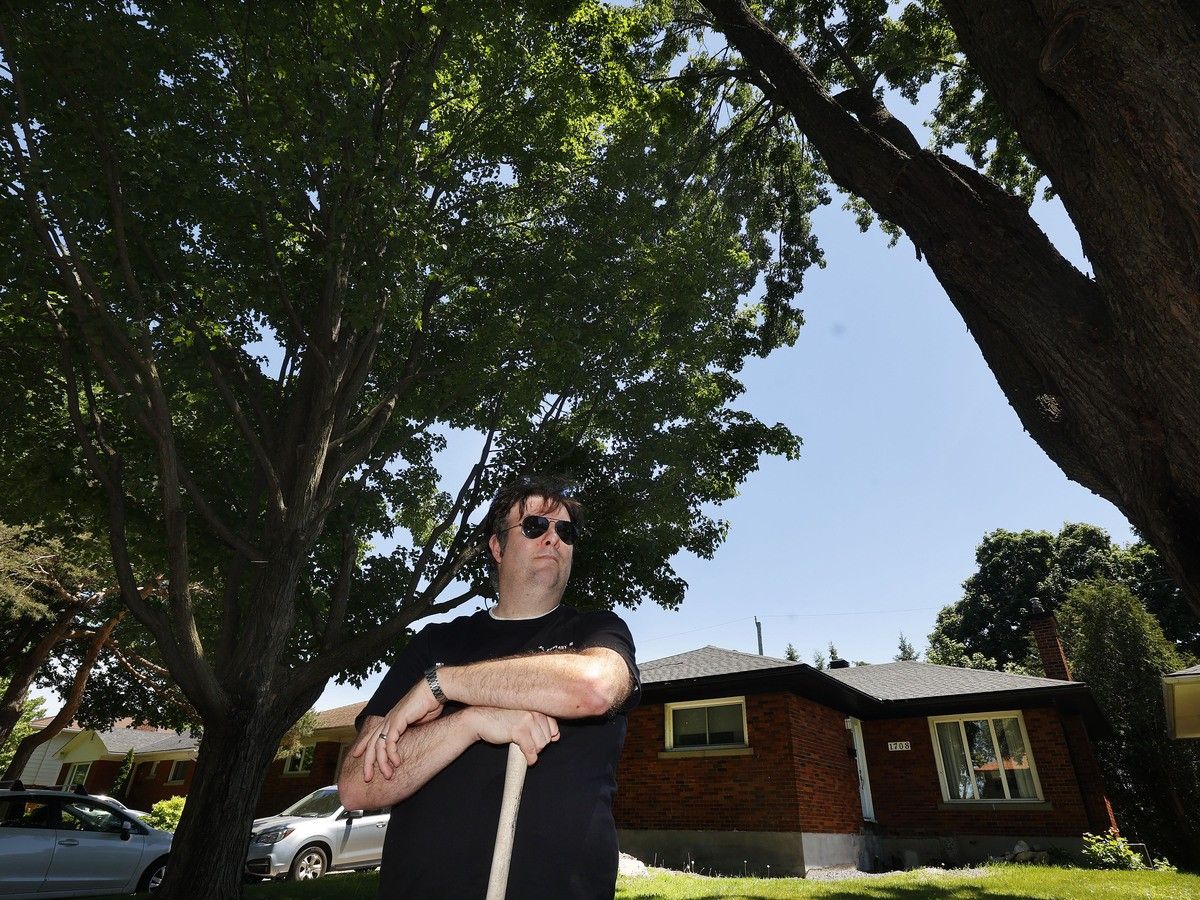
Jamie Mason, who lives just a few streets away from Robert, first noticed a crack running along his ceiling from the main floor to the basement in August 2005.
Geotechnical engineers and contractors also told Mason that the roots of a city’s sugar maple tree were the culprit.
Two decades later, along with extensive interior and exterior damage similar to Robert’s, Mason’s front door is unusable because the steps to it no longer exist.
Mason says the cost of it all is the worst part.
To prove it, though, you have to show it with costly documents even if your next-door neighbour already has.
“You have to spend from ($7,000) to $8,000 just drilling sample holes, and then they would have to go off to an engineer, and the engineer’s report would be a few thousand as well. Then there’s the estimate on how much it costs to fix it,” Mason says, adding that, after two decades of contractors and samples, the problem still isn’t fixed at his home.
He estimates the total cost will be about $115,000.
“It’s been really hard. I’ve been depressed about it because we bought this house 19 years ago, and you put a lot of work into your home. What really made me sad is that, when this work is done, the house can’t revert back to the way it was. It can just be prevented from getting worse. So my house will always have a slant in it,” Mason said, adding that it’s been a frustrating, long process for him and his family.
Robert says she can’t keep waiting for answers as her home crumbles, especially as summers continue to be hot and dry.
If she doesn’t hear back from the city soon and the house becomes unstable due to foundation damage, she says she’ll be forced to pay money she doesn’t have.
Lo believes the city bears some responsibility in compensating affected residents, and, while he says he routinely asks for trees in council meetings, is working on changing the bylaw.
“The municipal government has to be reasonable, and we have to serve the interests of our residents while balancing environmental goals. But I believe where we’re so restrictive that we won’t even remove a tree after a resident has spent $100,000 in repair and damage costs, that goes beyond reason,” Lo says.
“The mandate seems to be protecting trees at all costs, even if the cost is your home,” Robert says.
In a statement issued on June 12, forestry section manager Jason Pollard said the City of Ottawa would consider “appropriate mitigation measures, such as tree maintenance,” if a municipal tree was determined to be a significant contributor to the damage.
“In cases where mitigation is not feasible or reasonable, tree removal may be considered as a last resort,” Pollard’s statement added.
Our website is your destination for up-to-the-minute news, so make sure to bookmark our homepage and sign up for our newsletters so we can keep you informed.