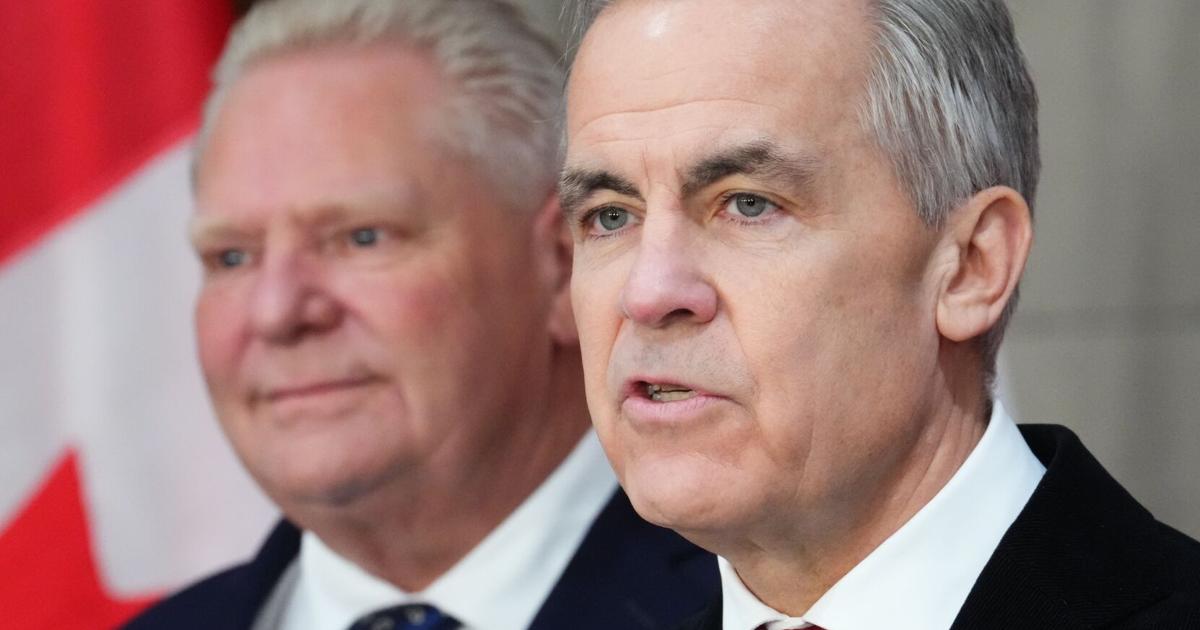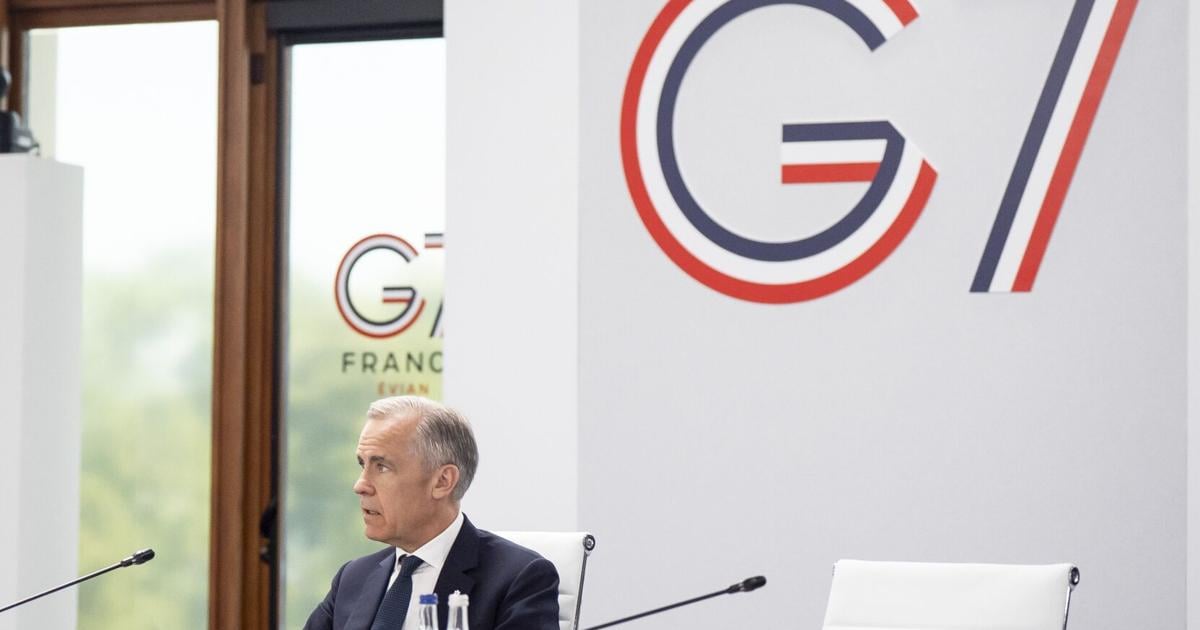
EVIAN-LES-BAINS, France — A tentative peace deal between the U.S. and Iran is a “game-changer,” according to Prime Minister Mark Carney—one that could shift the momentum of conflicts in Lebanon and Ukraine.
Details of the deal have not been publicly released, but U.S. officials have said it would include toll-free passage for ships transiting the Strait of Hormuz and an end to the U.S. naval blockade, followed by a series of performance-based incentives for Iran that, if met, would lead to the lifting of economic sanctions.
Speaking to reporters on the last day of the G7 Leaders’ Summit, Carney said that the cease-fire agreement has brought Donald Trump back to the side of Ukraine.
“In the discussions on Ukraine, there is a change in the orientation of the United States,” he said Wednesday. “There is a harder line on Russia and a more realistic position, in our estimation, about the eventual result of the war and Russia’s defeat.”
Carney said that the G7 leaders discussed the provision of additional defensive support for Ukraine against Russia.
Asked on Tuesday, Trump said he would “do whatever I can” to help resolve the Russia-Ukraine conflict. He urged Russia to make a peace deal, but downplayed his country’s involvement.
“We have nothing to do with it … It has no impact on us, other than that we sell weapons. We’re thousands of miles away.”
Carney said the Iran peace deal will also put pressure on Israel to end its incursion into Lebanon and its targeting of the Iranian-linked militant group Hezbollah. An end to the conflict in Lebanon is a crucial condition of the U.S.-Iran peace deal, but one that the Israelis have been reluctant to accept.
“Yes, there are risks. Yes, the accord has to be put into place,” Carney said of the U.S-Iran deal, which is to be signed later this week.
“But the very fact of it, and the fact that so many countries were involved in its development and are vested in its development, does bring knock-on effects, positive knock-on effects.”
In addition, Carney said Canada was “willing to help” implement or oversee aspects of the agreement, if necessary.
A joint leaders’ statement on geopolitical issues also spoke about the need to diversify energy supply routes in order to avoid market shocks like the one sparked by the closure of the Strait of Hormuz. The statement notes “the potential for Canada to deliver significant additional capacity to global markets in the coming years.”
Carney said this was in reference to a potential increase in oil and natural gas shipments from Canada to Europe and Asian markets through pipelines, including a proposed new line that would take Alberta oil to the British Columbia coast.
“When you total those up, it’s a material amount of additional energy that Canada can provide,” Carney said. “It’s quite substantial and it’s important to our European partners, in support of our Asian partners, and it was raised with me on a number of our bilateral (meetings) as well.”
The situation in Iran dominated the agenda at the G7 meeting, but it was not the only issue.
On the margins, Canada tried to press its case with the Trump administration for renewal of the Canada-U.S.-Mexico free trade deal.
International Trade Minister Dominic Leblanc and Janice Charette, Canada’s chief U.S. trade negotiator, were in France for a meeting with Jamieson Greer, the U.S. Trade Representative. With the July 1 deadline for renewal of the agreement looming, their meeting resulted in plans to talk again next week.
Carney was overheard Tuesday explaining to Trump the details of a deal with China to sell a limited number of Chinese electric vehicles in Canada, which initially angered the Americans.
But Carney did not get an official bilateral meeting with Trump in France.
“I wouldn’t take a big message from that,” he said. “I had seven or eight discussions with President Trump over the course of the last 36 hours.”
Carney said that Trump “likes the structure” of Canada’s Chinese EV agreement. And he explained that it was actually a means of attracting investment and creating high-quality jobs in Canada, rather than simply allowing entry to inexpensive foreign-made goods.
“We are only interested in Chinese investment in Canada when it’s for material Canadian production,” Carney said.
“We’re not interested in kits being put together in Canada. We’re interested if there are joint venture partnerships, Canadian people, substantial value add, Canadian labour standards, substantial jobs, etcetera, that are consistent with that.”
Error! Sorry, there was an error processing your request.
There was a problem with the recaptcha. Please try again.
You may unsubscribe at any time. By signing up, you agree to our terms of use and privacy policy. This site is protected by reCAPTCHA and the Google privacy policy and terms of service apply.
Want more of the latest from us? Sign up for more at our newsletter page.