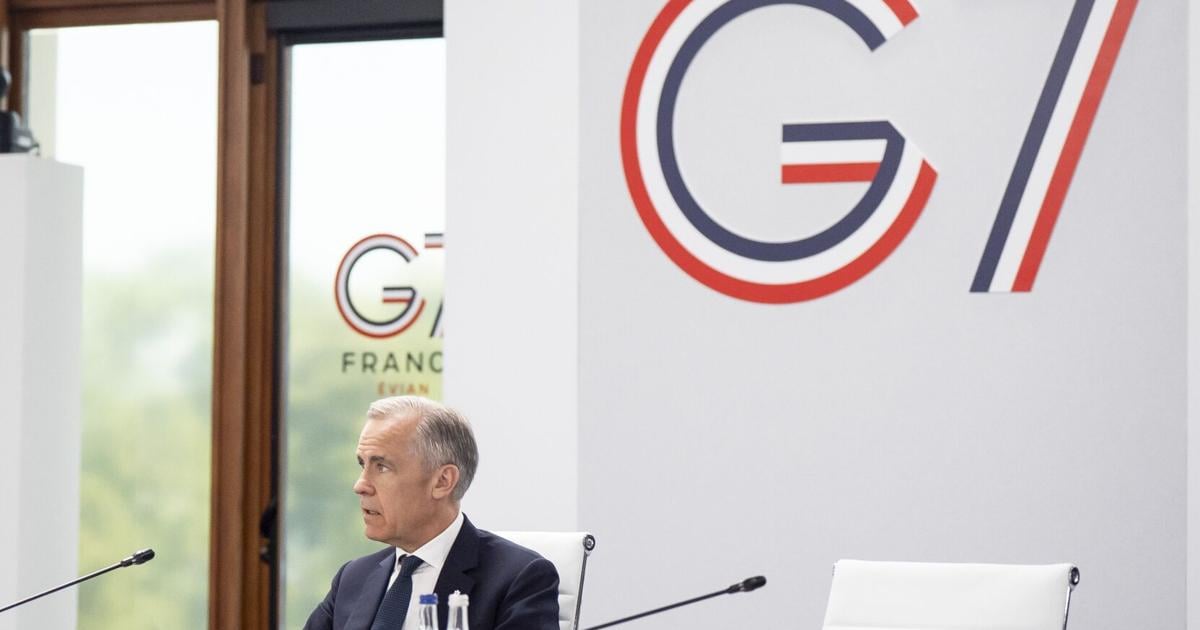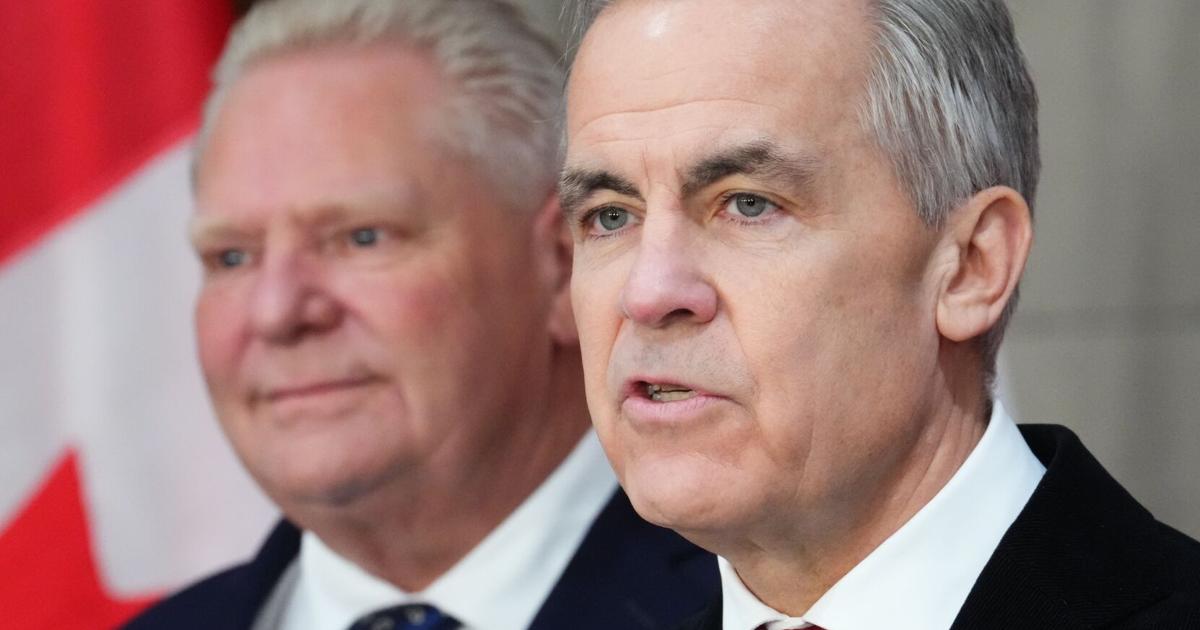
Mark Carney made the mistake of hiding behind Doug Ford, during the push for an expansion to Billy Bishop airport.
And as a result, the prospect of jets and millions more passengers flying onto and off the Toronto Islands every year — which the prime minister seemed initially to want — is looking more unlikely by the day.
Contrary to how he’s more recently presented it, Carney was not dispassionately neutral about the controversial would-be project when it first came onto the radar.
People who engaged on the subject months ago with the prime minister, or Transportation Minister Steven MacKinnon, got the impression that a bigger, more international downtown airport fit with their government’s idea of how Canada should upgrade its economic infrastructure.
There were hints of that enthusiasm in their public comments, too. In March, Carney called the prospect “a very interesting vision;” around the same time, MacKinnon noted the airport’s value when speaking to the Empire Club.
But there’s recently been a cooling in the feds’ tone, as they’ve punted Billy Bishop’s future into public consultations (despite no specific plan to consult on).
That doesn’t mean the public debate around it, going strong this week, will die out anytime soon. And the expansion could yet proceed in some more modest form than its provincial proponents have suggested.
But at this point, it may not even be the airport whose future that should be most preoccupying Torontonians — with the privatization of Pearson having more federal momentum behind it.
Depending where you stand on a bigger Billy Bishop, you can either credit or blame Ford for making Carney’s Liberals more nervous about it than they initially were. There was a relatively nuanced and understated case that Ottawa or the province could have made for new investments there.
It would have started with safety. The island’s runways already need to be extended with 150-metre buffer zones to meet federal regulatory requirements. There might also be an argument for expanded infrastructure to minimize service vehicles — delivery trucks, fire trucks, even school busses which use the airport for island access — crossing busy runways.
And the case for further expanding those runways to accommodate jets might have started from the premise that, before the current fleet of turboprop planes reaches the end of its lifespan, we should consider which other planes could best serve our future.
Instead, Ford’s bull-in-a-china-shop approach has defined the issue by two of his familiar fixations: legacy-building through giant waterfront monuments, and flexing on municipal politicians.
We’ve mostly gotten a grandiose but light-on-details case for making the city more world class by quintupling (to 10 million) Billy Bishop’s annual passenger load, which would supposedly increase its GDP contribution ten-fold.
Meanwhile, Ford changed the airport’s governing arrangement to shut out the City of Toronto, while expropriating surrounding green space and declaring a “special economic zone” where environmental assessments and other processes can be suspended.
The perception in political circles is that most Torontonians and suburbanites living far from the islands aren’t too fussed about all this.
But there’s also awareness that Ford’s handling of it has raised the temperature in a handful of ridings in the city’s core, whose Liberal MPs have become increasingly anxious. And the heat of this year’s municipal election campaign will probably raise it further, with amplified warnings of traffic snarls, overhead jets, and a loss of the islands as an urban refuge.
Throw in a coming byelection in one of those ridings, where the NDP will try to snatch the seat being vacated by Nate Erskine-Smith, and the odds of Carney signalling support in the foreseeable future look remote.
That’s especially the case because, much as it initially seemed to fit the prime minister’s agenda, Billy Bishop’s expansion has never been central to it.
This is where it’s worth circling back to the push to sell off Pearson and other large airports, for which Carney is more pilot than passenger.
There’s a perception around Ottawa that he’s favourable toward private airports because of positive travel experiences in Britain while running the Bank of England, odd though that may seem as a policy motivator.
More substantively, he’s interested in the tens of billions of dollars the sell-off could kick into federal coffers, even if it meant losing about $500 million in annual revenues (from non-profit corporations that now run airports on federal lands). And he wants to open up ownership to Canadian pension funds, to get them more invested in domestic infrastructure.
That possible win-win, though, comes with its own set of concerns.
No doubt, there’d be assurances of protections for passengers and surrounding communities. But there are only so many conditions Ottawa could attach — limitations on fees, community representation requirements in the governance model, restrictions on resales to foreign entities — if it wanted to maximize the sale price.
That discussion has yet to take hold publicly. The privatization process is still preliminary, with lots of complications to work through.
And in Toronto, Billy Bishop has been sucking up most of the oxygen.
But in a year or two, Pearson might be the airport we’re talking more about. If so, Carney better be ready to make his own case for that one.