

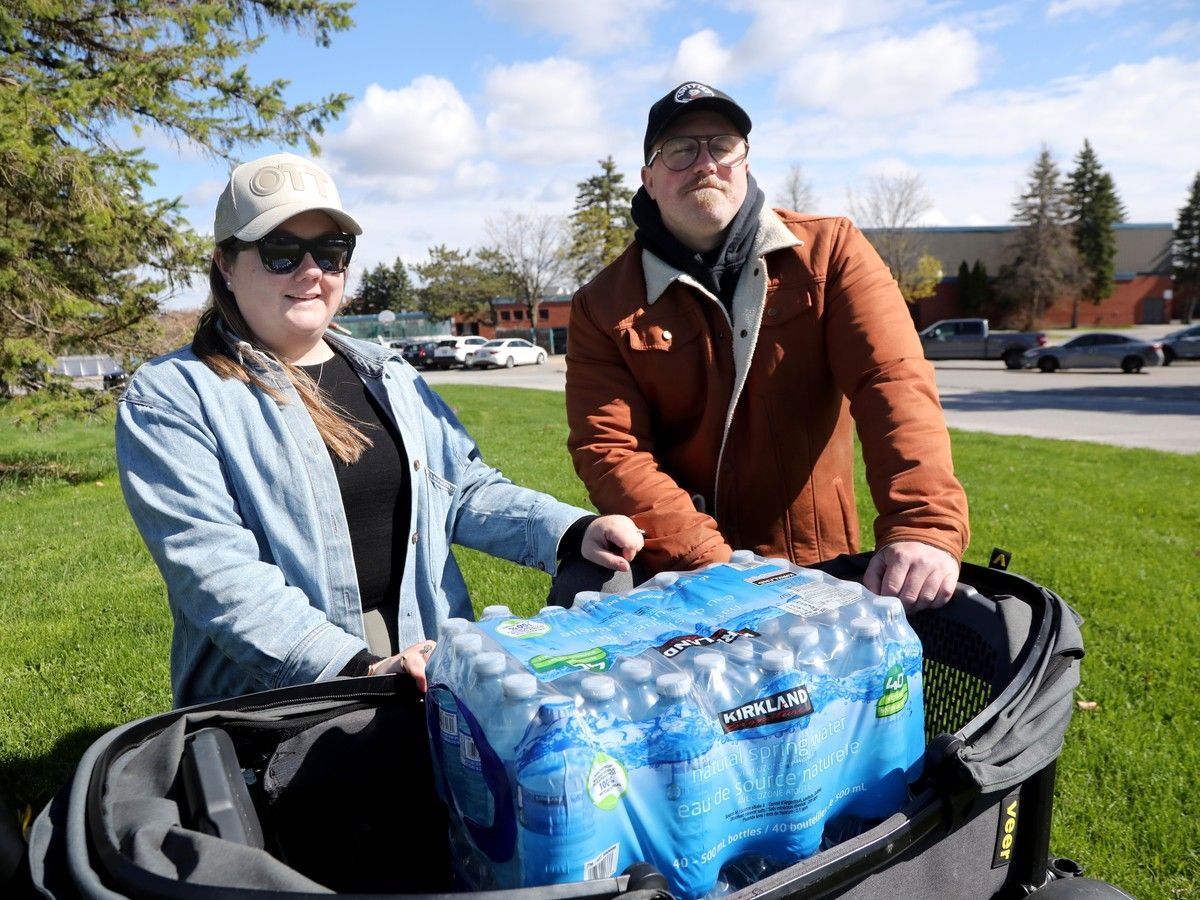
The walk to Fallingbrook Elementary is a short one. Two minutes tops, said Crystal Mask, who accompanies her daughter to school with her husband Garrett Hansen every morning.
But since March, the Orleans couple has been forced to rejig their morning routine.
Mask would hold her five-year-old child’s arm with one hand while the other gripped the handles of the veer wagon stroller carrying the two cases of water she would deliver to her daughter’s kindergarten classroom.
Mask and Hansen have now dropped off eight cases of water since March 2026. (It’d be more if other parents hadn’t started chipping in to help.) Theirs is water — they can be sure — that does not contain lead.
The dense, odourless and bluish-grey metal has been silently seeping its way into school drinking water fountains and taps across the province, with many Ottawa schools testing and failing to keep the contaminant out.
Some Ottawa parents, including Mask and Hansen, are now forming a wave of renewed parental concern over the quality of water at their childrens’ schools, all while demanding transparency from their school boards.
Mask initially caught wind of the lead saga through an Ottawa Citizen article about a March 2026 report by the Canadian Environmental Law Association (CELA).
The organization ranked individual schools and school boards across the country based on the number of tests exceeding the provincial and federal government’s limits for allowable lead levels in drinking water.
While most provinces and territories have adopted Health Canada’s most recent suggestion for a stricter limit on lead in drinking water — which went down from 10 parts-per-billion (ppb) to five ppb — Ontario’s limit remains at the original 10ppb, making it one of only two provinces and territories, alongside Saskatchewan, who have not followed the federal government’s guidance.
Lead is omnipresent in our environment, according to Health Canada’s 2017 scientific review. But over the past forty years, Canada’s efforts to reduce lead in consumer products such as paints and gasoline meant that food and water were the new primary source of exposure to lead for most Canadians.
Yet, the health side effects remain equally as detrimental.
“Effects that have been studied include reduced cognition, increased blood pressure and renal dysfunction in adults, as well as adverse neurodevelopmental and behavioural effects in children,” reads Health Canada’s report.
The national health agency said lead is present in tap water mainly as a result of dissolution (or corrosion) from leaching of plumbing systems that contain lead.
This was the case for many Ontario schools who have failed to meet provincial limits of 10ppb of lead in their water fountains.
The Ottawa-Carleton District School Board (OCDSB) had it the worst.
Out of more than 1,300 tests, the school board had 104 water fountains and taps that exceeded Ontario’s allowable lead limit of 10ppb in a school’s drinking water in 2024-2025.

The school board exceeded the federal lead limit of 5ppb on 156 occassions, according to a March 2026 report by CELA, which used publicly available provincial data for its analysis.
This made OCDSB the school board with the highest amount of tests exceeding both federal and provincial lead limits that year in Canada, according to the CELA analysis.
How have other Ottawa school boards ranked against lead regulations?
The Ottawa Catholic School Board (OCSB) , the capital’s second-largest school board following the OCDSB, had 22 exceedances of the 562 water fountains tested in 2024-2025.
Ottawa’s two french school boards, however, had little to no exceedances for lead that year.
The French Catholic school board — Conseil des écoles catholique du Centre-Est (CECCE) — tested 105 fountains and only failed twice.
The French public school board — the Conseil des écoles publiques de l’Est de l’Ontario (CEPEO) — passed all 90 tested water fountains.
The CELA report also ranked individual schools.
OCDSB had two schools among the top five on that CELA list. The third worst offender was Orleans Wood Elementary, while fourth was Fallingbrook Community Elementary.
“That’s very concerning to me as a mom of two young kids,” Mask said, adding that her son will be joining his sister at Fallingbrook come September 2026.
“We need full transparency from the school and the school board,” Hansen said, adding that there wasn’t much information from the school board regarding how the lead levels were fixed when there was an exceedance.
“We weren’t being told what was actually happening, and that’s not right in our eyes.”
In a statement to the Ottawa Citizen , OCDSB spokesperson Diane Pernaric said the school board complies with the annual lead testing mandated by the province.
Ontario Regulation 243/07, a legislation intended to reduce children’s exposure to lead in drinking water, mandates schools to conduct annual lead testing between May and October. This is because lead is more soluble with water at higher temperatures.
Pernaric wrote that OCDSB had elevated failure numbers because some of their testing occurred during the “unoccupied summer months when water consumption is significantly reduced” and lead leaches at higher levels.
She added that this year, lead testing will take place during the school year, which will bring the school board in line with the practice of other school districts across the province.
While identifying the issue is the first step, CELA’s Julie Mutis, a community outreach worker for the organization, said Ontario needs to move towards the stricter federal five ppb limit and focus on finding a sustainable solution to the issue.
Mutis said that part of the explanation for why Ottawa has high levels of lead in their water is because Ottawa is an older city.
“And older schools are generally more likely to have lead soldering or lead components in their plumbing systems,” Mutis said.
Another reason, Mutis added, is that Ottawa tends to do more than the bare minimum when it comes to testing.

In Ontario, when a school finds an exceedance in the level of lead in their water taps, the school has to prove — through just one test — that the tap is no longer showing lead over 10ppb.
“Ottawa chooses to make sure that two consecutive water tests come back under 10ppb,” she said.
“When you look for lead, you’re going to find it.”
Is Ontario fixing the issue so far?
Ontario’s current response to high levels of lead in drinking water is flushing. This means the province requires older schools — with plumbing installed before 1990 — to flush water daily by letting it run for typically about one to five minutes before the school opens for the day.
If a water fountain at a school is found to have exceeded the allowable provincial lead limit, a public health unit will instruct the school to flush daily for a certain amount of time, typically longer than five minutes.
But critics are pushing back against Ontario’s strategy, arguing that flushing is not a sustainable long-term solution.
“Schools will (opt) for flushing because it doesn’t cost a lot of money and it is technically adhering to the regulation,”Mutus says.
And yet there’s no evidence that suggests flushing protocols keep the water safe for the full school day, says Dr. Nicole Shadbolt, a family doctor at the Richmond Medical Clinic.
“It might make the water safe immediately after when they retest it (but) I have not seen any evidence to convince me that it makes it safe for the whole day.
“If the water sits for two hours before the next kid drinks from it, well then, the lead has leached again.”

Ontario used to be a leader in water quality advocacy and implementation.
“Ontario was one of the first provinces and territories to implement a testing regime back in 2007,” Mutis said. “(Ontario) was the first to be making sure all the taps are being tested and we’re reporting that information.”
But in the twenty years that followed, Mutis said the province fell behind in reflecting the new information from scientific research that showed that no amount of lead is actually safe to consume.
She said testing taps against the Health Canada standard and making an inventory of what works and what doesn’t to track systems over time is a good start.
This includes prioritizing the removal of lead components instead of simply flushing. She said this includes putting filters on taps “and making sure that highly vulnerable young children aren’t being exposed to lead.”
Are schools being transparent enough with parents?
According to a statement from the Ottawa Public Health (OPH), individual schools are responsible for communicating lead test results (specifically exceedances in lead levels) and “corrective actions” to parents or guardians.
OPH said that when lead levels in drinking water exceed the Ontario standard, the unit works with the schools “to ensure that appropriate measures are taken to protect the health of students and staff.”
Dr. Shadbolt, meanwhile, said that she had not received any communication from Merivale High School, where her two children attended, when taps and water fountains exceeded lead limits in past school years.
Instead, she found out about the issue through a Reddit post linking a database created by the Investigative Journalism Bureau.
“The data is all there but it’s not publicized,” she said. “I was a bit stunned that neither the school or the school board had ever told us about it.”
The OCDSB did not responded to questions about transparency regarding communication protocols to parents.
Dr. Shadbolt’s son, who used to drink multiple litres of water a day, mostly from water fountains at his Merivale High School, tested positive for having lead in his system.
“It wasn’t sky high but slightly elevated,” she said. After buying him a bottle to bring water to school from home, his lead level decreased in a few months.
Her kids have now developed a tell-tale sign for lead water. After learning from their own family doctor that lead actually tastes sweet, they know which fountains to avoid.
“My kids said: ‘Yeah, that one fountain is super sweet,’” she recalled.
The lesson to her kids was simple: “So, now we know that we don’t drink the sweet water,” she quipped.
But she worries younger children may not know to do the same.
Mask and Hansen say this is the case for their toddler, which is why they say they believe it’s important for parents to advocate for their children.
As for the water they bring on the wagon from home, Mask and Hansen tested their home’s tap water for lead after finding out about the CELA report.
The test results came back with less than 0.1ppb.
Our website is your destination for up-to-the-minute news, so make sure to bookmark our homepage and sign up for our newsletters so we can keep you informed.

