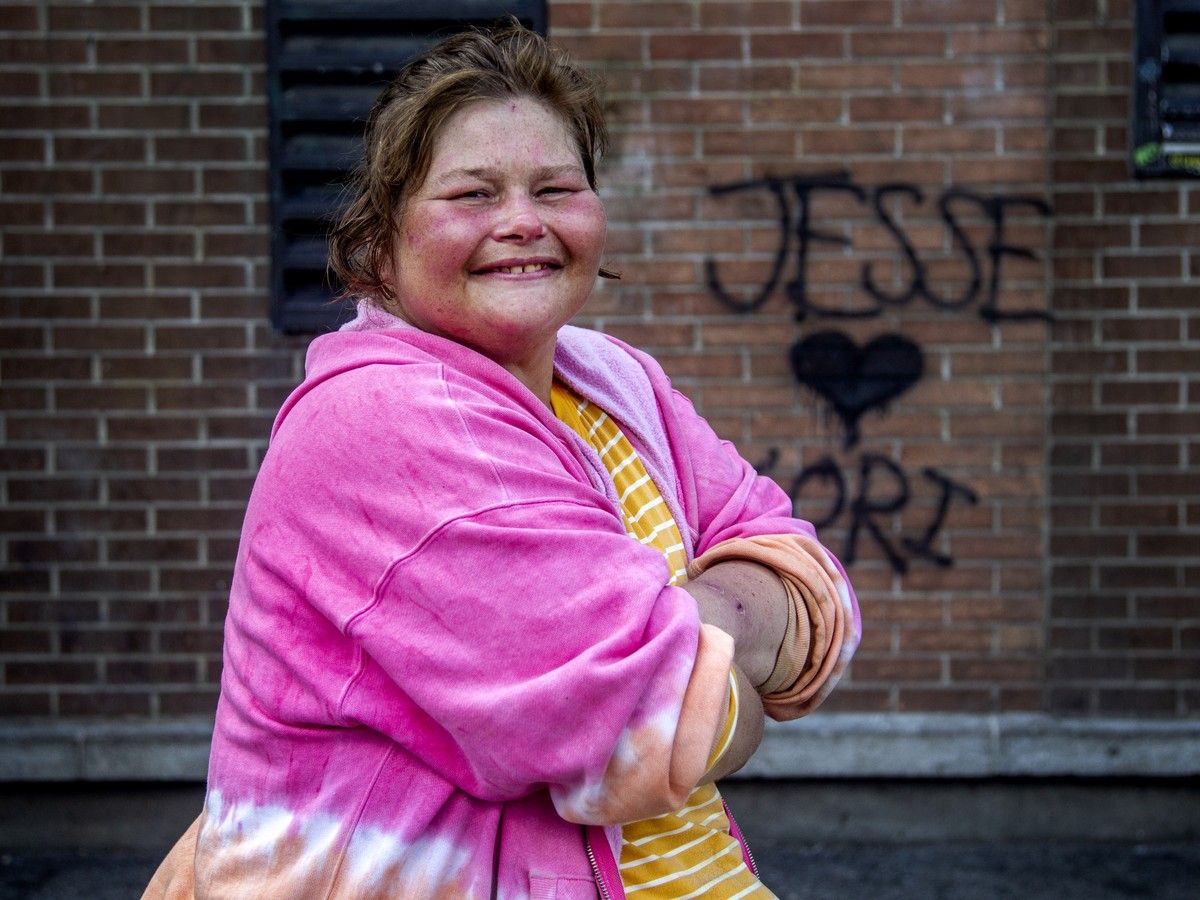
I want to tell you about an eight-year-old girl and her pet dog, Scooby.
But first, I want to tell you about one recent Friday.
It was the day before the last of Ontario’s supervised consumption sites were closed by government fiat, when people with substance use disorders lost the place where they could more safely use injectables.
On that day — June 12 — I wandered between Ottawa’s two remaining sites — The Trailer at the Shepherds of Good Hope at Murray and King Edward, and the Sandy Hill Community Health Centre on Nelson at Rideau — to ask folks how they were feeling and what they thought the closures would bring.
Most were afraid. More people, they said, will use alone. There would be more overdoses, more deaths.
One of the people I met was Amber Turner, a 39-year-old woman who smokes crack. Another was Ashley Smith, a 35-year-old whose use of fentanyl and Dilaudid saw her visit The Trailer daily.
Both were kind enough to speak with me and let me take their photographs, and as I was sorting through the photos that evening, theirs in particular stuck with me. I didn’t see drug users or homeless people in them. Instead, I saw in each — or at least thought I saw — something very familiar: an eight-year-old girl, perhaps before whatever happened happened, before the traumas pressed down so hard and narrowed their lives.
It’s a look I actually get to see frequently as a volunteer and board member with the not-for-profit Ottawa School of Theatre. It’s a look of possibility, rooted in the belief that the world ahead of them will continue to expand rather than contract. In the photos I take at the school, these youngsters are often beaming.
So I returned to the Sheps the following Monday to find the pair and ask each about their eight-year-old selves. Was that little girl still inside them? What did she want? What did her future look like then?

I ran into Ashley first, who agreed to speak with me again, but asked that I come back in a few minutes; she had something else she had to do first.
When I returned, she had reconsidered. “I don’t want to talk about my childhood,” she explained. “It wasn’t good then, either.”
“Was there a time when it was?” I asked.
“No,” she replied. “I was abused from the time I was four until I was eight, and then I went into foster care.”
Amber, in contrast, described a different childhood. The oldest of four siblings, she grew up in Brockville. She attended private school and played piano and violin. Her favourite colour was — and remains — purple. She remembers playing at St. Lawrence Park beach. She listened to rock and rap music — Eminem was her favourite — and played video games, particularly Call of Duty.
And she had a dog, a collie named Scooby.
Her childhood, however, wasn’t always carefree. Her father, she said, wasn’t a good person, and she and her mother often experienced friction — “We were too much alike,” she explained. “She had her attitudes about things and I had my attitudes about things, and they didn’t always mesh.”
I asked her if she knew what she wanted to be then when she grew up. A veterinarian, maybe? An astronaut?
“I didn’t really have any dreams,” she answered. “I just wanted to be happy and have a good life.”
She paused a moment before repeating: “I just wanted to be happy.”
Then I asked her what happened. There was another pause.
“Drugs,” she said.
Things stopped being good when she was 16. Her parents divorced and she started using crack cocaine. At odds with her mother, she left home, staying around Brockville until, at 18, she moved to Ottawa with the hope of finding more services here.
That was more than 20 years ago, and she’s been homeless since, living rough for most of that time. For the past five years, though, she’s had a room at the Shepherds, and is now on a list for housing.
She has no idea if or when that will happen.
Ontario closed its supervised consumption sites, leaving people like Amber and Ashley with one fewer source of support, safety and connection. People will argue the pros and cons of the government’s decision, but before deciding what people like these two women deserve, it’s worth remembering how they got there.
One had a dog named Scooby and loved trips to the beach. The other discovered far too early how terrible and cold the world can be. Neither, though, grew up hoping to one day be smoking crack or shooting fentanyl on a sidewalk.
They just wanted what every kid wants: to be loved, to feel safe and to be happy.