

We pull back the curtain for a glimpse of the people who keep Parliament Hill working.
When we think about the House of Commons, politicians, partisanship and heckling most often come to mind.
But there are those who work in the shadows of power, specialized workers who have refined their niche crafts to ensure that the House of Commons retains its polish and function.
Our Parliament Hill photographer Blair Gable was given rare access to document the quiet and unseen workers who maintain the foundations of Canadian democracy.

There are the carpenters who retain the beauty and function of the gothic, Victorian-era furnishings.

The Evening Citizen
There are the specialists who recycle the fillings of chamber chairs using a thick blend of horse and hog hair, a material that cannot be purchased due to its near absence in modern furniture.
There’s the staff of the Library of Parliament who preserve the living record of our democracy.
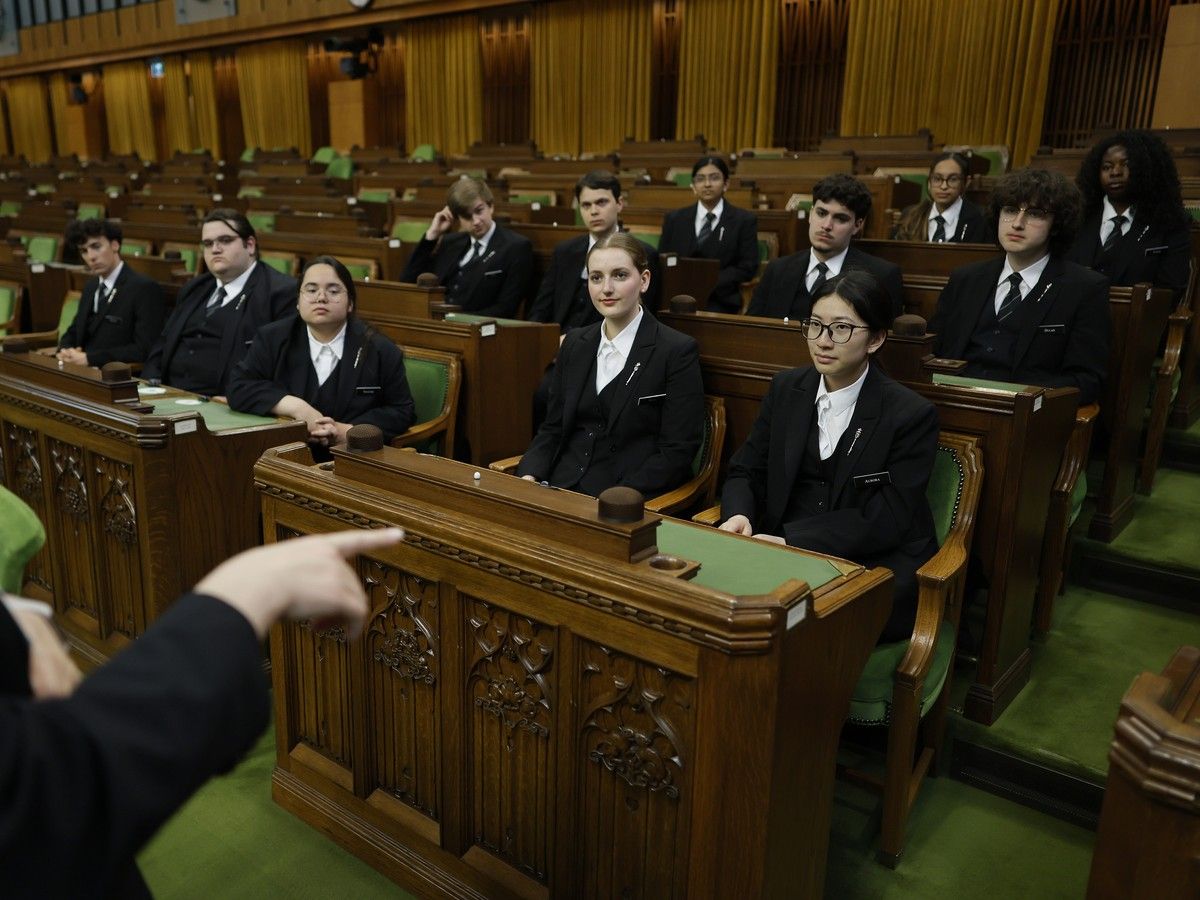
And — an extraordinary opportunity for a news photographer to capture — the young university students who hustle to make sure every member of Parliament is served during House proceedings, and ensure the House collects every piece of oration for its records.
Normally, those pages are not allowed to be photographed by news media when the House is in session. But from Gable’s lens, we can marvel at a view of the vital, unseen members of Canada’s political life.
Matteo Cimellaro
PARLIAMENTARY PAGES
A page is something like a ball boy or ball girl at a professional tennis tournament. Always in the background, they are ever vigilant, head on the swivel and ready to jump into action when the moment calls.
While politicians trade barbs, they race to collect the speeches for the parliamentary record. When a parliamentarian is thirsty, they deliver a glass of water, still or sparkling, lime or lemon, depending on the particular MP’s preference. No other beverages are allowed when the House is in session.
Pages are also responsible for delivering speeches to MPs. It’s a high-stakes environment for the young part-timers where a mistake can require literal on-the-toes problem-solving.
A page’s uniform is a black jacket and pants with a white shirt, a nod to their work as a shadow, hardly noticed by the guests in the House galleries and swift in their dodging of the cameras that capture speaking parliamentarians.
But before everything is started in the House, pages will unlock every desk, so parliamentarians have access to their materials when they enter the House.
Pages are the young students who were lucky enough to find their part-time job not waiting tables at a campus pub, but with-in the heart of Canada’s democracy marked by pageantry, green carpets and the characters who populate headlines.
Those first-year students all study at one of the universities in the National Capital Region, either in Gatineau or Ottawa.
Becoming a page is a long and rigorous process. Before hiring, there are written submissions, interviews and reference checks.
Training is perhaps even more rigorous, involving weeks of preparation that culminates in a written exam where each page must identify each of the 343 Members of Parliament.
They will have weeks to learn each face and each name. They will be quizzed and they will have to pass before entering the floor.
It’s a test that few political journalists would probably pass
Matteo Cimellaro
LIBRARY OF PARLIAMENT
The Library of Parliament, and the workers who sustain it, is something like the Hill’s brain trust — a cohort of sages and craftspeople whose predecessors survived two fires to carry on the living record of our democracy.
The natural light is brilliant in the workshop in Gatineau, Que., where two craftswomen carefully preserve and expand the collection.
On this day, assistant conservator Maria Salgado is using her favourite tool: a spoon with a flattened bowl, something like a tiny metal canoe paddle. It is a custom piece and a gift from a retired colleague.
She is calm and focused in her movements, patiently removing the glue from the text block of the book, a necessary task before rebinding.
This is just one of several projects: one book is in front of her, while another is pressed together by weights to compress the glue into its new binding. In the specialized room behind her is a summer project, a mould-ridden book that will take months to repair with a tiny vacuum.
Upstairs in the storage room, Emily Loker, the book binder, will carefully use a dropper to plop paint into water laced with a seaweed base before using a special tool of nails to wave the paint into kaleidoscopic patterns. Adding paint is a process to marble a book, which gives it a funky design, something the Library uses for special books.
To understand the rarity of some books explains the delicate nature of their work. In a boardroom, preservation librarian Shannon Mooney brings two rare tomes out of the collection.
A giant book — The Birds of America, by John James Audubon — captures in brilliant colour the birds of North America and all pictures are composed in life size.
The other is a scrapbook curated by one of Parliament’s first librarians, who collected all speeches reported in the newspapers in the early years of the House. It is our only surviving record from the period; official records did not begin until 1875.
Matteo Cimellaro
TRADE SERVICES
In an Ottawa warehouse far from Parliament Hill, the velvet cushion of a House of Commons chair is split down the middle.
The cross-section of the iconic green chair shows six springs coiled under layers of burlap, foam, felt and — the key ingredient — a tangle of horse and hog hair.
“Quite a mishmash,” said Chelsea Koski, supervisor of the upholstery and framing shop at the House of Commons trades services facility.
Horse and hog hair is the traditional padding in each of the hundreds of seats in Parliament’s lower chamber. Unlike synthetic fibres, the hair doesn’t break down. That longevity is a blessing, Koski said, because the material is “incredibly expensive” and getting harder to source.
“We actually reuse it,” she said. “We fluff it back up, and then we re-stuff it in there.”
The chairs are emblematic of the output from this little-known facility, where skilled government tradespeople restore, re-upholster and refinish furniture for the House of Commons.
As MPs come and go, workers in the shop maintain the chairs, desks and tables that make politics possible.
Though some Canadians may be surprised to learn the work isn’t outsourced, manager of trades services Sylvain Beaulne said keeping everything in-house is a no-brainer.
“Moneywise, you’re saving so much to Canadians, it’s crazy,” he said.
By refurbishing rather than replacing, Beaulne said furniture can be recycled repeatedly and made to last a lifetime.
The approach also allows workers to develop highly specialized expertise, such as the intricate hand-carved woodwork that adorns so many surfaces in the House of Commons. Wood worker Jean-Sébastien Hotte is the only person trusted with the job.
As MPs consider whether to replace many of the iconic members’ chairs with benches (in an effort to fit more MPs into a renovated House of Commons), Bealne said his team is ready to support the overhaul.
“We’re hoping by next year, we’ll get a final design for us to start building whatever they ask us to build,” he said.
Ben Andrews

