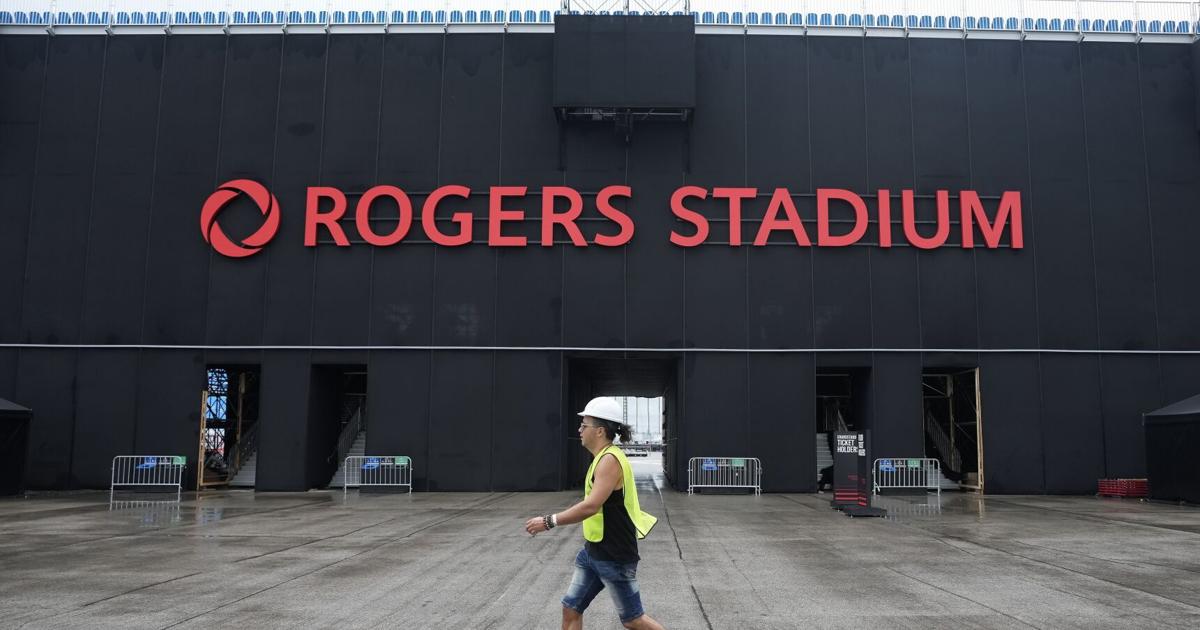
Rogers Stadium is going quiet for the next month, offering a chance to assess how Toronto’s mammoth concert hotspot is faring in its second season.
While the Live Nation-owned venue opened last summer to an array of traffic headaches, organizers have resolved many of them this year. But noise complaints continue to frustrate some nearby residents, leading one local city councillor to push for big changes. Local businesses, on the other hand, say the upside has been mixed.
Folk-pop singer Noah Kahan played the final concert at the 50,000-capacity venue last Sunday before the four-week pause began. The mid-season break may come as a surprise given Rogers Stadium operates for only about four months each year.
Live Nation says the gap is largely the result of stadium tour routing, with some artists avoiding cities hosting FIFA World Cup matches.
Colombian superstar Karol G will be first on the Rogers stage when the venue restarts on July 29, giving city officials and organizers an opportunity to consider further changes in the meantime. Once the shows are back in session, several roaring rock acts are booked to play in August, including Foo Fighters and Guns N’ Roses.
Traffic woes fixed
For Live Nation, the stadium is already running much smoother. Traffic jams that spilled into surrounding neighbourhoods last summer have eased, and concertgoers are getting out of the site more quickly after shows.
Nathalie Burri, vice president of venues and operations, said part of that improvement can be attributed to better communication with concertgoers.
A week before Rogers Stadium reopened this year, Live Nation launched an app to help ticketholders navigate their event. So far, about 70,000 people have downloaded it, the venue manager said.
“Whenever you’re working on a continuous project, you look for ways to improve everything, even if nothing is ever perfect,” Burri said.
“There are some factors outside of our control, but where we can put plans in place was ultimately what we set out to achieve.”
Burri said organizers have learned that every audience behaves differently. Fans attending Bruno Mars concerts moved through the venue differently than Luke Combs fans. Some crowds arrive earlier while others linger after the show to keep the party going.
After the first wave of Bruno Mars concerts in May, Live Nation decided to put its crowd controllers atop scissor lifts with megaphones to better direct the large crowds out of the venue. Digital signs inside the venue have also been updated to more clearly point people to exits and transit stops.
One measure of success has been fewer “crowd pulses,” or temporary restrictions on people entering Downsview Park Station to prevent overcrowding. Burri said “quite a few more” had to be done last year to get people safely into the station.
“Now, because more people are going to Sheppard West and Wilson, we’ve had to do less metered entries at Downsview,” she said.
Burri estimates 20 per cent of the crowds are now flowing to Sheppard West Station while about 10 to 15 per cent head to Wilson.
“We continue to try to educate people because those stations can absorb so much more traffic than they’re seeing right now,” she said.
About 12 TTC shuttle buses loop between the accessible entrance at Rogers Stadium and Wilson Station to help move crowds, with a priority for concertgoers with mobility challenges.
Rogers Stadium also added a new parking lot on site that accommodates about 2,000 vehicles. Access permits are prepaid through the venue’s website and Burri said the parking passes sell out for almost every show.
Noise remains the biggest challenge
Coun. James Pasternak, who represents York Centre, said noise from concerts remains the biggest unresolved issue despite new vinyl cladding installed this year to help dampen the sound.
When the Bruno Mars concerts started the season, some residents as far away as Thornhill said they could hear the bass. Pasternak worries those complaints will return once musicians are back on the stage in a few weeks.
“The stadium is in temporary hibernation,” he said on Tuesday.
“And this gives us time to work with residents, and Live Nation, to come up with some low hanging fruit, some immediate ideas, that we can fix.”
Last week, Pasternak introduced a motion at city council calling on Live Nation to pay for additional noise mitigation measures. The motion calls for steps including hiring an independent acoustics consultant to study the venue and looking at whether a sound barrier could be constructed.
Council approved the motion, and Pasternak said his office is now gathering suggestions from sound experts.
Noise has proven difficult to address because the impact can change depending on conditions such as wind direction and cloud cover. For instance, Pasternak said he received no calls from residents after Noah Kahan’s show, which took place on a calm, clear night.
“I don’t know what the decibel level was, but I can tell you there was a concert Sunday night and nobody knew except the people in the stadium,” he said.
“I didn’t get one complaint.”
Business impact is mixed
The stadium’s economic impact has been varied for nearby businesses.
On concert days, the food court at Yorkdale Mall is noticeably packed with fans of the artist who’s playing the stage, many of them grabbing a quick bite before heading to the venue.
Robert McBride, manager of Downsview Park Merchants Market, said he sees a steady flow of concertgoers in the hours before shows.
“It’s great because people who might not necessarily come to the market are here on site, so they’ll buy some beverages and shop a little bit,” he said.
“For Bruno Mars, we saw a wide demographic, from people in their 60s to teenagers.”
But Elis Koskocan, owner of Champion Döner across from Downsview Park, said there isn’t a major jump in sandwich sales at her restaurant, though she notices some hungry music fans who decide to pop in.
“I see a difference — and it’s beautiful having different cultures and different people here for their favourite singers,” she said.
“But we don’t get enough business. For 50,000 people they should be lined up.”
What’s next?
Charlie Wall-Andrews, a music business scholar at Toronto Metropolitan University, said the troubles with Rogers Stadium have unfairly overshadowed the positive impact of a huge concert venue in a city that’s lacking sizable music spaces.
“Our summers are short, so being able to have such an outdoor venue is very special,” she said.
“In the first year, there are growing pains, but it’s worked through finding its groove so that people have access to a better experience. That’s just part of the game.”
Pasternak said as city councillor he has advocated for what he describes as “a small group of people who are very upset” about persistent noise issues, while also hearing from residents who support the venue because of its economic and cultural benefits.
“Many people write me and say they do not agree with the complaints about the stadium — that they think it’s been great for the area,” he said.
“There’s no doubt that the hard rock and heavy bass create the most problems. But over a million people are going through that stadium this summer, and I can tell you that’s a lot more than FIFA is getting in this city.”