Just how nonsensical does a pitch for a new oil pipeline have to be, in the current political climate, to be rejected out of hand?
Courtesy of Doug Ford and Danielle Smith, we’re about to find out.
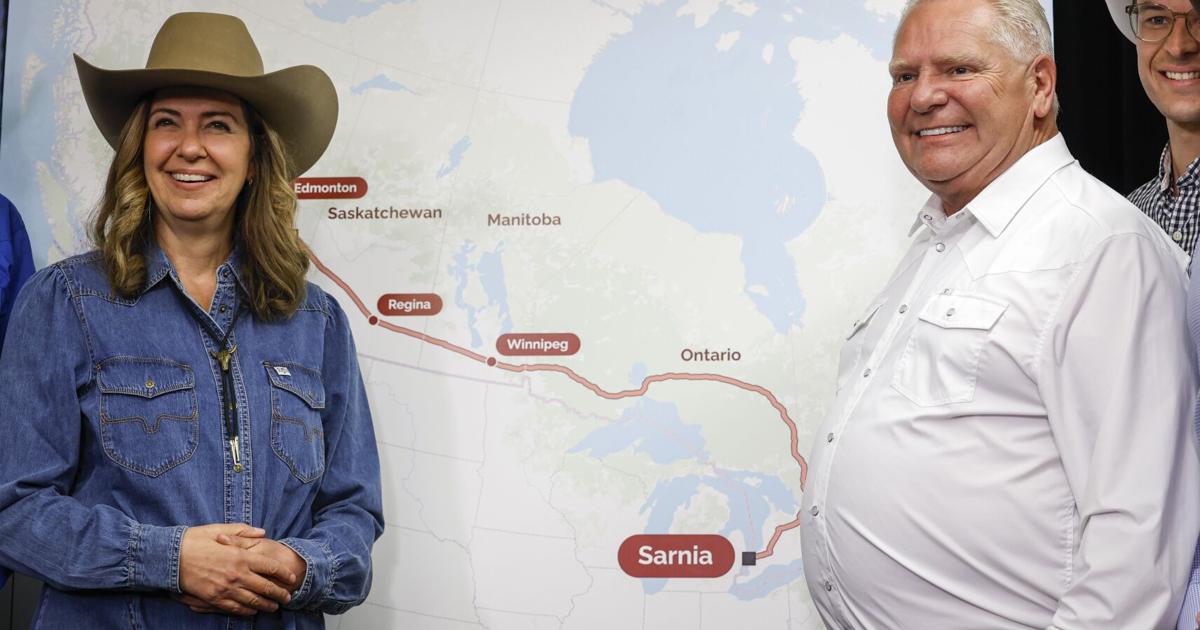
This week’s proposal by the two premiers to build a 3,300-kilometre route to Ontario from Alberta is, at the outset, not being taken very seriously even by many of the people who were pushing for the new west-coast pipeline tentatively announced a few days earlier.
You can see that in the muted and in some cases overtly skeptical responses from the oil industry itself, even amid a Calgary Stampede that’s verging on being a fossil-fuel pep rally.
You can see it, too, in the tepid reaction from a federal government that’s otherwise embraced new oil-and-gas infrastructure as both a national unity and an economic sovereignty play. Energy Minister Tim Hodgson’s office has been offering a statement saying Ottawa will review additional information provided by the two provinces, but stressing that the more advanced west-coast plan “is our priority at this time.”
You’d like to think that will be the end of it. And on merit, it absolutely should be.
We already have one new pipeline moving forward with a business case too shaky for the private sector to get behind, hence the revelation last week that the federal and Alberta governments plan to pay for 90 per cent of it.
And in almost every imaginable way, the business case for this one is shakier.
This is a line that would travel nearly three times as far — 3,300 kilometres to Sarnia, versus 1,200 kilometres to southern B.C. And compared with the west-coast line, which is to run parallel to the existing TransMountain pipeline, it would present vastly greater challenges around permitting and the duty to consult with First Nations.
In other words, the costs — which Ford is already acknowledging would probably be picked up by taxpayers — would make the roughly $40-billion estimated cost of the Alberta-B.C. project look like a pittance.
Meanwhile, there’d be much less chance of governments earning back (at least some) of that investment through tolls on the pipeline and royalties on new oil-sands production to fill it. That’s because, with major questions around whether there will even be enough new production to fill the west-coast pipeline’s proposed new capacity of one million barrels daily, it’s highly unlikely there’d be enough additional oil coming out of the ground to fill this one.
Nor, unlike the B.C. pipeline, does it have much potential to decrease reliance on exporting to the U.S. by providing access to Asian markets. It should speak for itself that the Great Lakes are not the Pacific coast. Nor for that matter is northern Manitoba’s Port of Churchill, to which Ford suggested an (even more costly) pipeline extension could be added — notwithstanding that it’s a seasonal port in a province that has yet to buy into this scheme.
And, no, it probably wouldn’t make gasoline cheaper for Ontarians, given that prices are tied to international markets.
The closest the proposal gets to any sort of plausible economic case is a security one: that by providing an alternative to Enbridge’s Line 5, which currently carries oil from Alberta to Ontario on a route that travels through Wisconsin and Michigan, it would make Canadian consumers less vulnerable to U.S. whims.
But that might be a more compelling case if the aforementioned construction challenges didn’t make it unlikely this project would be completed sometime before the late 2030s, at best.
By then, based on both market forces and the federal government’s stated goals, Ontarians (and other Canadians) should be relying less on oil and more on electric power.
So the tens of billions of dollars that Ford seems eager to spend on this, beyond what other governments would have to put in, could either keep this province unnecessarily locked into an expensive, inefficient and polluting energy source, or leave us with a trickle of oil going through a white elephant.
All of this — even some of this — should be enough to dissuade anyone who should know better from pretending this is a viable plan, or from being too polite to say otherwise.
Because we should know by now what happens otherwise.
The more that the would-be pipeline is framed as yet another necessary correction to Justin Trudeau’s supposed reign of terror against fossil fuels, the more that the current Prime Minister expresses openness to it for fear of being lumped in with his predecessor, the more that supportive op-eds start popping up, the more that it becomes a topic of discussion at summer barbecues and around dinner tables — it can all add up to the thing taking on a life of its own.
And if that doesn’t actually get it built, because of all the impracticalities, all the better for those who wish to stoke Albertans’ grievances with the rest of the country.
That’s the last thing we need, as Alberta heads into a fall referendum in which separatism will be on the ballot.
Or, for that matter, as we try to avoid this one, controversial form of infrastructure continuing to dominate our nation-building discourse.
Nobody was asking for this until a few days ago, and it’s hard to understand why Ontario’s premier decided now was the time for a clumsy attempt to jump on the pipelines-for-national-unity bandwagon.
But the faster we laugh it off as such, the better.