

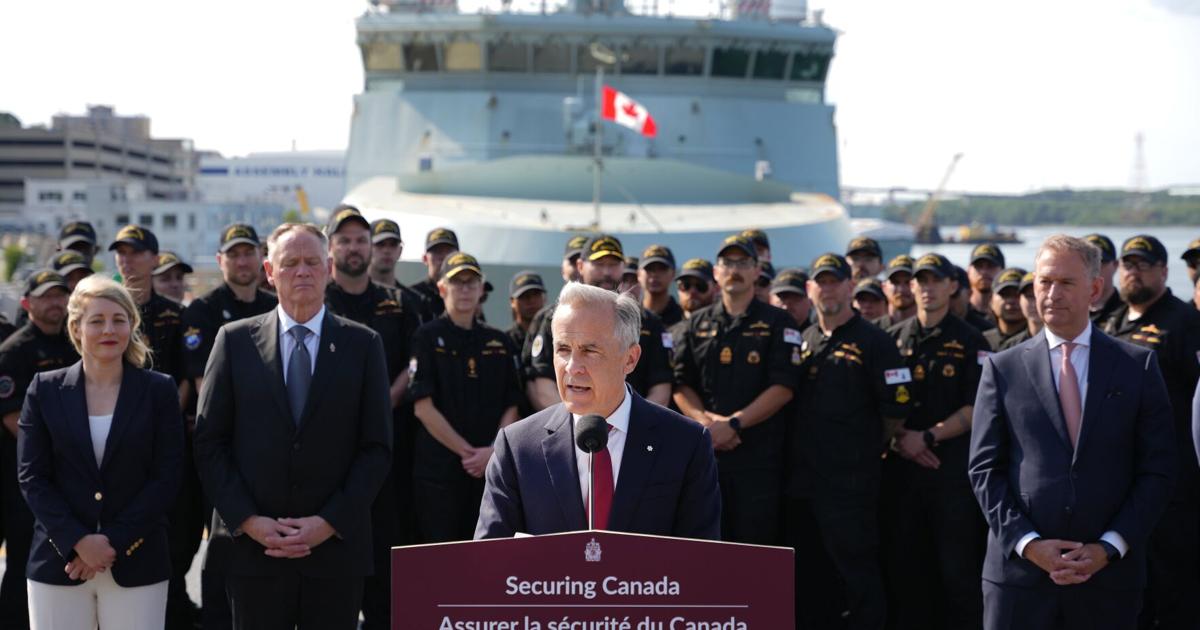
It will take close to a decade before the submarines Canada wants to buy will have any in-the-sea impact on the country’s security.
But Prime Minister Mark Carney will nonetheless get a boost from Monday’s announcement at the NATO leaders’ summit that began Tuesday.
That’s because it’s right on track with the theme of this year’s gathering in Ankara.
In 2025, U.S. President Donald Trump insisted on members of the military alliance greatly increasing their defence budgets to five per cent of GDP.
This year, the impetus is to start spending that money.
Carney’s carefully timed announcement — just before taking off for Turkey — that Canada will negotiate the purchase of a dozen submarines from German company TKMS sends a message that he has understood this and plans to meet the expectations.
Expect to hear it often over the course of the two-day summit that the sub contract, when it is eventually signed, will be “the largest defence procurement in Canadian history.”
It’s something the Canadian public may have difficulty getting too excited about, even if the winning bid promises it will have a direct economic impact of $86 billion and generate many Canadian jobs.
But the larger consideration — as seemingly always for Canada — is whether it will be enough to impress Trump.
The number of submarines Canada hopes to acquire starting in 2034 won’t be enough on its own. The Americans currently count a submarine fleet six times the size of the future fleet that Canada plans on having.
But Canada needs to find that sweet spot in which Washington views Canada as an ally in North America’s continental defence and not a liability — one vulnerable to emergency tariffs, taunts and annexation threats.
To that end, Carney has sought to carve out an Arctic specialization for Canada within the NATO alliance, and has been purposefully forging closer ties with the Nordic nations with northern shores.
He’s also positioning Canada as a financial problem solver by hosting the new Defence, Security and Resilience Bank, a financial institution meant to raise and distribute money for large-scale security purchases of the kind that might be needed to take up the slack of a less-interested United States.
On Tuesday, Carney announced the backing of Albania, Belgium, Greece, Latvia, Luxembourg, Romania, Turkey and Ukraine for the bank.
Carney isn’t alone in the larger struggle with Washington.
All the European NATO leaders are arriving in Ankara spooked by Trump’s latest threats to reduce the American troop presence on the continent.
U.S. Defense Secretary Pete Hegseth last month announced a review of the country’s military presence in Europe, part of what he has described as Washington’s effort to create “NATO 3.0” — a better equipped and more capable alliance in which European member states are “stepping up to take primary responsibility for the defence of Europe.”
NATO Secretary General Mark Rutte has preferred to describe the potential American pull out as a necessary “rebalancing.”
“Otherwise, the alliance, to be honest, would long-term probably not have been sustainable,” he told reporters Monday.
“We are now creating an alliance which is sustainable where the U.S. knows it is a fair deal.”
The precursor to the NATO leaders’ summit — the Defence Industry Forum — highlighted the allied effort to “turn cash into capabilities,” as NATO deputy secretary general Radmila Šekerinska put it.
“We will announce tens of billions in new contracts that will provide the crucial kit we need to deter and defend,” Rutte said.
On Tuesday, NATO member states and defence companies announced plans to replace its aerial surveillance fleet of planes, to spend $40 billion on counter-drone capabilities and to expand its space launch network to more quickly send satellites and other equipment into the skies.
Trump is also expected to announce that he will lift a ban on selling American F-35 fighter jets to Turkey during the summit, reversing a decision he took during his first term after the country purchased Russian S-400 anti-aircraft systems.
The fear at the time was that using the two technologies would give Russia insight into the capabilities of the fighter jets.
Despite the spending promises and economic opportunities, the American president arrives in Turkey in a bit of a funk about the alliance. He is still upset that none were willing to join in his war with Iran or his attempts to forcibly unblock the Straits of Hormuz, which paralyzed a vital shipping lane for energy, fertilizer and other goods.
“I know your irritation about that,” Rutte said last month in a visit to the White House to set the stage for the summit.
But he reminded Trump that Europe opened its runways to thousands of American military flights over the course of the Iran war.
“Generally speaking, your European allies have been there with you. I really want to make the point.”

