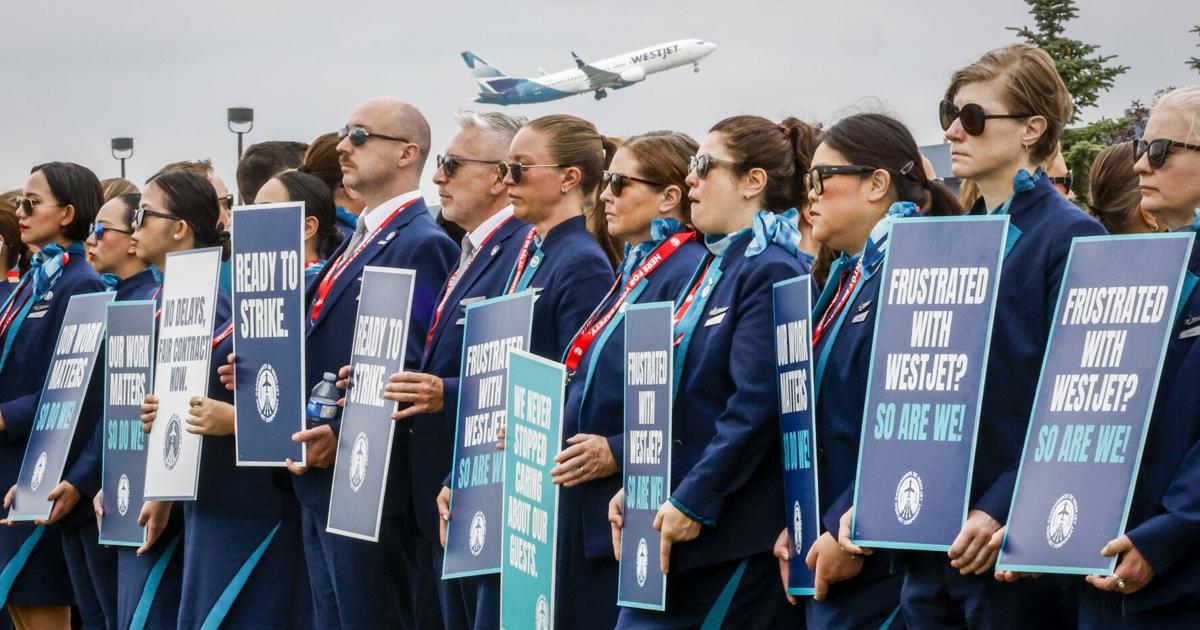
More than 4,000 WestJet flight attendants have voted to give their union a strike mandate that could allow members to legally walk off the job as early as Aug. 2.
The Canadian Union of Public Employees Local 8125 announced Wednesday morning that 97.3 per cent of members cast a ballot and voted 99.4 per cent in favour.
The union has been bargaining with the Calgary-based carrier since last fall for a new collective agreement to replace the one that expired on Dec. 31, 2025.
“The members of CUPE 8125 are united and determined. They voted to strike because they stand behind the bargaining priorities that they have identified, especially pay for all hours of work performed,” said Alia Hussain, president of CUPE 8152, in a statement.
“WestJet should do the right thing,” she added, “and prevent travel disruptions for their passengers.”
The strike vote is necessary to move negotiations forward after talks with WestJet stalled, the union said.
WestJet Group CEO Alexis von Hoensbroech said in a media release that the airline remains “steadfast” in its push for a meaningful deal with the union, one that recognizes flight attendants’ contributions while keeping WestJet “competitive and sustainable.”
“A strike authorization vote is a common step by unions in context of the overall labour negotiation process and does not mean a strike will occur,” Hoensbroech said.
Union president says WestJet flight attendants among the lowest paid in industry
WestJet flight attendants are among the lowest paid in Canada, Hussain said, and have performed unpaid work, including during flight delays and while handling ground evacuations and medical emergencies. Those issues, she added, are among the main sticking points in bargaining.
Ground-duty pay was also among the most contentious issues in Air Canada flight attendants’ contract fight last summer.
“We want all hours paid,” she said. “However, we’re looking to be reasonable, and we’re looking to find a deal.”
WestJet compensates crew members through a complex “credit hour” system. It treats 80 credit hours a month as full-time work and pays a starting wage of $28.80 an hour as of January 2025, or $2,304 a month.
“The system has to end,” she said, “and it’s not enough for big corporations that rake in billions to say that they can’t afford to pay their largest working groups, who are predominantly women.”
What will happen next?
Hussain told the Star that the union has scheduled a round of bargaining with WestJet next Monday.
The flight attendants’ union must provide 72 hours’ notice before it can legally walk off the job. Following a 21-day cooling-off period, cabin crew could go on strike as early as the August long weekend.
Last August, Air Canada began cancelling daily flights two days before the official strike date to gradually suspend all its operations, affecting 130,000 customers a day.
Despite a federal back-to-work order issued less than 12 hours after the strike began, the union representing Air Canada’s flight attendants refused to comply, allowing the strike to continue for 72 hours before a tentative agreement was reached.
Steven Tufts, an associate professor of labour at York University, told the Star there’s a possibility the federal government will intervene in WestJet’s bargaining and send the dispute to arbitration before a strike even begins.
Tufts is one of 70 Canadian labour scholars who signed a letter denouncing the government’s “intensified efforts” to limit workers’ right to strike, saying it could jeopardize their ability to win better wages and working conditions.
“It would be politically costly for the Liberals to do that,” Tufts said.
What are the options for travellers?
Air passenger rights advocate Gabor Lukacs said the most important thing for travellers to know is that WestJet is obligated to rebook passengers on a competitor airline’s flights, even if WestJet may not comply with the law.
If a flight is cancelled before the strike happens, the airline must rebook passengers on the next available flight it or its partner operates within nine hours, or if unavailable, on the next available flight operated by any competitor.
The airline also has to provide passengers with a lump-sum compensation of up to $1,000 for meals and accommodation, Lukacs said.
Once the flight attendants walk off their flights, the time allowed for the airline to first rebook passengers on its and its partners’ flights will be extended to 48 hours, he added.
In this scenario, no food or accommodation is owed if the cancelled itineraries are within Canada.
“If they refuse to rebook you, the next step is you buy yourself a ticket on another airline and later on make WestJet pay for it,” Lukacs said.
“That may involve suing WestJet in small claims court, but they will have to pay for it.”