Editor’s note: This story is part of an OMNI News special feature examining Canada’s Hong Kong pathway, the backlog facing applicants, and what comes next as the program nears its end.
When the federal government launched the permanent residence pathways for Hong Kong residents, it was described as a faster route for eligible Hong Kong nationals already in Canada to become permanent residents.
Five years later, the Hong Kong pathway is set to close Aug. 31, while tens of thousands of applicants are still waiting.
For applicants like Roger Yeung, the wait is no longer just about immigration paperwork. It is affecting careers, education, and the ability to plan a future in Canada.
A career plan put on hold
Roger Yeung has been living in Vancouver since April 2023. He applied for permanent residence under the Hong Kong pathway in October 2024, but says there has been no progress.
“Just being hopeless, and being here, and at the same time, there’s nothing you can do,” Yeung said.
Yeung worked at a construction engineering company after moving to Canada. He says the company saw potential in him and was prepared to support his training for a more professional role.
But without permanent residence, tuition could cost about three times more under international student fees. The plan was put on hold.
“They see the potential in me, which I really appreciate,” Yeung said. “And they thought that within a short period of time, they can sponsor me to study and then become one of the professionals, based on what they need. And it’s just very unfortunate that I was going to disappoint them.”
Yeung eventually left the job.
A family rebuilding careers from the beginning
Simon Ling and Agnes Yan are also waiting for permanent residence under the Hong Kong pathway.
The couple moved to Vancouver from Hong Kong with their young son in 2024. Ling was an optometrist in Hong Kong, while Yan was an elementary school teacher.

But without permanent residence, Ling says it is difficult to pursue the local qualifications needed to return to his profession in Canada. For now, he can only work as an optician.
Ling says he would need to complete additional training and pass national exams before becoming qualified as an optometrist in Canada. But without PR, the cost is much higher.
“If you don’t have PR, it seems to cost more than $20,000 to $30,000 Canadian every half academic year,” Ling said in Cantonese. “By the time you finish the program and exams, it could be more than $100,000 Canadian, close to HK$800,000.”
Yan said the uncertainty has made the family hesitant to invest in more education.
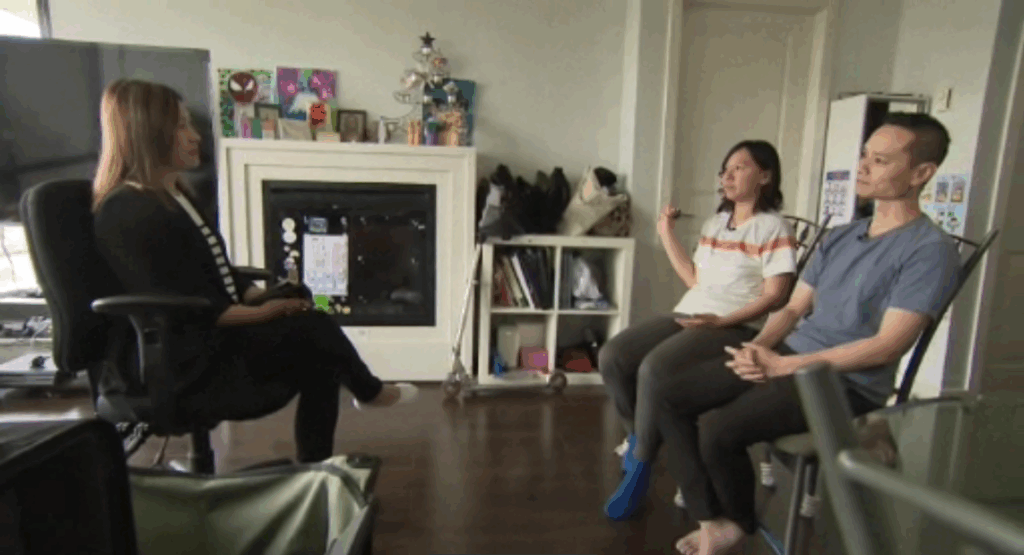
“We don’t dare to invest in it, because there is so much uncertainty,” Yan said in Cantonese. “What if we study and invest all that money and effort, and then we are suddenly told we have to leave? Would everything be wasted?”
For families like theirs, the delay affects more than immigration status. It affects careers, education, and long-term plans in Canada.
More than 33,000 applications still waiting
The Hong Kong pathway was introduced in 2021, after Beijing imposed the national security law in Hong Kong. At the time, Canada said it was concerned about human rights and freedoms in the city.
The pathway allows eligible Hong Kong nationals already in Canada to apply for permanent residence through recent Canadian education or work experience.
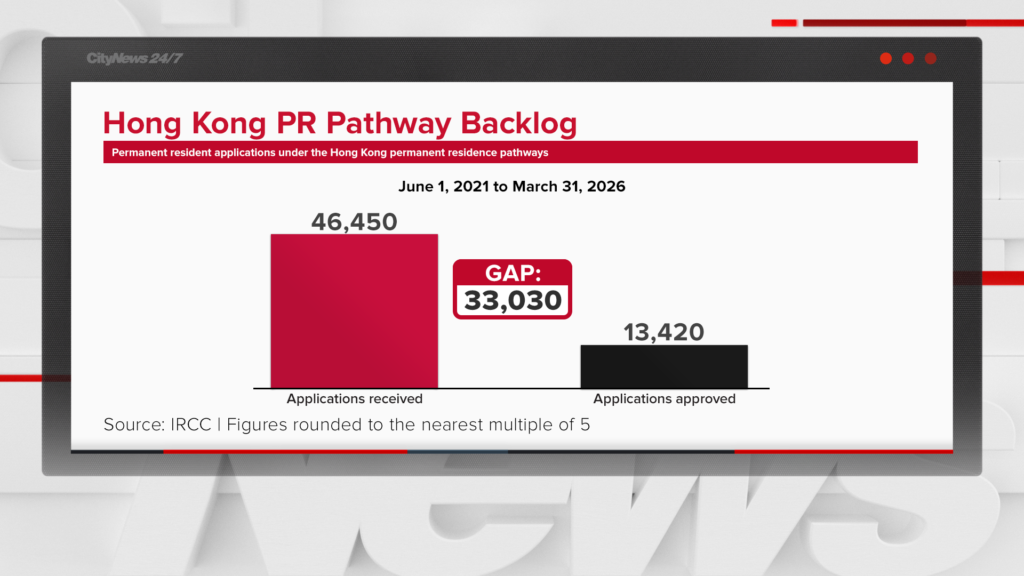
In a statement to OMNI News, Immigration, Refugees and Citizenship Canada (IRCC) says it has received more than 46,000 permanent residence applications under the Hong Kong pathway. More than 33,000 are still in the backlog.
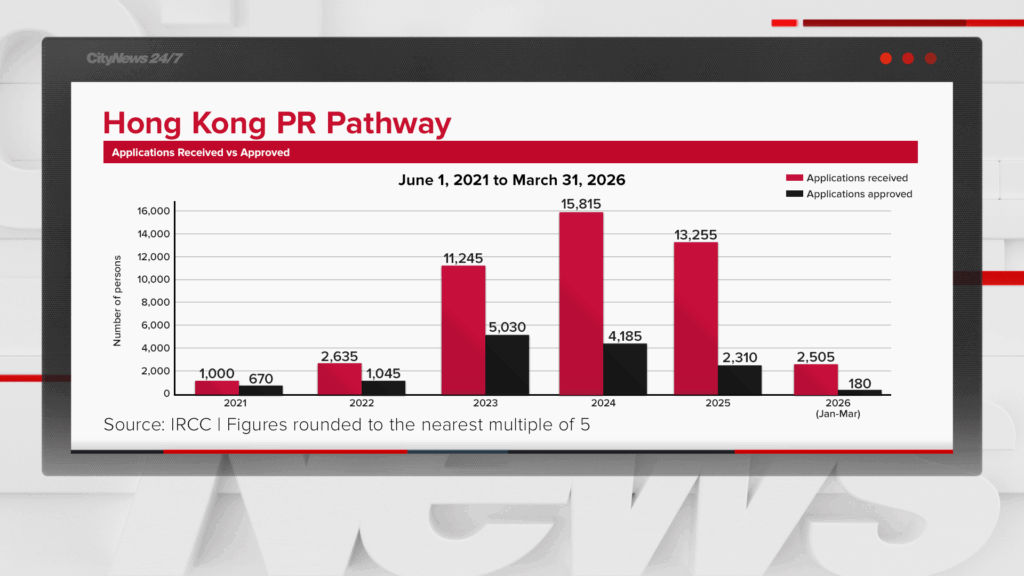
The department said the pathways have helped thousands of Hong Kong nationals stay in Canada, but noted Canada is admitting fewer permanent residents in most categories than in previous years.
IRCC says Hong Kong pathway applications are now included in the Humanitarian and Compassionate and Other category, where 6,900 admissions are projected in 2026 and shared among several commitments and priorities.
The department said new Hong Kong pathway applications are now estimated to take more than 10 years to process. Applicants can apply for open work permits while they wait.
Critics call for action
NDP immigration critic Jenny Kwan says the wait is unacceptable.
Kwan says the federal government originally promised expedited processing for Hong Kongers under the lifeboat program, and that the process appeared to work in the first year.
“The government, in this first year of implementation of the Lifeboat Stream A, Stream B program, they did expedite the process,” Kwan said.
“But then, over the years, we started to notice that the government was slowing down in the processing.”
Kwan says the problem grew after Hong Kong pathway applications were grouped under the Humanitarian and Compassionate and Other category.
She said that category also includes other urgent commitments, including Ukraine and Sudan, leaving Hong Kong applicants competing for limited space.
“For Hong Kongers, there are over 33,000 applications waiting in the backlog, and that’s just for Hong Kongers,” Kwan said.
“If you add in Ukraine and Sudan, you can just imagine how lengthy the wait is.”
To clear the backlog, Kwan says the federal government should change the Immigration Levels Plan quota and allocate enough spaces to process existing applications. She also called on Ottawa to restore immigration staffing levels.
“Rebuild the trust. Honour what you promised Hong Kongers, and deliver on the program. Change the quota now,” Kwan said.
Calls for certainty
Liberal MP Wade Chang says qualified applicants should be given more certainty while they wait.
“For those qualified applicants under the Hong Kong Pathway, I would urge the IRCC to issue approval in principle, so those families can feel certain and assured that they have a future here in Canada,” Chang said.
Advocate group Hong Kong Watch is also calling on Ottawa to allocate spaces from either the economic immigration quota or the refugee quota to the Hong Kong pathway.
Spokesperson Lanson Chan said past one-time measures, including the temporary resident to permanent resident pathway and a measure for protected persons, show there are precedents for clearing the backlog.
“We believe there should be a way to create a Hong Kong Pathway by following these precedents,” Chan said.
A message to applicants
Chan, who also came to Canada through the Hong Kong pathway, tells applicants to “hang in there” and says the long wait is why he continues to advocate on the issue.
Chang urges applicants not to give up, saying many have already built their lives in Canada.
Kwan says she will continue to pressure the federal government.
“I stand with you. I will fight for you,” she said.
The Hong Kong pathway is set to close Aug. 31, 2026.
But for thousands of applicants already living in Canada, the bigger question is when their wait for permanent residence will finally end.

Add CityNews Toronto as a trusted source on Google to see more local stories from us.