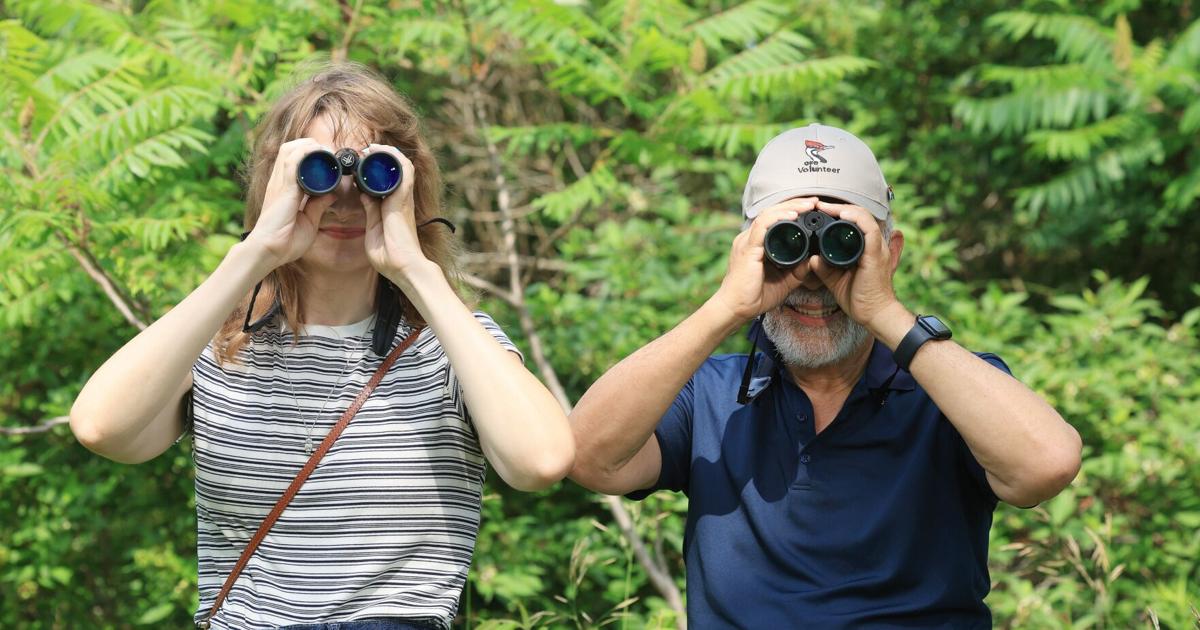
Anthony Le squinted up at the tree through his binoculars. Perched atop a willowy branch, preening itself in smug satisfaction, was what appeared to be a chubby mango with wings.
The gorgeous diva, real name cedar waxwing, whistled once and flew a loop around its tree, drawing “oohs” and “aahs” from the group gathered below. Le, 29, smiled and offered me his binoculars to take a look.
At a time of rampant social isolation, when more and more people are living through their phones and computer screens, a growing number of Torontonians are flocking to analog hobbies like birdwatching to make new friends and reconnect with nature.
Birding has “historically been seen as an old white guy thing,” said our group’s co-leader, May Matchim, a naturalist and documentary maker. But in the past decade, a flood of younger and more diverse Torontonians has breathed new life into the hobby. “It’s been really lovely to see that change happen in real time.”
It’s a good thing too: This trend coincides with growing evidence of the neurological and mental health benefits of birdwatching, from reducing anxiety and stress to rewiring the very structure of our brains.
That’s what led me to spend a warm Sunday morning with the Toronto Ornithological Club (TOC), a nearly century-old birding society in the city, on its Pride Month birding walk on the last weekend of June.
A morning with the birds
Stepping out of my car, I was surprised to find a group of mostly 20- to 30-somethings milling around the entrance pavilion of Tommy Thompson Park, binoculars in hand. Many of them were newbie birders just like me.
Our group’s co-lead along with Matchim, John Nishikawa, chuckled when I remarked on the demographics. “We used to be a club of experts, academics mostly,” said Nishikawa, who is the TOC’s director of conservation. “But after the COVID-19 pandemic, the interest in birdwatching exploded because everybody wanted to get out of the house.”
After a quick introduction, our group of 19 set off into the park. Strolling down the sun-dappled path, ensconced in birdsong and the gentle morning breeze, I felt a knot in my gut begin to loosen. Amid my busy life in Toronto’s concrete jungle, it felt profoundly grounding to slow down and immerse myself in nature and conversation with my fellow birders.
Le felt the same way. The Toronto student said he was on a “healing journey” after recently getting out of a relationship. “I’m trying to get out of this mould that I’ve forced myself into because I was uncertain and scared,” he said. “I just wanted to go out and start living more.”
He borrowed a free birding kit from Toronto Public Library, complete with binoculars, birding guide and backpack, and got started.
How birdwatching changes the brain
At a time of shrinking attention spans, birdwatching can be an exercise in mindfulness and living in the moment. “It’s a meditative activity,” said Agatha Nyambi, a 34-year-old Ph.D student who drove from Hamilton to Toronto to attend TOC’s birding walk. “It helps me focus on something else completely for however long that I want to spend.
While learning to distinguish the fine details between different bird species and songs, we’re slowly “training our brains to perceive the world in a different way,” explained neuroscientist Allison Sekuler, the president and chief scientist at Toronto’s Baycrest Academy for Research and Education.
“You’re training your memory, you’re training your attention, you’re training your perception,” she said. This improves our overall brain health, and may also help prevent or delay the onset of dementia and cognitive decline. “The stronger your brain is in terms of its cognitive abilities, the more give it has if something goes wrong,” Sekuler said.
This process can result in visible structural changes in the brain, said Erik Wing, a neuroscientist at Baycrest Hospital and York University. In March, Wing published a study suggesting that experienced birdwatchers had “more densely organized brain structure” in regions involved with visual perception, memory and environmental awareness.
“Birding involves a lot of different types of cognitive processes, which is one potential reason why we’re seeing these changes,” Wing said.
Another major benefit of the hobby is it’s often done in a group. “When you spend time with birding groups, you start to recognize people and it helps you feel like part of the community,” Nyambi said.
This isn’t just a nice-to-have: Social isolation is a major contributor to cognitive decline, and can increase risk of dementia by about 60 per cent. Loneliness is as bad for you as smoking 15 cigarettes a day, Sekuler said. “The good thing about birding is that, no matter where you go in the world, you can find a community in it.”
The joy of touching grass
“I think there is something about birds and our appreciation of them — their strangeness, their beauty — that compels us to think outside of ourselves,” said Dr. Jonathan Rosand, a professor of neurology at Harvard Medical School and a neurologist at Mass General Brigham.
But simply being out in nature may help reduce stress hormones such as cortisol, improve our mood while decreasing anxiety and bolster our sleep quality and duration, according to a comprehensive 2021 review. Just listening to birdsong can have benefits, including reduced anxiety and paranoia.
“When you are in nature, you will often feel like you’re part of something bigger than yourself,” said Rosand. “So, if you enjoy being out in nature and listening to birdsong, go for it! Indulge, socialize around it. There’s no question in my mind that it’s going to improve your mental well-being and is highly likely to contribute to reducing your risk of brain disease in the future.”