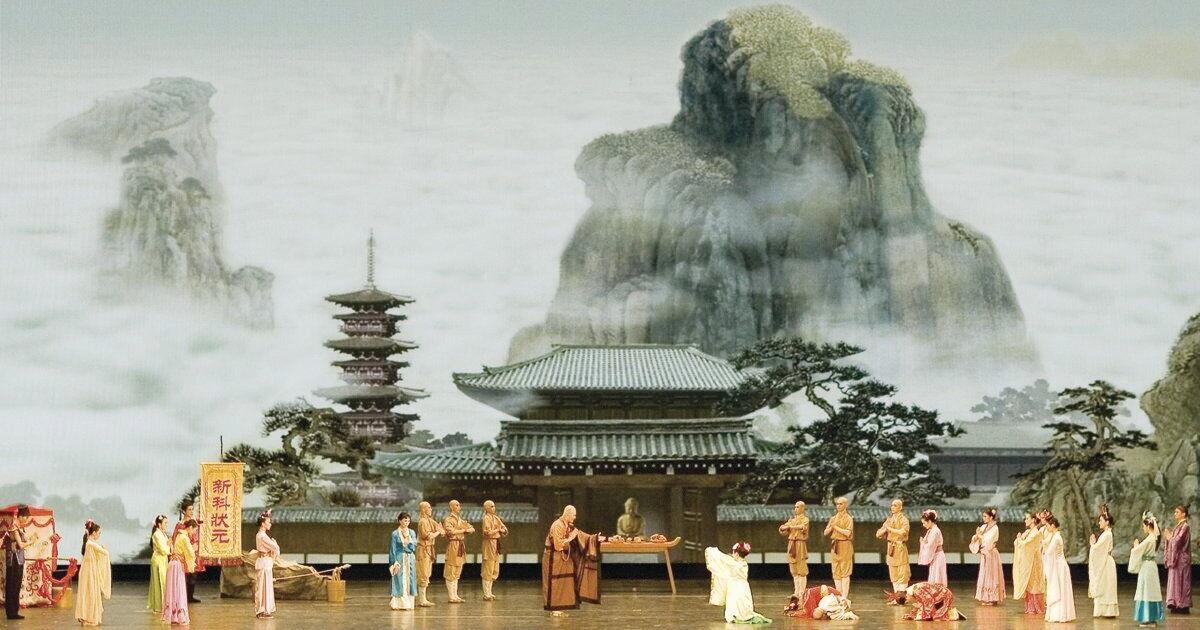
Shen Yun, the Chinese performing arts troupe whose ubiquitous ads purport to showcase “China before communism,” runs one of the most aggressive marketing campaigns in the world. Even if you don’t know what exactly the company does, you’ve almost certainly heard of them — their ubiquitous TV spots, with women twirling silk-sleeve extensions have become as much cultural touchstones as Ikea’s old “Start the Car!” ads.
But as visible as the group already is, it became the centre of a cultural and political flashpoint earlier this spring, when a series of bomb threats led to the cancellation of Shen Yun’s run at Toronto’s Four Seasons Centre for the Performing Arts.
Police eventually deemed the threats to be unfounded. When the group eventually returned to the city earlier this month for a series of rescheduled performances, I decided to purchase a ticket to see Shen Yun for the first time, and learn more about the controversial company whose image is seemingly everywhere, yet whose history and practices have remained largely shrouded from public view.
The history behind Shen Yun and its connection to Falun Dafa
Established in 2006, Shen Yun is the performing arts arm of Falun Dafa (also known as Falun Gong), an anti-Communist spiritual movement that was founded in China in 1992 by a man named Li Hongzhi. The movement’s core beliefs centre on truthfulness, forbearance and compassion, achieved through various spiritual exercises and meditation techniques.
According to the latest estimates from the U.K. government, there are anywhere between 7 million to 40 million Falun Dafa practitioners in China. But these practitioners are widely considered to be a persecuted minority.
International human rights groups have found that Falun Dafa followers in China have routinely faced harassment, coercion and arrest. There have also been widespread reports of the state harvesting the organs of detained Falun Dafa practitioners, though the Chinese government denies this.
Shen Yun itself has also been the target of terror threats and censorship campaigns, some traced back to the Chinese government. In Vancouver earlier this year, Chinese consular officials tried to lobby city officials to shut down Shen Yun performances, according to a report from Global News. In addition, the group says it has received about 150 other threats around the world over the past two years, including threats of mass shooting and bombings targeting Shen Yun performances in Australia and across the U.S.
What’s in a Shen Yun performance
These themes of persecution are woven into Shen Yun’s shows, which feature various short scenes, narrated in Mandarin in English by a pair of emcees. One skit toward the end of the first act depicts a Falun Dafa practitioner being detained by Chinese officials and having their organs harvested. The show’s finale features another skit, set in the present, with a philandering woman who cheats on her partner. She’s quickly washed away in an apocalyptic tsunami, while the most pious Falun Dafa devotees are miraculously saved.
To be clear, the quality of the Shen Yun artistry is superb. The dancers I saw — part of one of eight Shen Yun companies touring the world — possessed the athletic precision of the Radio City Rockettes, paired with the grace of any top-tier ballet ensemble. But commingling with this artistry is what feels like an unsettling amount of proselytizing, too.
Scenes depict Falun Dafa practitioners levitating mid-air, and evil wrongdoers being transmogrified into babies. Elsewhere, the dance routines give way to songs with lyrics that criticize evolution.
Little of what’s on stage, in fact, is actually authentic to traditional Chinese culture. And the traditional dances that are included feel more like window-dressing to mask the more obvious religious messaging.
At the show I attended, God was depicted as an ancient Roman deity wearing a white toga. The orchestrations, though often ravishing to the ear, are a fusion of Chinese and western influences and instruments. The lyrics, meanwhile, repeatedly nod to the Abrahamic religions, with multiple references to Satan and the Devil. In one song, Shen Yun even cribs from Shakespeare. (“All the world’s a stage, and always has been,” sings soprano Haolan Geng.)
As a whole, the two-hour spectacle I experienced can only be described as a bewildering fever dream — a discombobulating mix of politics, art, religion and mythmaking that ultimately left me with more questions than answers.
How Shen Yun has evolved over time
The mastermind behind Shen Yun is Li himself (who uses the pseudonym D.F. in Shen Yun’s program). He is behind almost all of the company’s artistic choices, from the music and lyrics to the elaborate costuming, all of which evolves from year to year.
My colleague Michael Crabb, the Star’s freelance dance critic, saw one of the earlier iterations of Shen Yun, when the company was still relatively new to the Toronto scene.
He described it to me like this: “The performers were very enthusiastic, and they tried their best to put on a good show. But they were undermined by pretty ordinary choreography and production values that were sort of tacky cross between Vegas and Disneyland. And then, of course, when the second half arrives, they turn on what is — essentially — propaganda.”
But what irked him, too, was how the company tried to sell what they were performing as authentic traditional Chinese dance. “Nobody knows for sure what traditional Chinese classical arts really looked like, because so much of it was obliterated during the Cultural Revolution,” he said. “It’s so hard to resurrect … and all that stuff is really is a recreation.”
At the performances Crabb attended, there were patrons who walked out midway through the show. Others, who were forewarned that the second act was heavy of the religious themes, stayed for just the first half.
Shen Yun’s controversies
Much of the controversies surrounding Shen Yun stem from the Falun Dafa movement more broadly. Li, its leader, is not one to shy away from conspiracies. In previous media interviews, he claimed that aliens have infiltrated humans’ minds and given us modern technology, and that Falun Dafa practitioners who harness their inner energy can ultimately gain supernatural abilities, like levitation.
In 2024, a New York Times investigation found that Shen Yun performers have also faced emotional abuse, isolation and untreated injuries. (Shen Yun has called those allegations “ridiculous” and “insulting,” saying that its performers have access to “high-quality medical care.” It also refuted claims that their performers are isolated, noting that its staff “mostly live off-campus” and “contribute to the communities of their local towns.”)
Last year, the CBC reported that the National Arts Centre in Ottawa had cut ties with Shen Yun over broad concerns with the group, including its treatment of audiences with disabilities. Shen Yun told the public broadcaster that those incidents amounted to a misunderstanding.
In a statement to the Star, Shen Yun spokesperson Leeshai Lemish added that the company does not seek to convert audiences. “Shen Yun is, first and foremost, an artistic performance. What is depicted in dances on stage is never meant to be taken literally,” he told me via email. “The story with a villain being turned into a baby is a whimsical fairy tale, and is no more supposed to be taken literally than the idea of an arrogant prince being turned into a frog.”
Those are fair points. But the lines between pure fiction and propaganda blur for a company like Shen Yun, whose performances don’t so much exist in a vacuum, but in a complicated stew where politics, culture and religion all collide.
From my perspective, it’s hard to categorize what a Shen Yun performance exactly is. Dance showcase? Chinese variety show? A cultural manifesto? Maybe a bit of everything. But one thing is certain: what’s on stage is much more than merely a portrait of ancient Chinese culture.
Error! Sorry, there was an error processing your request.
There was a problem with the recaptcha. Please try again.
You may unsubscribe at any time. By signing up, you agree to our terms of use and privacy policy. This site is protected by reCAPTCHA and the Google privacy policy and terms of service apply.
Want more of the latest from us? Sign up for more at our newsletter page.