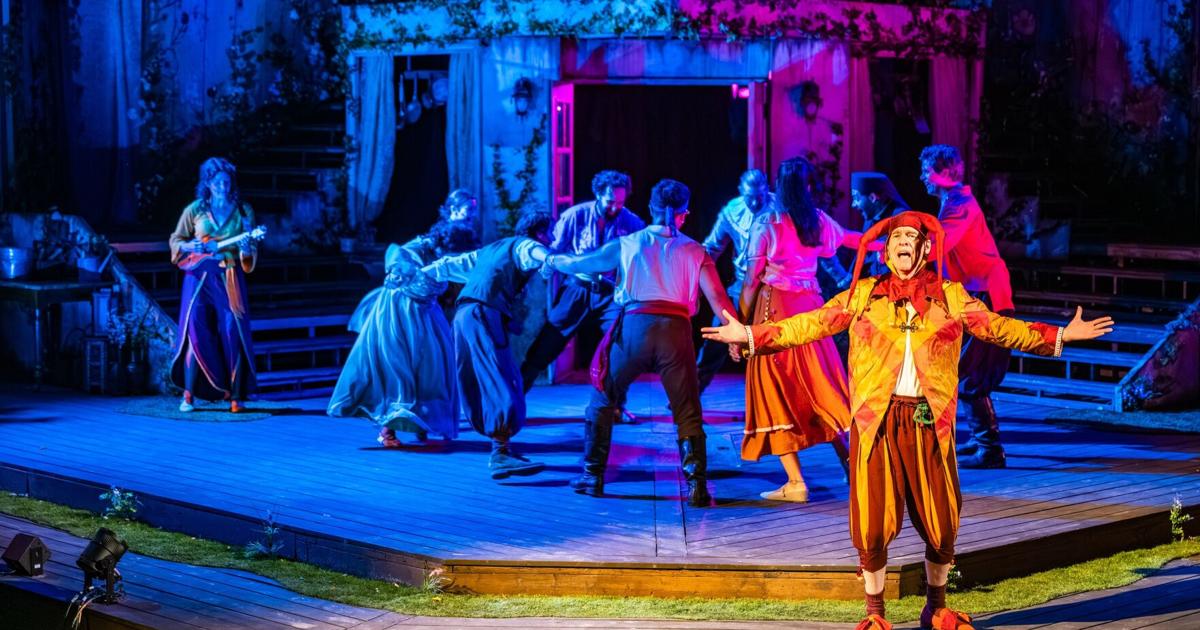
The new revival of “Twelfth Night” at the High Park Amphitheatre begins not, as you might expect, with the play’s famous opening monologue: “If music be the food of love, play on …”
In director and adapter Gregory Prest’s lively and emotionally tempestuous production, the show instead begins with a prologue filled with Shakespeare’s greatest love lines, delivered in a speech by Steven Sutcliffe’s Feste, in which you suddenly realize a) just how obsessed the Bard was with the idea of love and b) how often he tried to define it in terms of rich metaphors.
It’s a montage that starts with several passages drawn from various Shakespearean plays and poems:
- “Love is a smoke, rais’d with the fume of sighs.” (“Romeo and Juliet”)
- “Love is a spirit all compact of fire.” (“Venus and Adonis”)
- “Love comforteth like sunshine after rain.” (Another line from “Venus and Adonis”)
But about halfway through this speech, Sutcliffe’s Feste homes in on a single idea: “Love is merely a madness,” he says, borrowing Rosalind’s line from “As You Like It.”
He lingers on this thought longer still, breaking the fourth wall, the tone of his voice shifting ever graver and darker: “Love is madness most discreet. Love is madness, murderous and unjust. If thou remember’st not the slightest folly that ever love did make thee run into, thou hast not loved.”
If Prest is underlining his thesis a bit too obviously and obtrusively in this prologue (especially considering that Shakespeare’s original opening conveys the same message in a far more subtle and elegant manner), this can mostly be forgiven. At least the rest of this revival doesn’t continue in this vein, pureeing Shakespeare into mushy, easily digestible baby food (which other abridged productions of Shakespeare’s plays are often guilty of). And at least what Prest does achieve with this new opening is rendering the thrust of his production crystal clear.
This is a “Twelfth Night” concerned with how love can drive us mad — for better or for worse — and how it can cleave us apart from the inside out, leaving us vacillating erratically between our wildest extremes.
The story’s central love triangle focuses on Viola, Duke Orsino and Olivia. The former, disguised as a male page named Cesario and working in the duke’s court after a shipwreck separates her from her twin brother, Sebastian, quickly falls for her master. But she’s trapped — afraid of expressing her true desires for fear of betraying her disguise. Orsino, meanwhile, is lovesick for Olivia, who coldly dismisses the duke’s advances but is instead in love with Cesario.
Prest has judiciously and sensitively pared Shakespeare’s script down to approximately 100 minutes, running without an intermission. The trims are not so much made with a butcher’s knife as they are with a finely sharpened scalpel, performing a series of barely perceptible nips and tucks to the proceedings. And other than adding that new prologue, plus switching the order of the play’s first and second scenes (placing Viola front and centre), Prest’s revival remains mostly faithful to the play’s original structure.
This revival, in fact, at least from a cursory glance, both looks and feels wholly traditional. Sim Suzer’s beautifully earthy set, with vines creeping up the walls, evokes the image of sunbathed villas along the Mediterranean coast. Her costumes, too, subtly suggest an early Renaissance setting.
But dig deeper, and you’ll discover that Prest has uncovered new layers to the text, expressed through this production’s fine set of performances.
Caroline Toal, off an astounding run in “Anne of Green Gables” at the Stratford Festival last year, lends warmth and grace to the role of Viola. Farhang Ghajar’s Orsino, meanwhile, swings wildly between moments of vulnerability and hyper-masculinity as his unrequited love overwhelms him.
As Olivia’s dictatorial steward, Malvolio, cruelly tricked by Sir Toby Belch (Mike Shara), Sir Andrew Aguecheek (Justin Otto) and Maria (Navtej Sandhu) into believing that his mistress has caught feelings for him, Rick Roberts draws out the comedy in the role like a magician would pull a rabbit out of a hat. But there’s bite to Roberts’ Malvolio, too. Behind all the humour is a portrait of a man who’s lost in his lovesick delusion.
Prest also toys with some of the key relationships in the play. He draws out some of the homoerotic subtext between Cesario and Orsino, while turning it down between Sebastian (Ori Black, with some revelatory line readings) and his steward, Antonio (Ray Jacildo, also wonderful).
Certainly not all the performances are successful. In trying to render Olivia as a more assertive character — not merely a passive figure mourning the loss of her brother and pitifully falling for Viola’s disguise — Prest goes a bit too far overboard, to the point of making Olivia come across as insincere. As played by Ghazal Azarbad, she’s domineering and preening, ordering her servants around with a flick of her finger. It’s an interesting take, for sure, but one that feels perhaps more suited for Regina George in “Mean Girls.”
But even still, there’s much to enjoy in Prest’s revival. His spirited staging makes good use of the two-tiered High Park Amphitheatre stage. Logan Raju Cracknell also does a commendable job of lighting the action, all while contending with the ever-changing natural light that peeks through the trees. And when this production breaks into song, as it often does (with Olivia Wheeler’s graceful compositions), it seemingly feels as if it’s floating on Cupid’s wings.
Indeed, if music be the food of love … play on.
Error! Sorry, there was an error processing your request.
There was a problem with the recaptcha. Please try again.
You may unsubscribe at any time. By signing up, you agree to our terms of use and privacy policy. This site is protected by reCAPTCHA and the Google privacy policy and terms of service apply.
Want more of the latest from us? Sign up for more at our newsletter page.