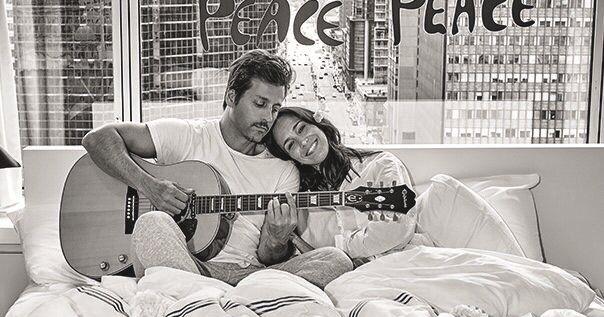
The Dalai Lama once said, “The best relationship is one in which your love for each other exceeds your need for each other.” After reading “I’m Going to Break Your Heart: A Rock N Roll Love Story,” one is left feeling that Chantal Kreviazuk and Raine Maida subscribe to this wisdom.
In even the most steadfast partnerships, over time, invisible cracks appear. Facing a breaking point, the Canadian musicians, married since 1999, realized that keeping their relationship fresh needed work. They first explored their journey in the 2019 documentary “I’m Going to Break Your Heart.”
Maida and Kreviazuk’s book offers much more than love lessons. In the first chapter, “Getting Help,” Kreviazuk writes about seeking help from Dr. John Grey, a neuroscientist from Stanford who operates a marriage coaching clinic: “At my core, I believed John would, well-intentioned or not, blow up my life and marriage. We had three little boys at home, and we really needed to keep this thing together. But just being together wasn’t enough for me. I wanted better than together. I wanted to be obsessed with together — the way we were when we first met, and for years after. I couldn’t find the moment that feeling changed or where it went. Why didn’t it feel like it used to?”
Written in alternating chapters, the book covers their love at first sight at a Pearl Jam concert, the rise of Maida’s alt-rock band Our Lady Peace and Kreviazuk’s journey from Winnipeg to a $1-million two-record deal at age 22.
As Maida told the Star, the title refers to the fact that in any long-term relationship, one partner will outlive the other, so one person will always eventually have their heart broken.
The Star chatted with the couple via Zoom a few weeks before the book’s release. Apropos for these creatives, who are always on the go — pursuing individual musical careers while also raising a family — the pair joined the call from different locations: Maida in a Portland hotel room where he had just arrived for an OLP gig that night, and Kreviazuk back home in Los Angeles.
You gave fans a close-up look at your life in the documentary. How did the book come about?
Maida: The documentary was a great stepping stone to the book. Some people wanted us to do some sort of TV show based on the documentary, but I always felt that would have been forced. A book was something we could control. Because it has a bit of a memoir feel, it was really enjoyable to go back and to reflect on moments from my past. When you’re living it, sometimes you take it for granted and you don’t necessarily sink into these moments, whether it’s having a kid or opening for the Ramones.
Kreviazuk: We’ve received phenomenal responses about the film’s impact. For some, it was dark. For others, it was hopeful. The two mediums (film and print) present different opportunities to explore different ideas and issues. A book is an entirely different way to reflect on our experiences and relationship, especially doing it the way we did. It’s a very interdependent way of coming at our relationship because Raine uses his voice and I use my voice, so nobody’s trying to control anybody.
Was it a conscious decision to write the chapters separately and/or in isolation to maintain these distinct perspectives?
Kreviazuk: Not necessarily in isolation because that has such a negative connotation. It was more of just, we’re two different people with two different voices, and we’ve learned our differences through our marriage work, coaching and therapy. It was the only way this book was going to happen, as having those differing perspectives is important.
Maida: (With) the documentary, some people found themselves relating more to Chantal, and some found themselves relating more to me. So, to deny them that in a book wouldn’t be right. Guys might just read some of my chapters, and maybe not read some of Chantal’s … Just by virtue of being male, they might relate to some of the typical male stuff that I have, and vice versa. What we wanted to do was write a book that felt more like a conversation, because if we did it together, the chapters would have been much longer. The chapters are really bite sized. You can almost open the book anywhere and start reading.
Chantal, how does writing a book differ from writing songs?
Kreviazuk: First of all, you get a lot more freedom with a book to just write down your thoughts. In songwriting, you have to think about things like rhyme and structure. For example, I have a song I wrote where I just say the word “today” over and over again. It’s making the point about carpe diem and just being in the moment. You can do that in a song: you can say something over and over again until you’re blue in the face for a theme. But you could say the most important thing of an entire book, and it’s maybe only said once, and it just floats by — like, “Wait, what did he or she just say?”
It means the world to you, but maybe one reader will read it and recognize its importance. With a song, you can really hammer home what you want your audience to hear.
Maida: Writing songs is so confining in terms of wordplay — things like, how many words you can use. I love the challenge of that. But to be freed up to just write is something I’ve never really done. I enjoyed finding the art in long-form writing that I had not had a chance to experience. I was able to express myself even more than I do in my songs because in songs you’re trying to express an idea and get that to listeners in a concise way. Without those parameters, it’s like the palace is bigger, and it felt liberating.
Chantal, what comes across in the book is your belief in honesty. How has it shaped your writing?
Kreviazuk: Honesty is phenomenal and an awesome approach to writing anything. I had to stop myself and go back a few times, and be like, “Wait, there are not enough dead people for me to put this on paper yet!” So, I just put those stories on hold. I mean, there’s 100 books in all of us, right?
What was really nice about the book was knowing that my partner was also writing, so whether I was conscious of that or not, it always allowed for this epicentre, almost like a place that you were trying to go, so I could talk about anything, but in the back of my mind I knew that it had to somehow relate to being Raine’s partner. That gave me a direction.
Raine, was this act of getting honest, and being vulnerable in the process, difficult?
Maida: The documentary cracked that nut open because I am normally an introvert. So, to put myself out the way I did in the documentary was enlightening.
Chantal, one phrase that resonated with me from the book is, “Words are like toothpaste. Once they are said, you can’t put them back in the tube.” What does it mean to you?
Kreviazuk: That phrase is so important. You are your thoughts, your words and your actions. We can’t always control our thoughts, but we don’t say it, and we don’t do it and try not to think it.
Just the other day I stopped by a friend’s house and heard her call her husband an idiot because he left the door open. My other friend, when she gets mad at her husband, she calls him an asshole. I’m like, “Wow, I’m glad it’s all working for you. But in our marriage, we tried that once, and it didn’t go well, so we just don’t do it.”
I don’t necessarily think that’s even a character thing for Raine or myself, but it’s something that we organically, or accidentally, put into practice. We haven’t said horrible things to each other. You can’t take those things back, and they can really hurt a marriage.
This interview has been condensed and edited for clarity.
Error! Sorry, there was an error processing your request.
There was a problem with the recaptcha. Please try again.
You may unsubscribe at any time. By signing up, you agree to our terms of use and privacy policy. This site is protected by reCAPTCHA and the Google privacy policy and terms of service apply.
Want more of the latest from us? Sign up for more at our newsletter page.