

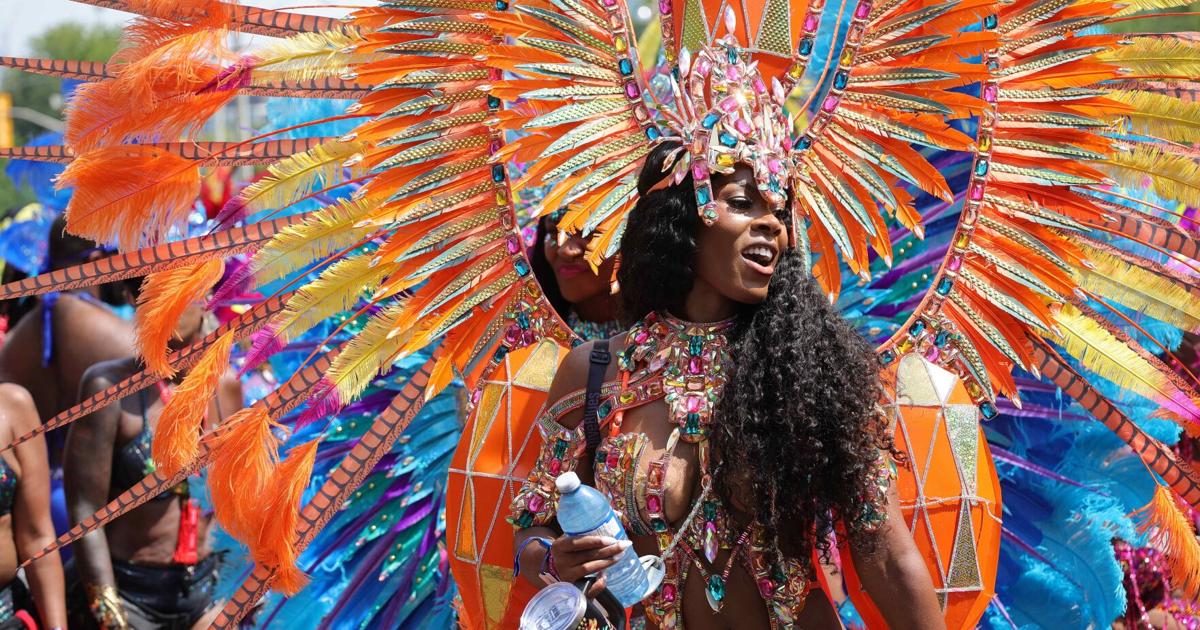
As sunny skies and sweltering heat defied a forecast for rain, thousands of people joined dancers in elaborate, colourful costumes and the beckoning beat of bands at this year’s Toronto Caribbean Carnival Grand Parade.
The 59th annual parade held on Saturday is one of the largest in North America and drew fans from around the world to the downtown route along Lake Shore Boulevard West at Exhibition Place for the daylong spectacle.
“It’s amazing to me how everybody here just embraced the diversity of the Caribbean culture, and then it becomes part of who they are to celebrate,” said Jordan Dumas who came with her mother Roxanne from Los Angeles, Calif.
Dumas, who was born in Toronto, performed with her mother in a mas band representing Brazil. They said they were relieved by the day’s sunshine and temperatures that hovered around 30 C with humidity after initially worrying about rain.
Early Saturday morning, paradegoers arrived to set up tents and to get the best view along the route that travelled from Exhibition Place, west along Lake Shore Boulevard to Jameson Avenue and then back again. Dozens of vendors lined the route to sell food, drinks, flags representing Caribbean countries and costumes.
The parade got going around 11:30 a.m. as Toronto Fire Services blasted sirens from fire trucks and a group from the TTC led the charge accompanied by dozens of celebrants wearing intricate costumes.
There was a delay of roughly 30 minutes following the first two floats, though it was not a cause for concern, said Toronto firefighter Richard Birkett. He said he was happy to be working the event because it made him feel like part of the community and culture.
“It is a lot of fun to just see everybody having a good time,” said Birkett.
As the parade paused, soca and calypso music blasted from flatbed trucks stacked roughly three metres high with speakers. Paradegoers were encouraged to dance along by DJs atop the floats. At moments, it felt like the entire crowd was dancing together, propelled by joy.
Performers Jason Layhe and Nicholas Greenidge, from Barbados and living in Canada, stood on the sidelines of the parade route, preparing to join a float and perform two songs. Greenidge, who said they planned to “get on, do our thing, then come back” to enjoy the parade, noted it was important for them to be there to represent Barbados and share their passion for music.
The parade continued following the pause and an estimated 4,000 masqueraders danced along Lake Shore, referred to as playing mas, in elaborate and colourful costumes adorned with crystals, glitter and feathers.
“We’ve had such an amazing weekend,” said Bonita Brown-Morgan, who came from Fort Wayne, Indiana. “Everybody’s been just so nice here. It’s just amazing. I’m glad we came.”
Brown-Morgan met up with her friend Vivian Mays, who travelled from near Washington, D.C., so they could together attend the parade for the first time. The pair joined eight other friends from around the world to take part in festivities through the long weekend.
“It’s been more than what we expected. It’s been so much fun. Everybody’s super friendly, and you know we’ll be back next year,” Mays said.
Next to the Grand Parade, the pair said another highlight was attending a show by R&B singer Mario on Friday night at Cabana Pool Bar on Polson Street.
“There was, like, people from all age groups, mothers with daughters,” said Mays. “Everybody was just having a good time.”
Inside the Exhibition Grounds, costumed mas bands in signature themes lined up to perform on a stage and compete to be the band of the year. Each band took a turn dancing on stage before a panel of judges.
Carnival dates back to Trinidad and Tobago to mark the abolition of slavery in the British Empire in 1834 and the continued fight against oppression. The first Toronto edition was in 1967, and was then known as Caribana. It is now Toronto’s biggest yearly celebration, bringing an estimated two million visitors to the city.

