

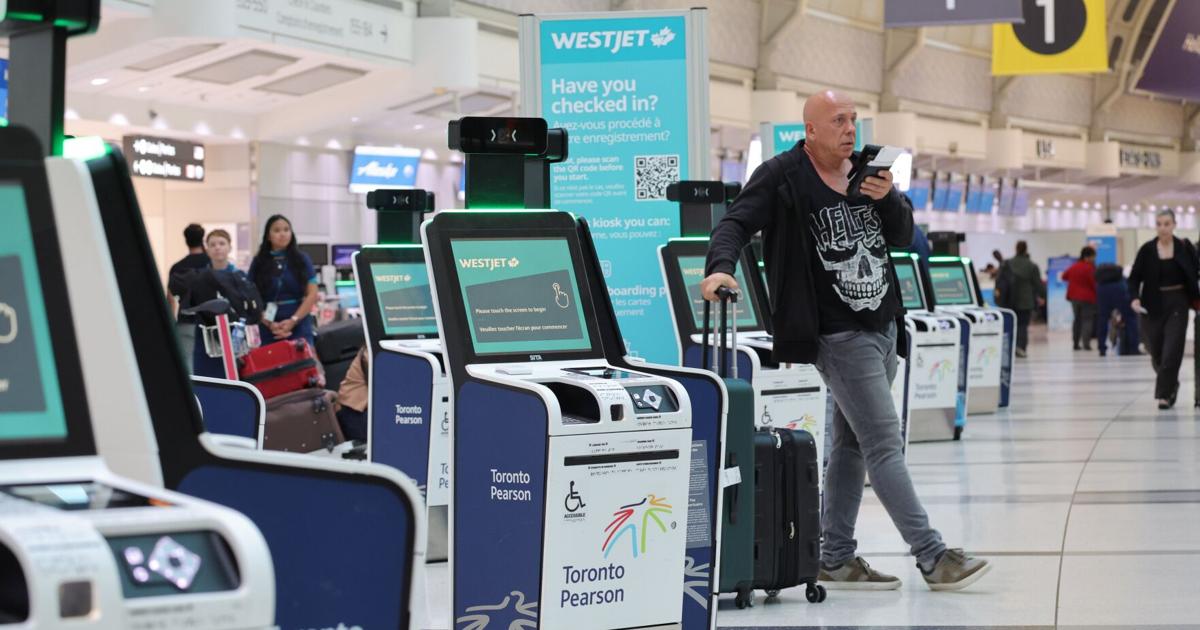
Kelly Sutley had just arrived in Toronto on a flight from Dubai when he found out his connecting flight home to Edmonton on WestJet was cancelled.
“It’s a little stressful, running around all over the place,” he said Sunday morning after his Emirates airline flight had landed. “I just want somewhere to relax for a bit. It was a 14-hour flight.”
Initially, Sutley could only find flights home for Monday or Tuesday, meaning he’d have to book into a hotel in Toronto overnight, and WestJet representatives at the airport told him there was nothing they could do.
“It’s been a long day,” he said.
Sutley was just one of thousands of travellers who were left scrambling to rebook flights during the busiest stretch of the summer travel season after West Jet flight attendants went on strike early Sunday morning.
More than 4,000 flight attendants represented by CUPE 8125 walked off the job at 2:01 a.m. Toronto time, capping nearly 11 months of bargaining with the Calgary-based carrier and a tense 72 hours that saw the airline cancel hundreds of flights pre-emptively.
“We tried until the very last minute to get a fair deal that recognizes the value of the work cabin crews do,” said CUPE 8125 president Alia Hussain in an emailed statement. “WestJet’s offer did not go far enough.”
On Sunday morning, striking cabin crew members set up picket lines outside Terminal 3 of Pearson airport.
Fortunately for Sutley, representatives for both Emirates and WestJet worked together and managed to book him a flight home with Porter Airlines Sunday afternoon.
“Right at the last minute, I got this flight,” said Sutley, relieved.
The WestJet walkout followed a 72-hour strike notice the union delivered to the company on Thursday morning. Shortly after, the airline issued a 72-hour lockout warning to employees that would also have taken effect on Sunday.
Since Friday, the airline has cancelled 600 flights, including just under 300 flights that were cancelled on Sunday, before 5 a.m. At Pearson, of the 136 cancellations, WestJet is responsible for 121, according to FlightAware.
On Sunday evening, WestJet said it will now allow guests with travel planned up to Aug. 6 to make a one-time change or cancellation at no extra cost.
“We’ll continue to evaluate additional extensions on a daily basis,” the carrier said on X.
Passengers stranded with few flight or hotel options
Some passengers weren’t as fortunate as Kelly Sutley.
Scott Crosbie, for one, ended up paying another $4,000 to get his family of four home.
They had spent a vacation exploring Toronto, and were originally scheduled to fly back to Edmonton on Saturday at 5 p.m., but after hearing of the potential strike, they decided to rebook for a slightly earlier flight at 3 p.m.
To their surprise, WestJet reached out at 1 a.m. on Saturday with news their flight that day was cancelled and rescheduled for Tuesday — even as they saw the original 5 p.m. flight continued.
“There’s various reasons we had to get home,” Crosbie said. “My wife has medical needs, we have a diabetic cat who needs insulin twice a day, my dad was watching her but then he left town, so we had no one to take care of that.”
Crosbie had called WestJet by 2 a.m., and at 5 a.m., he was still on hold with an hour and a half wait, he said. In the meantime, he looked at flights with Air Canada, Flair and Porter.
“Things just kept disappearing,” he said. “So we’re like, ‘What do we do? What do we do?’”
In the end, the Porter Airlines flight that cost them $1,000 extra per person seemed like the best option, he said.
Jack Lucas and his two teenage daughters hadn’t planned on sleeping in a tent in a Nova Scotia campground on Saturday night.
But the family, travelling from Calgary to Sweden for a two-month work opportunity, arrived in Halifax on Saturday to find their connecting flight to Copenhagen that day was cancelled due to the strike.
“As soon as we found out it was cancelled, we knew we were going to be stranded in Halifax for at least one night, so I started looking for hotels,” Lucas said, but “they were just completely sold out.”
Thankfully, his daughters took the initiative to look into campgrounds and camping supplies nearby. They arrived in a cab at a rural campground around 10 p.m. with all their luggage, a new tent and three of the cheapest sleeping bags they could find.
While they settled into their unexpected accommodations, Lucas’ wife called WestJet — getting through and having the call drop six times, he said — until the airline finally booked them the following day on a partner airline, Iceland Air.
“It took an enormous amount of persistence to finally get through to somebody on the phone so that it could happen,” he said.
Porter Airlines told the Star bookings have recently increased across its network, and it’s considering ramping up operations.
“As this is the peak summer travel period, we are already operating a significant schedule to give travellers maximum options,” Porter spokesperson Brad Cicero said. “While flights are already extremely busy, seats are available on many existing flights and we are assessing whether we can add more flights.”
The airline has “passenger protection agreements with a number of airlines” but under this agreement, passengers must have their reservation changed by WestJet, he said.
What triggered the walkout?
General wage rates and compensation for work done on the ground have been sticking points between the negotiators representing the two parties, as they pursued near-round-the-clock talks in a Calgary hotel conference room to reach a new deal.
Hussain said the union is prepared to continue talks, and urged Ottawa not to intervene in the contract dispute.
“We are on strike because we believe we deserve better. We are ready to go back to the table to settle. We hope the federal government will not interfere and will let the bargaining process run its course,” Hussain said. “Unpaid work is a big piece of our priorities, but we are bargaining a comprehensive contract.”
“We would not be here if (the airline) had taken our concerns seriously for almost 11 months of bargaining.”
Responding to the onset of a strike, WestJet Group CEO Alexis Von Hoensbroech said that the outcome “directly impacts the travel plans of our guests, our WestJetters and the communities and businesses we serve.
“We’re disappointed to be here,” he added.
Hoensbroech said that the company had made an offer that “would have set a new standard for cabin crew in Canada,” offering an hourly rate that covered time before and after flights, and “a double-digit wage increase in year one among other priorities the union raised.
“Unfortunately, it wasn’t accepted.”
WestJet’s rejected offer: what was on the table
WestJet said that the proposal the union rejected included a 13 per cent wage increase starting this October, plus wage payments retroactive to January 2026, and three 2.5 per cent increases between January 2027 and January 2029.
The airline said it also offered “a payment for all duty hours,” or “additional pay for all hours worked designed to solve the union’s claim of unpaid work,” amounting to another 12 per cent salary increase.
It said it also offered $300 in health spending per year, a fifth week of vacation after 25 years of service, and more.
The statement noted that impacted guests would be refunded or reaccommodated, “as applicable.”
Passengers also have rights, however, under the Air Passenger Protection Regulations (APPR), which puts the onus on the airline to try to rebook a flight within 48 hours of the original one. Those travelling internationally have additional rights under the Montreal Convention.
WestJet began pre-emptively altering its operations Friday, saying it “must begin the difficult process of parking 737 aircraft” to keep planes and crews from being stranded away from base.
The WestJet flight attendants strike follows other labour disputes in the aviation sector that resulted in flight cancellations in recent years, including the Air Canada strike that took place in the summer of 2025.
In a letter shared to social media, Patty Hajdu, Minister responsible for the Federal Economic Development Agency for North Ontario, said that both she and top government mediators had been “on the ground” with both parties during the negotiations.
“This is a disappointing development,” she said.
“Canadians are counting on them to put their best efforts forward to reach a deal at the bargaining table.”
With files from The Canadian Press and Josh Rubin

